Find Trade Colleges
Masonry
Types of Degrees Masonry Majors Are Getting
The following table lists how many mason/masonry graduations there were in 2021-2022 for each degree level.
| Education Level | Number of Grads |
|---|---|
| Basic Certificate | 165 |
| Undergraduate Certificate | 94 |
| Associate Degree | 25 |
What Masonry Majors Need to Know
O*NET surveyed people in occupations related to masonry and asked them what knowledge areas, skills, and abilities were important for their jobs. The responses were rated on a scale of 1 to 5 with 5 being most important.
Knowledge Areas for Masonry Majors
According to O*NET survey takers, a major in masonry should prepare you for careers in which you will need to be knowledgeable in the following areas:
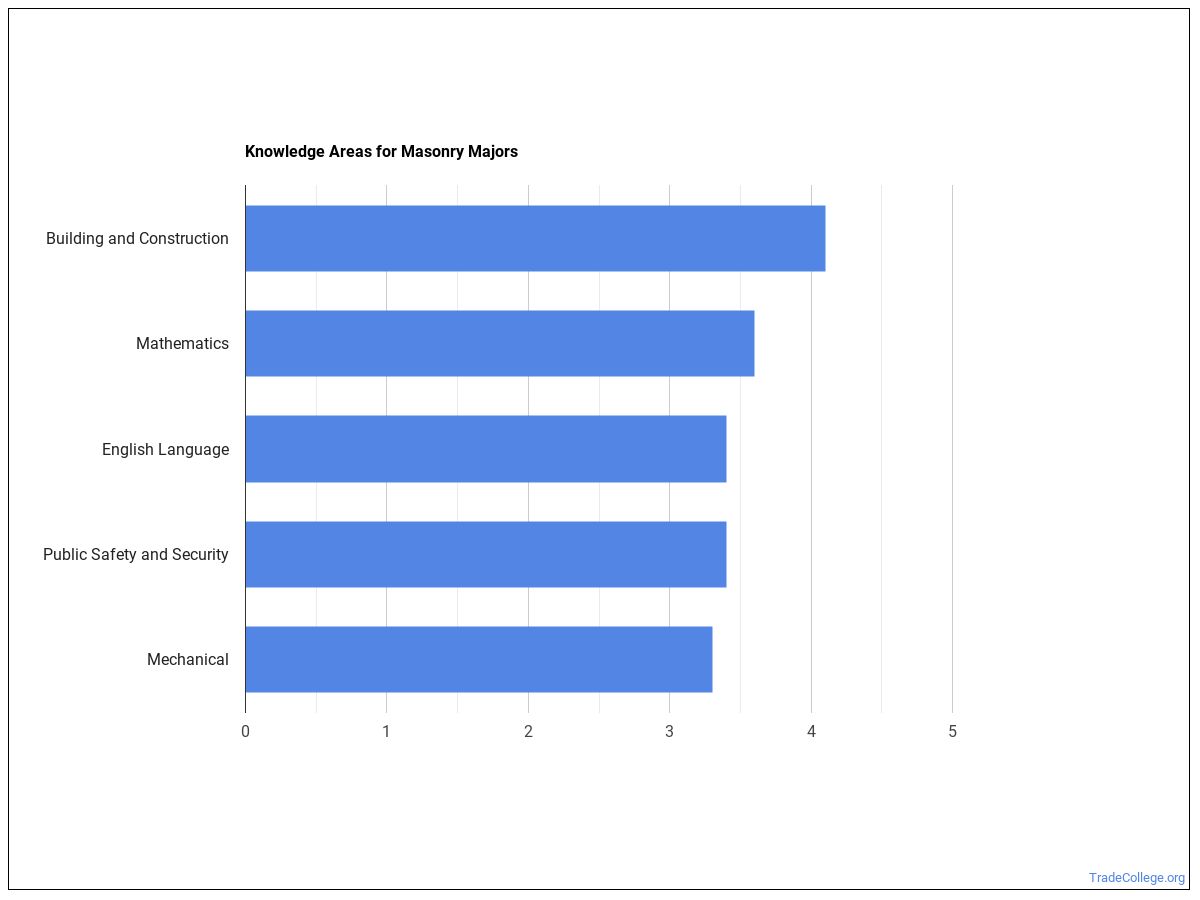
- Building and Construction - Knowledge of materials, methods, and the tools involved in the construction or repair of houses, buildings, or other structures such as highways and roads.
- Mathematics - Knowledge of arithmetic, algebra, geometry, calculus, statistics, and their applications.
- English Language - Knowledge of the structure and content of the English language including the meaning and spelling of words, rules of composition, and grammar.
- Public Safety and Security - Knowledge of relevant equipment, policies, procedures, and strategies to promote effective local, state, or national security operations for the protection of people, data, property, and institutions.
- Mechanical - Knowledge of machines and tools, including their designs, uses, repair, and maintenance.
Skills for Masonry Majors
A major in masonry prepares you for careers in which the following skill-sets are crucial:

- Critical Thinking - Using logic and reasoning to identify the strengths and weaknesses of alternative solutions, conclusions or approaches to problems.
- Coordination - Adjusting actions in relation to others’ actions.
- Active Listening - Giving full attention to what other people are saying, taking time to understand the points being made, asking questions as appropriate, and not interrupting at inappropriate times.
- Time Management - Managing one’s own time and the time of others.
- Speaking - Talking to others to convey information effectively.
Abilities for Masonry Majors
As a masonry major, you will find yourself needing the following abilities:
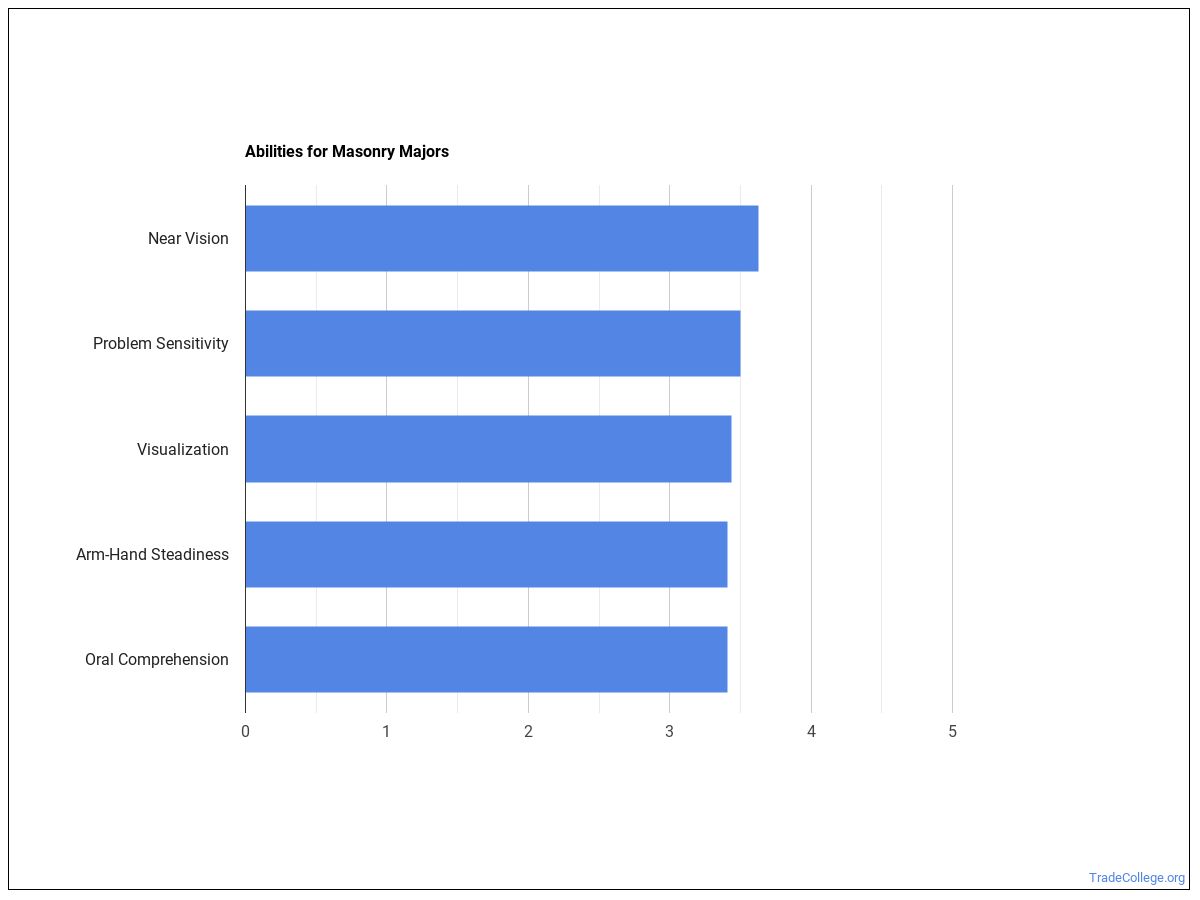
- Near Vision - The ability to see details at close range (within a few feet of the observer).
- Problem Sensitivity - The ability to tell when something is wrong or is likely to go wrong. It does not involve solving the problem, only recognizing there is a problem.
- Visualization - The ability to imagine how something will look after it is moved around or when its parts are moved or rearranged.
- Arm-Hand Steadiness - The ability to keep your hand and arm steady while moving your arm or while holding your arm and hand in one position.
- Oral Comprehension - The ability to listen to and understand information and ideas presented through spoken words and sentences.
What Can You Do With a Masonry Major?
People with a masonry degree often go into the following careers:
| Job Title | Job Growth Rate | Median Salary |
|---|---|---|
| Brickmasons and Blockmasons | 10.3% | $50,950 |
| First-Line Supervisors of Construction Trades and Extraction Workers | 12.6% | $65,230 |
| Stonemasons | 9.5% | $41,220 |
| Tile and Marble Setters | 9.8% | $41,840 |
Other Related Masonry Programs
Learn about start dates, transferring credits, availability of financial aid, and more by contacting the universities below.
MS in Management - Construction Management
Gain the leadership skills and expertise you need to manage large-scale construction projects with this specialized online master's from Southern New Hampshire University.

Who Is Getting an Associate’s Degree in Masonry?
Racial-Ethnic Diversity
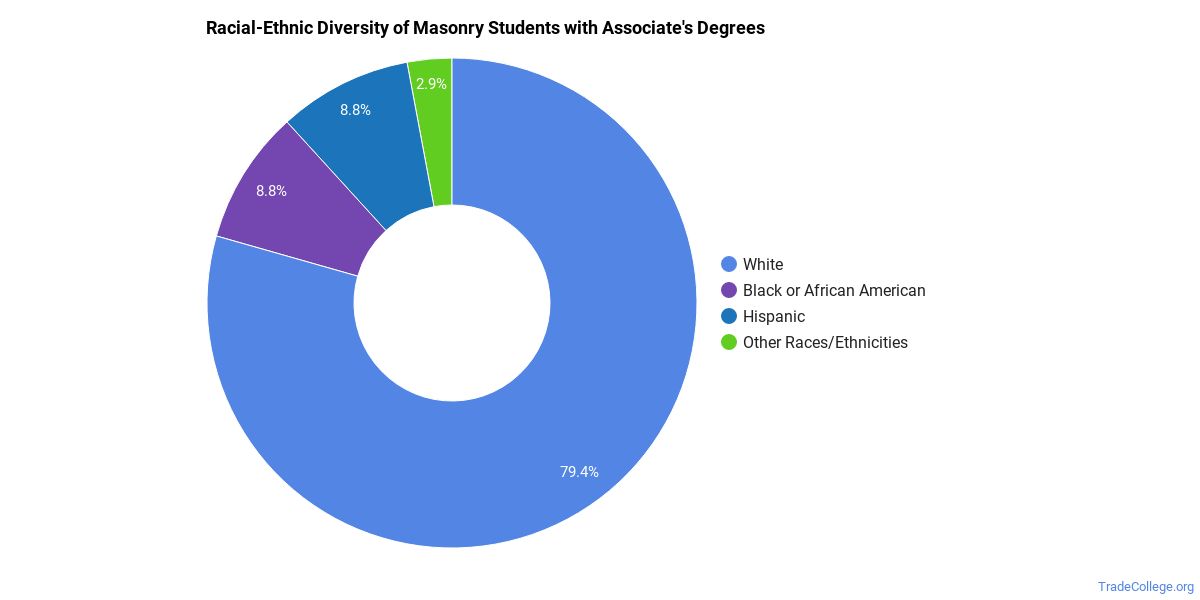
At the countrywide level, the racial-ethnic distribution of masonry majors is as follows:
| Race/Ethnicity | Number of Grads |
|---|---|
| Asian | 0 |
| Black or African American | 3 |
| Hispanic or Latino | 1 |
| White | 19 |
| International Students | 0 |
| Other Races/Ethnicities | 2 |
How Much Do Masonry Majors Make?
Salaries According to BLS
Masonry majors often go into careers where salaries can range from $44,370 to $54,430 (25th to 75th percentile). This range includes all degree levels, so the salary for a person with just a bachelor’s degree may be a little less and the one for a person with an advanced degree may be a little more.
To put that into context, according to BLS data from the first quarter of 2020, the typical high school graduate makes between $30,000 and $57,900 a year (25th through 75th percentile). The average person with a bachelor’s degree (any field) makes between $45,600 and $99,000. Advanced degree holders make the most with salaries between $55,600 and $125,400.
Amount of Education Required for Careers Related to Masonry
Some degrees associated with masonry may require an advanced degree, while others may not even require a bachelor’s in the field. In general, the more advanced your degree the more career options will open up to you. However, there is significant time and money that needs to be invested into your education so weigh the pros and cons.
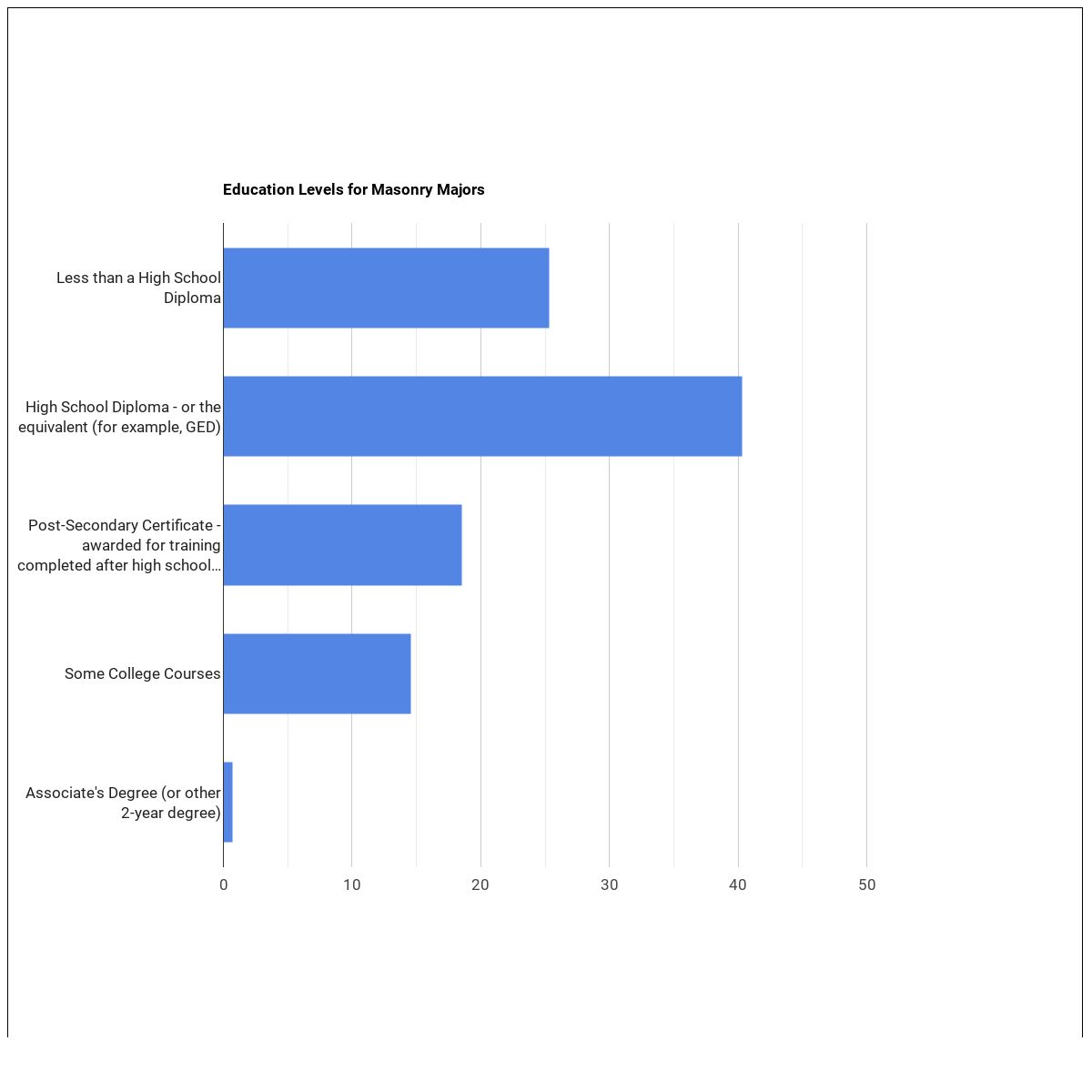
How much schooling do you really need to compete in today’s job market? People currently working in careers related to masonry have obtained the following education levels.
| Education Level | Percentage of Workers |
|---|---|
| Less than a High School Diploma | 25.3% |
| High School Diploma - or the equivalent (for example, GED) | 40.3% |
| Post-Secondary Certificate - awarded for training completed after high school (for example, in agriculture or natural resources, computer services, personal or culinary services, engineering technologies, healthcare, construction trades, mechanic and repair technologies, or precision production) | 18.5% |
| Some College Courses | 14.6% |
| Associate’s Degree (or other 2-year degree) | 0.7% |
Online Masonry Programs
The following table lists the number of programs by degree level, along with how many schools offered online courses in the field.
| Degree Level | Colleges Offering Programs | Colleges Offering Online Classes |
|---|---|---|
| Certificate (Less Than 1 Year) | 0 | 0 |
| Certificate (1-2 years) | 24 | 0 |
| Certificate (2-4 Years) | 4 | 0 |
| Associate’s Degree | 7 | 0 |
| Bachelor’s Degree | 0 | 0 |
| Post-Baccalaureate | 0 | 0 |
| Master’s Degree | 0 | 0 |
| Post-Master’s | 0 | 0 |
| Doctor’s Degree (Research) | 0 | 0 |
| Doctor’s Degree (Professional Practice) | 0 | 0 |
| Doctor’s Degree (Other) | 0 | 0 |
Is a Degree in Masonry Worth It?
The median salary for a masonry grad is $45,950 per year. This is based on the weighted average of the most common careers associated with the major.
This is 15% more than the average salary for an individual holding a high school degree. This adds up to a gain of about $121,000 after 20 years!

Explore Major by State
Alabama
California
District of Columbia
Idaho
Kansas
Maryland
Mississippi
Nevada
New York
Oklahoma
South Carolina
Utah
West Virginia
Alaska
Colorado
Florida
Illinois
Kentucky
Massachusetts
Missouri
New Hampshire
North Carolina
Oregon
South Dakota
Vermont
Wisconsin
References
*The racial-ethnic minorities count is calculated by taking the total number of students and subtracting white students, international students, and students whose race/ethnicity was unknown. This number is then divided by the total number of students at the school to obtain the racial-ethnic minorities percentage.
- College Factual
- College Scorecard
- National Center for Education Statistics
- O*NET Online
- U.S. Bureau of Labor Statistics
- Usual Weekly Earnings of Wage and Salary Workers First Quarter 2020
- Image Credit: By Leonard G. under License
More about our data sources and methodologies.

TradeCollege.org provides higher-education, college and university, degree, program, career, salary, and other helpful information to students, faculty, institutions, and other internet audiences. Presented information and data are subject to change. Inclusion on this website does not imply or represent a direct relationship with the company, school, or brand. Information, though believed correct at time of publication, may not be correct, and no warranty is provided. Contact the schools to verify any information before relying on it. Financial aid may be available for those who qualify. TradeCollege.org is a for-profit site, and the displayed options may include sponsored or recommended results, not necessarily based on your preferences.
© TradeCollege.org – All Rights Reserved.