Find Trade Colleges
Stationary Engineers and Boiler Operators: Job Description
Operate or maintain stationary engines, boilers, or other mechanical equipment to provide utilities for buildings or industrial processes. Operate equipment such as steam engines, generators, motors, turbines, and steam boilers.
The Daily Work of Stationary Engineers and Boiler Operators Take On?
Typical responsibilities of stationary engineers and boiler operators cover:
- Operate or tend stationary engines, boilers, and auxiliary equipment, such as pumps, compressors, or air-conditioning equipment, to supply and maintain steam or heat for buildings, marine vessels, or pneumatic tools.
- Activate valves to maintain required amounts of water in boilers, to adjust supplies of combustion air, and to control the flow of fuel into burners.
- Monitor boiler water, chemical, and fuel levels, and make adjustments to maintain required levels.
- Analyze problems and take appropriate action to ensure continuous and reliable operation of equipment and systems.
- Observe and interpret readings on gauges, meters, and charts registering various aspects of boiler operation to ensure that boilers are operating properly.
- Maintain daily logs of operation, maintenance, and safety activities, including test results, instrument readings, and details of equipment malfunctions and maintenance work.
- Test boiler water quality or arrange for testing and take necessary corrective action, such as adding chemicals to prevent corrosion and harmful deposits.
- Monitor and inspect equipment, computer terminals, switches, valves, gauges, alarms, safety devices, and meters to detect leaks or malfunctions and to ensure that equipment is operating efficiently and safely.
What Stationary Engineers and Boiler Operators Need to Know
Successful stationary engineers and boiler operators combine a mix of skills and domain knowledge.
Top Skills
These are the skills most important for this role, rated on an importance scale of 0 to 5:
Top Knowledge Areas
Related Job Titles
People in this occupation may also be known by titles such as:
- Air Compressor Engineer
- Air Compressor Operator
- Air Conditioning Engineer (AC Engineer)
- Air Plant Engineer
- Auxiliary Operator
- Blowing Engineer
- Boiler Engineer
- Boiler Fireman
Job Outlook
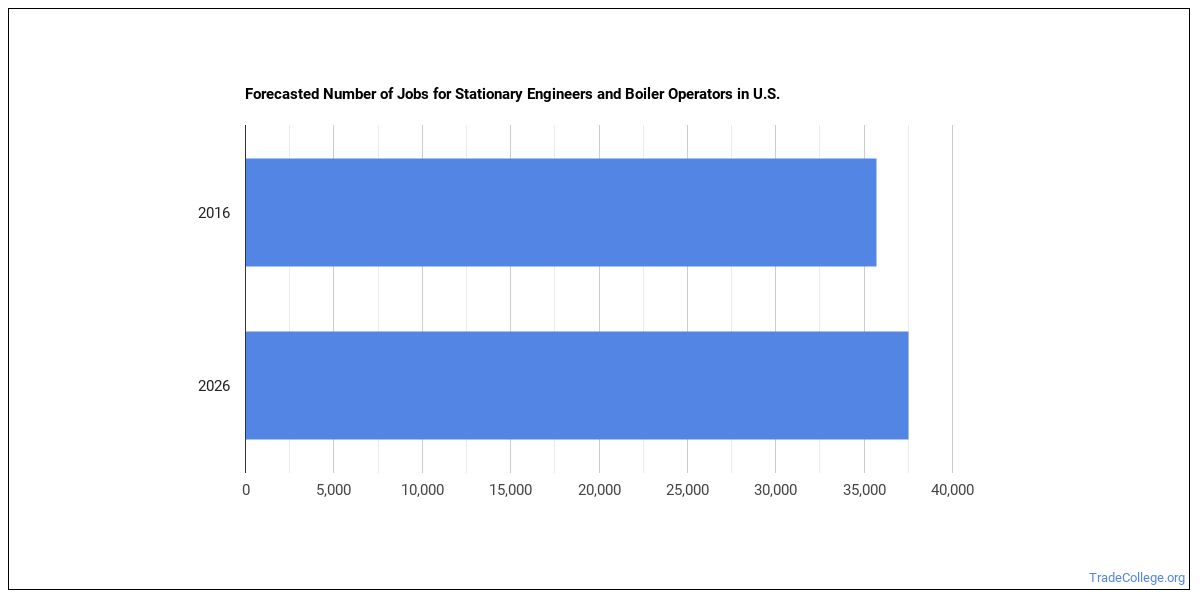
There are roughly 404,123 stationary engineers and boiler operators working in the United States today. This occupation is expected to grow by +2.2% over the projection horizon.
Stationary Engineers and Boiler Operators Pay
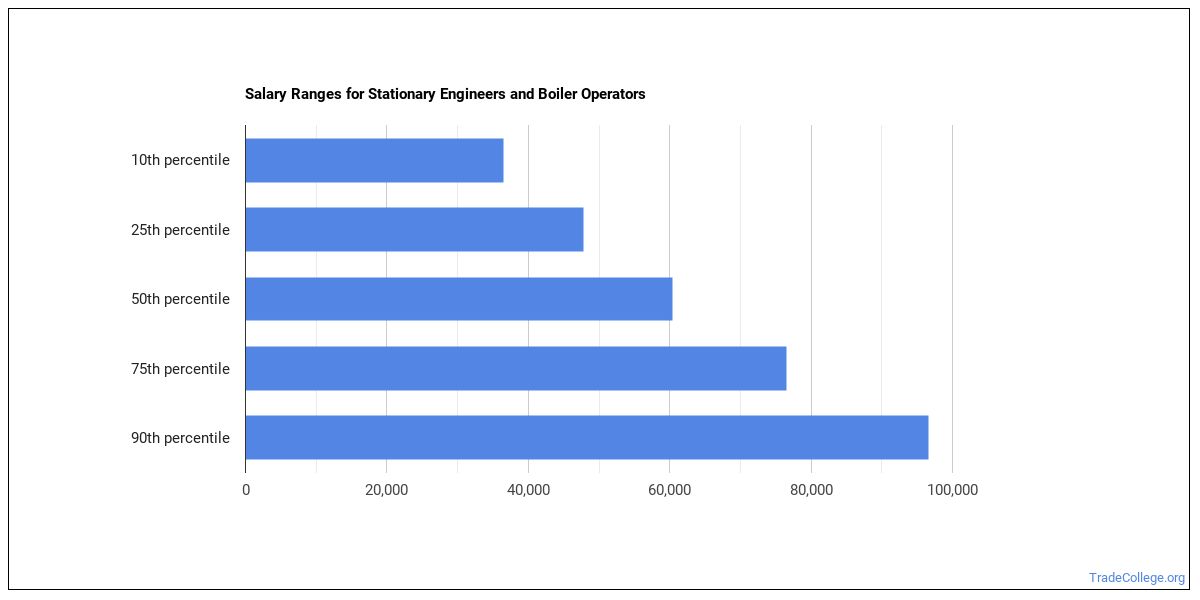
| Statistic | Value |
|---|---|
| Annual median | $35,910 |
| Hourly median | $17.26 |
| 10th percentile | $21,885 |
| 25th percentile | $28,897 |
| 75th percentile | $42,923 |
| 90th percentile | $49,936 |
Pay can vary substantially based on experience, location, and industry.
Pay by State
| State | Annual median salary |
|---|---|
| Illinois | $112,230 |
| Wyoming | $110,380 |
| Hawaii | $100,200 |
| New York | $91,790 |
| Connecticut | $90,420 |
| Washington | $89,170 |
| District of Columbia | $89,160 |
| Alaska | $87,010 |
| Maryland | $82,960 |
| California | $78,490 |
| Michigan | $78,370 |
| Delaware | $78,280 |
| Massachusetts | $76,850 |
| Nevada | $76,630 |
| New Jersey | $74,620 |
| Colorado | $73,900 |
| Minnesota | $73,560 |
| Arizona | $72,820 |
| New Hampshire | $72,360 |
| Ohio | $72,070 |
| Indiana | $69,580 |
| Utah | $69,450 |
| Pennsylvania | $69,290 |
| Florida | $69,250 |
| Georgia | $67,930 |
| Montana | $67,130 |
| Kentucky | $66,630 |
| South Dakota | $66,000 |
| Oklahoma | $65,900 |
| Iowa | $65,380 |
| Oregon | $65,340 |
| Virginia | $64,970 |
| Texas | $64,050 |
| Nebraska | $63,680 |
| Missouri | $63,560 |
| North Dakota | $62,760 |
| Rhode Island | $62,650 |
| Kansas | $62,460 |
| Idaho | $62,430 |
| Wisconsin | $62,010 |
| Maine | $61,300 |
| South Carolina | $59,450 |
| North Carolina | $58,280 |
| Arkansas | $56,180 |
| Vermont | $54,490 |
| Tennessee | $54,250 |
| Mississippi | $51,960 |
| New Mexico | $49,140 |
| Alabama | $47,460 |
| Louisiana | $46,170 |
| Puerto Rico | $38,240 |
Pay by U.S. Region
Compensation for stationary engineers and boiler operators vary by region. These regions lead on median pay:
| Region | Median annual wage | Share of U.S. jobs | Location quotient |
|---|---|---|---|
| Great Lakes | $92,358 | 10.8% | 0.96 |
| Middle Atlantic | $83,924 | 28.5% | 1.99 |
| Far Western US | $78,924 | 29.7% | 2.00 |
| Rocky Mountains | $75,190 | 3.4% | 1.04 |
| New England | $73,429 | 4.3% | 1.14 |
| Plains States | $69,197 | 9.1% | 1.90 |
| Southwest | $64,506 | 4.2% | 0.36 |
| Southeast | $57,343 | 9.8% | 0.59 |
Where the Jobs Cluster
| Metro area | State | Median annual wage | Employment |
|---|---|---|---|
| San Francisco-Oakland-Fremont, CA | CA | $124,120 | 1,290 |
| San Jose-Sunnyvale-Santa Clara, CA | CA | $119,310 | 330 |
| Vallejo, CA | CA | $119,310 | 110 |
| Chicago-Naperville-Elgin, IL-IN | IL | $112,230 | 1,170 |
| New Haven, CT | CT | $104,610 | 40 |
| New York-Newark-Jersey City, NY-NJ | NY | $103,880 | 3,490 |
| Seattle-Tacoma-Bellevue, WA | WA | $103,540 | 290 |
| Modesto, CA | CA | $101,980 | 60 |
Industry Breakdown
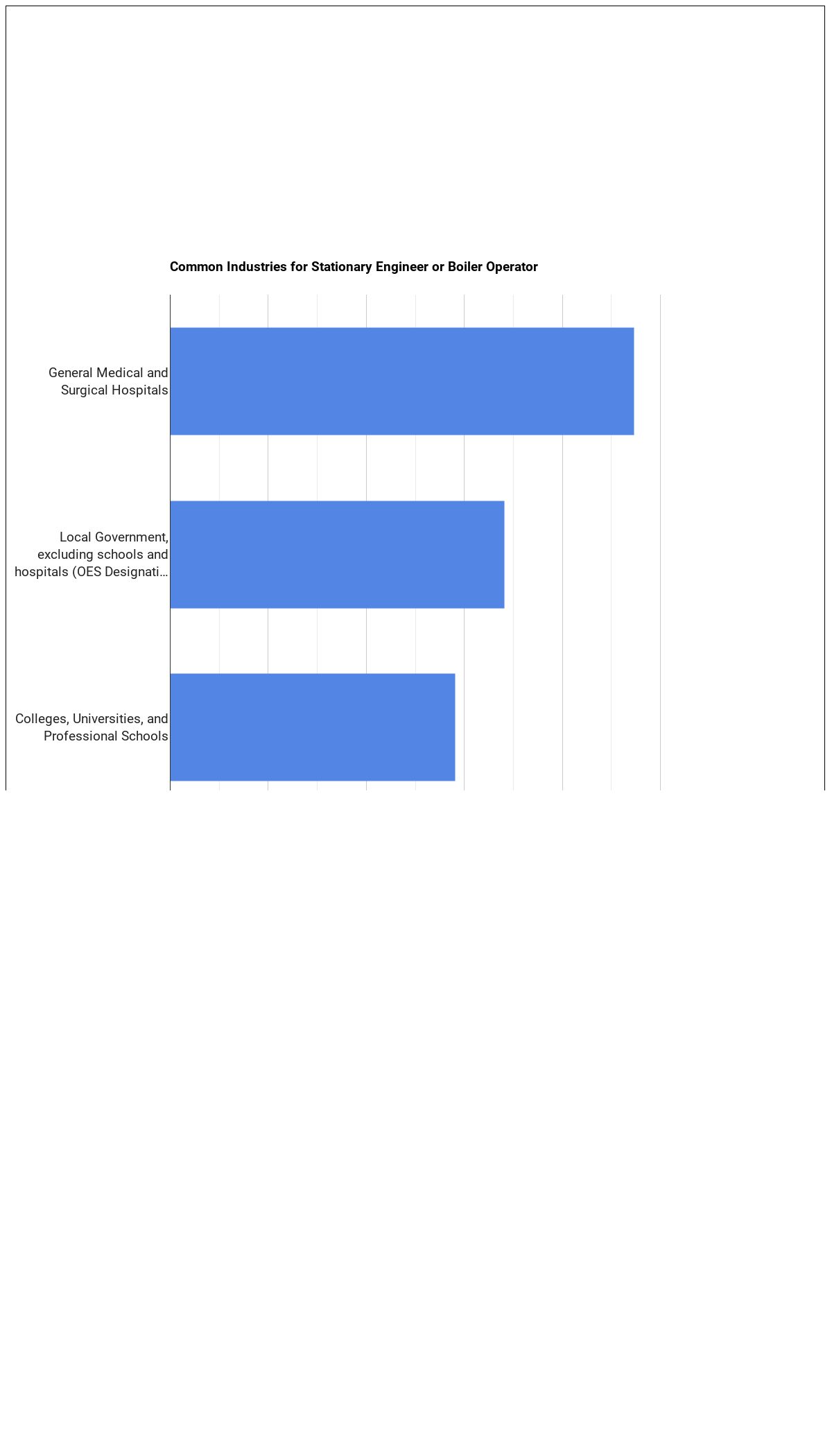
The bulk of stationary engineers and boiler operators work in these industries:
| Industry | Employment | Median annual wage |
|---|---|---|
| Health Care and Social Assistance | 6,370 | $78,950 |
| Manufacturing | 5,270 | $68,490 |
| Educational Services | 4,630 | $72,370 |
| Accommodation and Food Services | 3,600 | $50,920 |
| Administrative and Support and Waste Management and Remediation Services | 1,820 | $77,950 |
| Real Estate and Rental and Leasing | 660 | $94,500 |
| Utilities | 610 | $102,490 |
| Arts, Entertainment, and Recreation | 370 | $51,930 |
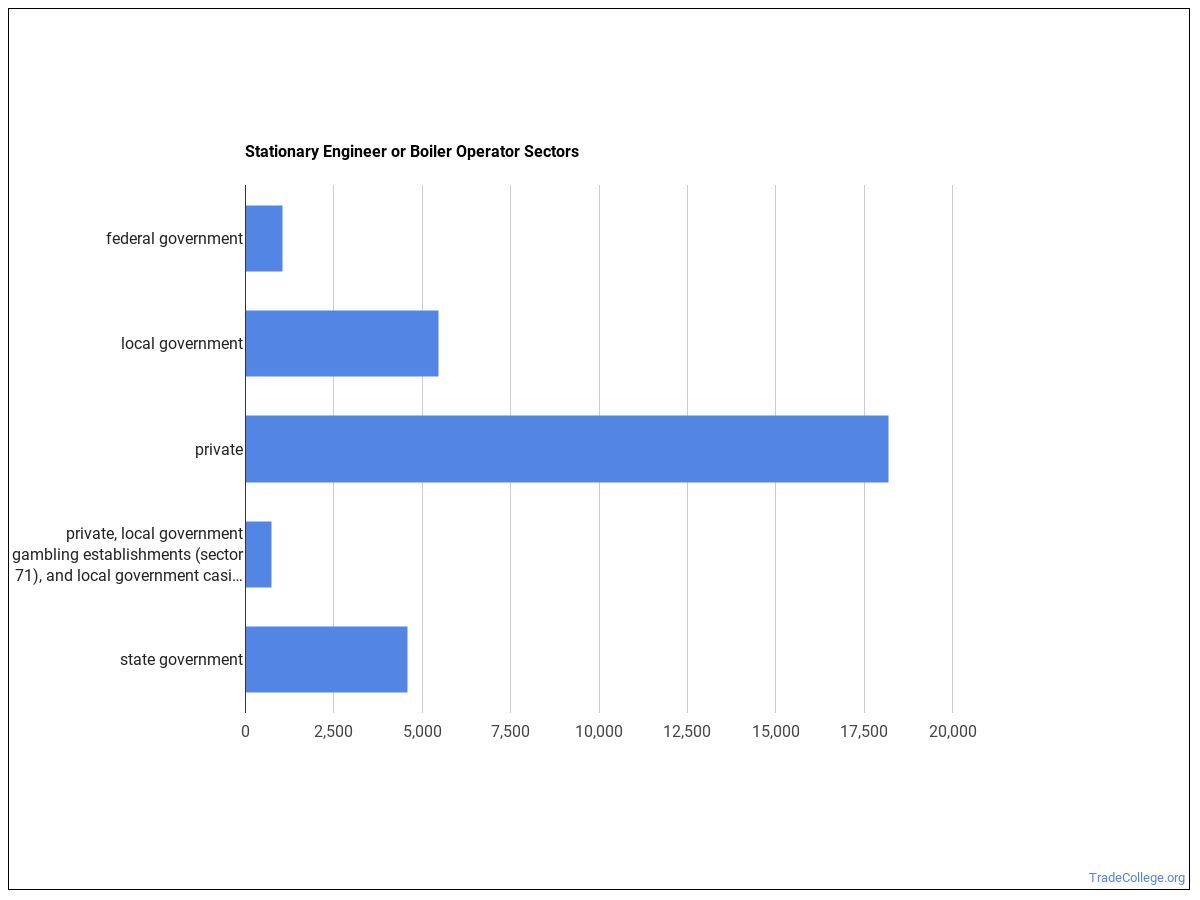
The table below shows some of the most common industries where those employed in this career field work.
Software Stationary Engineers and Boiler Operators Use
- Web platform development software: Microsoft Active Server Pages ASP (hot technology)
- Spreadsheet software: Microsoft Excel (hot technology)
- Office suite software: Microsoft Office software (hot technology)
- Electronic mail software: Microsoft Outlook (hot technology)
- Presentation software: Microsoft PowerPoint (hot technology)
- Word processing software: Microsoft Word (hot technology)
- Enterprise resource planning ERP software: SAP software (hot technology)
The Day-to-Day Environment
Daily working conditions for stationary engineers and boiler operators is shaped by the following characteristics:
- Telephone Conversations
- Contact With Others
- Work With or Contribute to a Work Group or Team
- Health and Safety of Other Workers
- Face-to-Face Discussions with Individuals and Within Teams
Education and Training
Most stationary engineers and boiler operators positions require some college, no degree as the typical entry-level education. The role falls in Medium Preparation Needed (Job Zone 3), indicating the level of preparation typically expected.
Similar Occupations
Similar Occupations
- Mechanical Engineers (Primary-Short)
- Boilermakers (Supplemental)
- Plumbers, Pipefitters, and Steamfitters (Supplemental)
- Electrical and Electronics Repairers, Powerhouse, Substation, and Relay (Supplemental)
- Control and Valve Installers and Repairers, Except Mechanical Door (Primary-Short)
- Heating, Air Conditioning, and Refrigeration Mechanics and Installers (Primary-Long)
- Industrial Machinery Mechanics (Supplemental)
- Maintenance and Repair Workers, General (Supplemental)
About the Data
Statistics shown above are sourced from the following authoritative sources:
- U.S. Bureau of Labor Statistics — Occupational Employment and Wage Statistics (OEWS) for employment and wage data by state and industry.
- BLS Employment Projections for total employment and growth forecasts.
- O*NET (Occupational Information Network) for skills, knowledge, tasks, work activities, work context, technology, and education-zone data.
SOC code: 51-8021.00 (Stationary Engineers and Boiler Operators).

TradeCollege.org provides higher-education, college and university, degree, program, career, salary, and other helpful information to students, faculty, institutions, and other internet audiences. Presented information and data are subject to change. Inclusion on this website does not imply or represent a direct relationship with the company, school, or brand. Information, though believed correct at time of publication, may not be correct, and no warranty is provided. Contact the schools to verify any information before relying on it. Financial aid may be available for those who qualify. TradeCollege.org is a for-profit site, and the displayed options may include sponsored or recommended results, not necessarily based on your preferences.
© TradeCollege.org – All Rights Reserved.