Find Trade Colleges
Electricians: Career Overview
Install, maintain, and repair electrical wiring, equipment, and fixtures. Ensure that work is in accordance with relevant codes. May install or service street lights, intercom systems, or electrical control systems.
What Do Electricians Take On?
Typical responsibilities of electricians span:
- Prepare sketches or follow blueprints to determine the location of wiring or equipment and to ensure conformance to building and safety codes.
- Place conduit, pipes, or tubing, inside designated partitions, walls, or other concealed areas, and pull insulated wires or cables through the conduit to complete circuits between boxes.
- Work from ladders, scaffolds, or roofs to install, maintain, or repair electrical wiring, equipment, or fixtures.
- Use a variety of tools or equipment, such as power construction equipment, measuring devices, power tools, and testing equipment, such as oscilloscopes, ammeters, or test lamps.
- Assemble, install, test, or maintain electrical or electronic wiring, equipment, appliances, apparatus, or fixtures, using hand tools or power tools.
- Connect wires to circuit breakers, transformers, or other components.
- Maintain current electrician's license or identification card to meet governmental regulations.
- Plan layout and installation of electrical wiring, equipment, or fixtures, based on job specifications and local codes.
Key Skills and Knowledge
Top electricians draw on a mix of skills and domain knowledge.
Top Skills
The abilities most central to this role, rated on an importance scale of 0 to 5:
Knowledge Areas
Other Electricians Job Titles
Common job titles for this role include:
- Airport Electrician
- Antenna Installer
- Antenna Rigger
- Commercial Electrician
- Conduit Installer
- Conduit Mechanic
- Construction Electrician
- Control Electrician
Employment and Demand
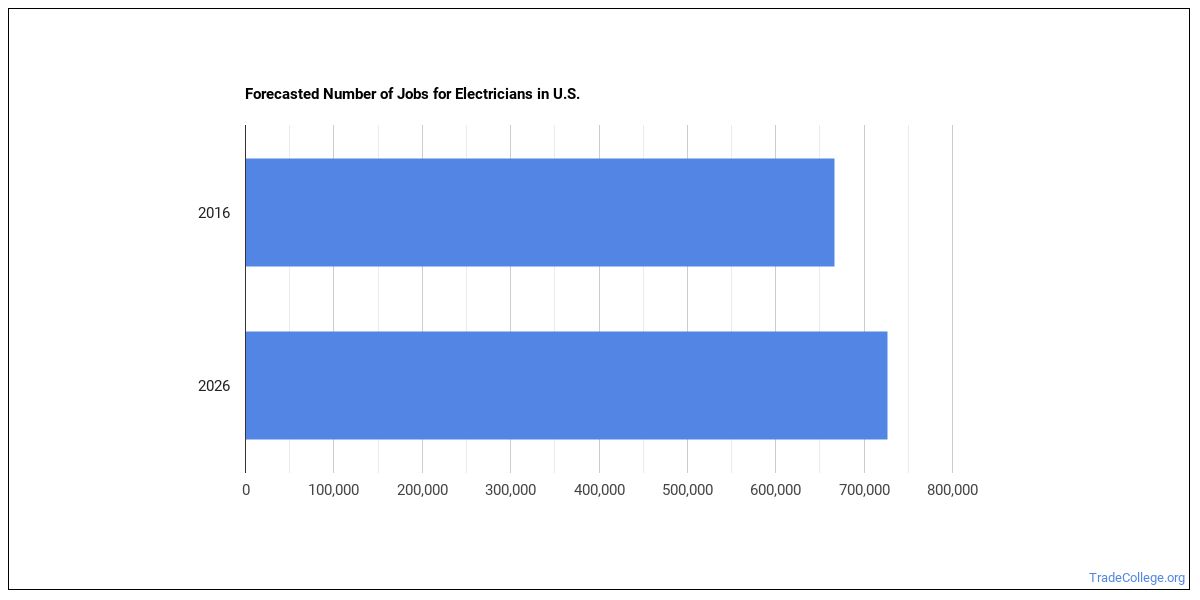
There are about 267,745 electricians working in the United States today. Demand is forecast to decline by -2.9% over the projection horizon.
Salary for Electricians
| Statistic | Value |
|---|---|
| Annual median | $57,376 |
| Hourly median | $27.59 |
| 10th percentile | $31,669 |
| 25th percentile | $44,523 |
| 75th percentile | $70,230 |
| 90th percentile | $83,084 |
Compensation varies based on experience, location, and industry.

How Much Do Electricians Make in Different U.S. States?
| State | Annual median salary |
|---|---|
| Oregon | $97,320 |
| Washington | $96,530 |
| Illinois | $96,360 |
| Hawaii | $83,200 |
| Massachusetts | $82,120 |
| District of Columbia | $81,950 |
| Alaska | $81,860 |
| Minnesota | $81,430 |
| New York | $77,460 |
| Connecticut | $76,790 |
| California | $76,540 |
| Wisconsin | $75,090 |
| Wyoming | $73,450 |
| New Jersey | $73,090 |
| Michigan | $72,680 |
| Missouri | $70,950 |
| Rhode Island | $70,160 |
| Montana | $68,980 |
| Maine | $67,820 |
| North Dakota | $65,820 |
| Maryland | $65,650 |
| Indiana | $65,480 |
| Pennsylvania | $65,400 |
| Nevada | $64,950 |
| West Virginia | $63,850 |
| Ohio | $63,560 |
| Virgin Islands | $63,020 |
| Delaware | $62,970 |
| Iowa | $62,880 |
| Colorado | $62,090 |
| New Hampshire | $61,990 |
| Kansas | $61,830 |
| Virginia | $61,610 |
| Utah | $61,430 |
| Idaho | $60,670 |
| Oklahoma | $60,050 |
| Nebraska | $60,020 |
| Vermont | $59,670 |
| Louisiana | $59,590 |
| Kentucky | $59,490 |
| Arizona | $59,480 |
| Tennessee | $59,190 |
| Georgia | $58,860 |
| South Dakota | $58,550 |
| South Carolina | $58,260 |
| Mississippi | $57,300 |
| Texas | $56,920 |
| New Mexico | $56,890 |
| North Carolina | $54,070 |
| Florida | $53,100 |
| Alabama | $52,420 |
| Arkansas | $49,420 |
| Guam | $41,590 |
| Puerto Rico | $33,370 |
Where Electricians Earn the Most
Pay for electricians shift depending on where you work. The following regions pay the most:
| Region | Median annual wage | Share of U.S. jobs | Location quotient |
|---|---|---|---|
| Far Western US | $80,905 | 15.4% | 0.93 |
| New England | $75,856 | 4.6% | 0.97 |
| Great Lakes | $74,586 | 14.0% | 1.01 |
| Middle Atlantic | $72,002 | 13.0% | 0.86 |
| Plains States | $68,924 | 7.0% | 1.05 |
| Rocky Mountains | $62,981 | 5.3% | 1.33 |
| Southwest | $57,679 | 14.3% | 1.14 |
| Southeast | $56,582 | 25.9% | 1.07 |
Top Metro Areas
| Metro area | State | Median annual wage | Employment |
|---|---|---|---|
| Kennewick-Richland, WA | WA | $108,740 | 970 |
| Mount Vernon-Anacortes, WA | WA | $103,270 | 520 |
| Decatur, IL | IL | $102,960 | 440 |
| Wenatchee-East Wenatchee, WA | WA | $102,160 | 450 |
| Portland-Vancouver-Hillsboro, OR-WA | OR | $102,070 | 7,290 |
| Seattle-Tacoma-Bellevue, WA | WA | $101,600 | 9,160 |
| Chicago-Naperville-Elgin, IL-IN | IL | $99,540 | 16,690 |
| Corvallis, OR | OR | $97,320 | 70 |
Top Industries Employing Electricians
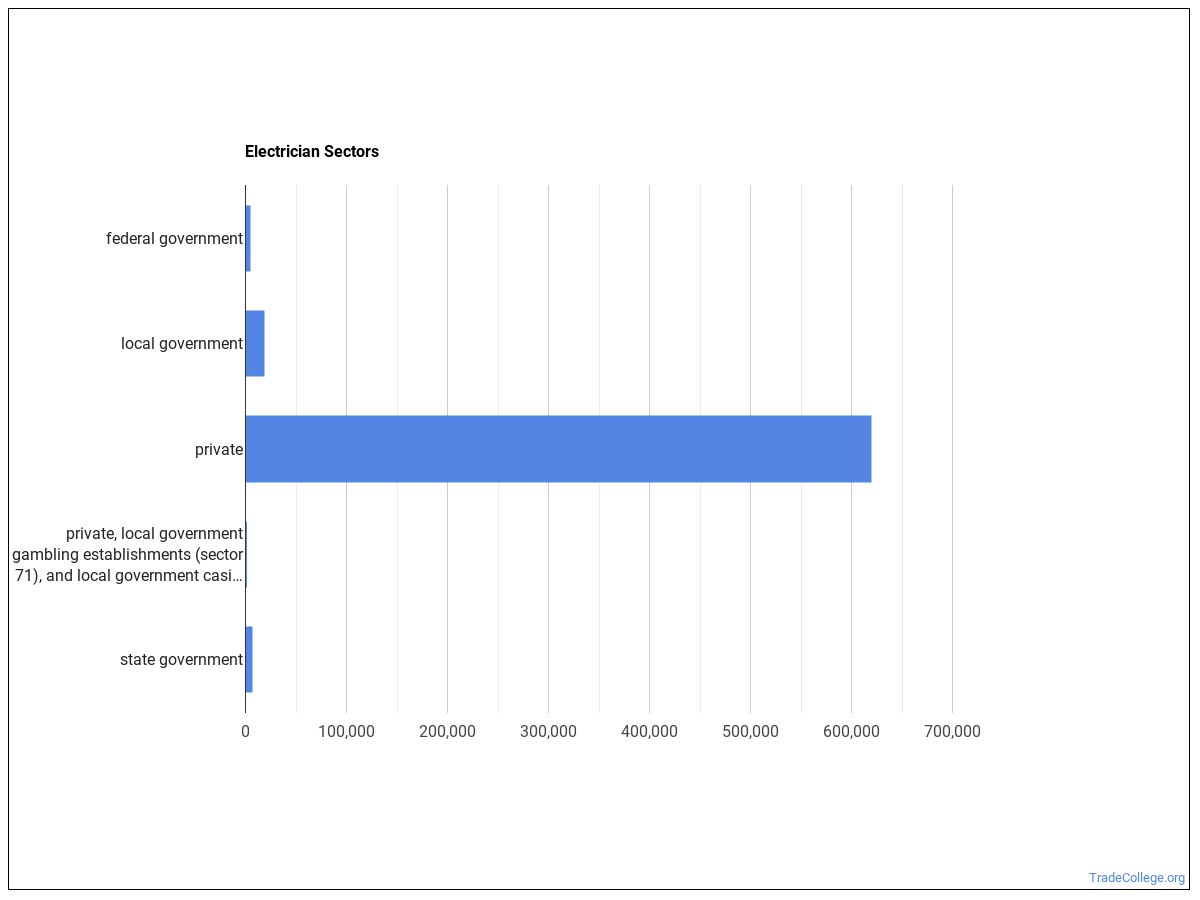
Most electricians are concentrated in the following sectors:
| Industry | Employment | Median annual wage |
|---|---|---|
| Construction | 582,130 | $61,420 |
| Manufacturing | 50,920 | $71,820 |
| Administrative and Support and Waste Management and Remediation Services | 31,650 | $58,070 |
| Educational Services | 9,200 | $64,870 |
| Utilities | 8,720 | $104,010 |
| Professional, Scientific, and Technical Services | 7,470 | $64,220 |
| Mining, Quarrying, and Oil and Gas Extraction | 6,160 | $81,990 |
| Transportation and Warehousing | 4,880 | $79,320 |
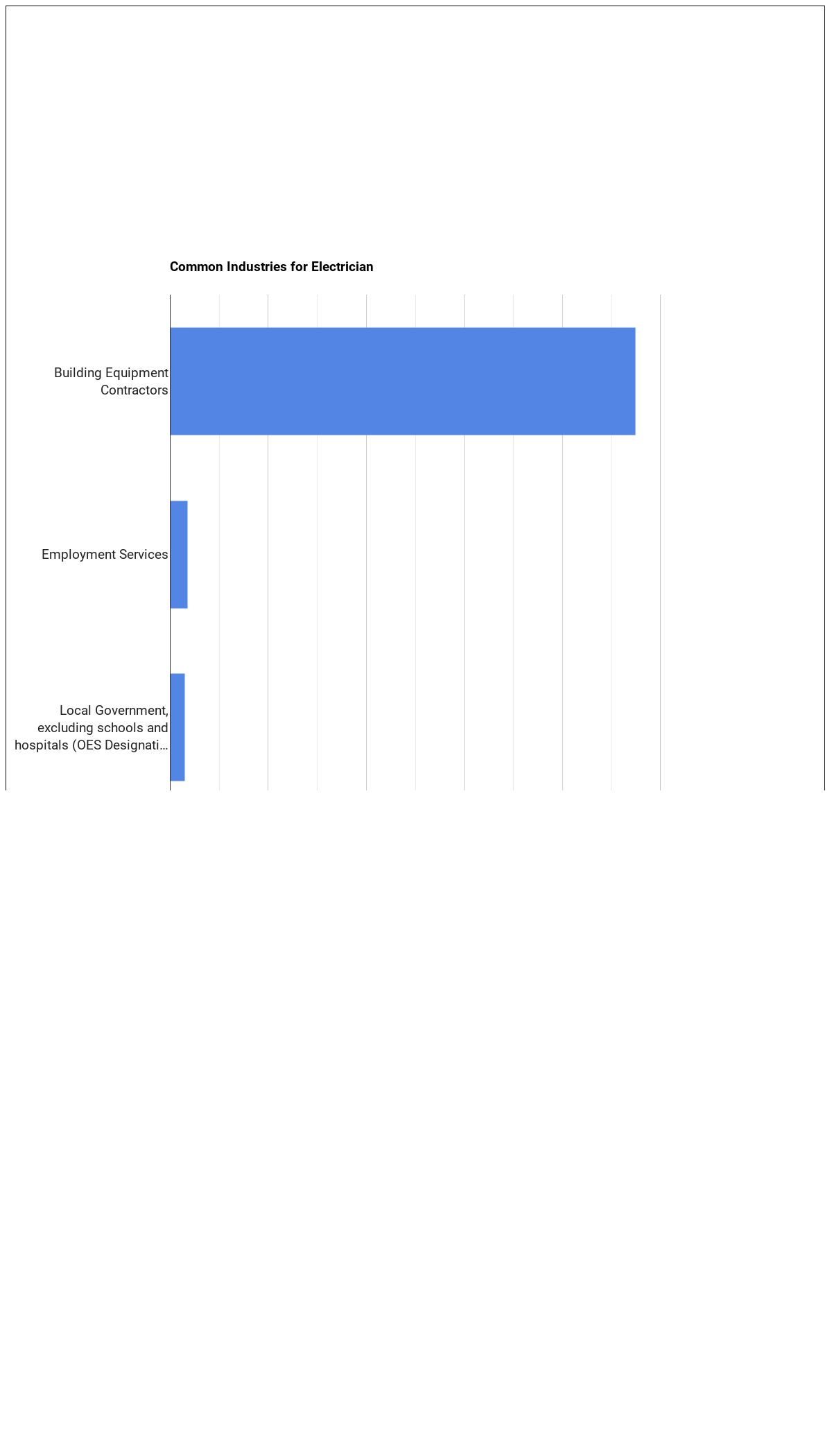
Below are examples of industries where electricians work:
Tech Stack
- Document management software: Adobe Acrobat (hot technology)
- Computer aided design CAD software: Autodesk AutoCAD (hot technology)
- Spreadsheet software: Microsoft Excel (hot technology)
- Office suite software: Microsoft Office software (hot technology)
- Electronic mail software: Microsoft Outlook (hot technology)
- Operating system software: Microsoft Windows (hot technology)
- Word processing software: Microsoft Word (hot technology)
- Enterprise resource planning ERP software: SAP software (hot technology)
What the Workplace Is Like
The work environment for electricians reflects the following characteristics:
- Wear Common Protective or Safety Equipment such as Safety Shoes, Glasses, Gloves, Hearing Protection, Hard Hats, or Life Jackets
- Spend Time Using Your Hands to Handle, Control, or Feel Objects, Tools, or Controls
- Face-to-Face Discussions with Individuals and Within Teams
- Contact With Others
- Importance of Being Exact or Accurate
Getting Started in This Career
Typical electricians positions require some college, no degree as the typical entry-level education. This occupation sits in Medium Preparation Needed (Job Zone 3), reflecting the level of preparation typically expected.
Other Careers to Consider
Similar Occupations
- Lighting Technicians (Primary-Short)
- Boilermakers (Primary-Long)
- Carpenters (Supplemental)
- Insulation Workers, Mechanical (Supplemental)
- Plumbers, Pipefitters, and Steamfitters (Primary-Short)
- Sheet Metal Workers (Supplemental)
- Structural Iron and Steel Workers (Supplemental)
- Solar Photovoltaic Installers (Supplemental)
Where to Study
Students preparing for electricians often complete programs in:
Construction Trades
1 programs across 1 majors
About the Data
Statistics shown above are sourced from the following authoritative sources:
- U.S. Bureau of Labor Statistics — Occupational Employment and Wage Statistics (OEWS) for employment and wage data by state and industry.
- BLS Employment Projections for total employment and growth forecasts.
- O*NET (Occupational Information Network) for skills, knowledge, tasks, work activities, work context, technology, and education-zone data.
SOC code: 47-2111.00 (Electricians).

TradeCollege.org provides higher-education, college and university, degree, program, career, salary, and other helpful information to students, faculty, institutions, and other internet audiences. Presented information and data are subject to change. Inclusion on this website does not imply or represent a direct relationship with the company, school, or brand. Information, though believed correct at time of publication, may not be correct, and no warranty is provided. Contact the schools to verify any information before relying on it. Financial aid may be available for those who qualify. TradeCollege.org is a for-profit site, and the displayed options may include sponsored or recommended results, not necessarily based on your preferences.
© TradeCollege.org – All Rights Reserved.