Find Trade Colleges
Septic Tank Servicers and Sewer Pipe Cleaners: Career Overview
Clean and repair septic tanks, sewer lines, or drains. May patch walls and partitions of tank, replace damaged drain tile, or repair breaks in underground piping.
What Do Septic Tank Servicers and Sewer Pipe Cleaners Take On?
The day-to-day responsibilities of septic tank servicers and sewer pipe cleaners cover:
- Communicate with supervisors and other workers, using equipment such as wireless phones, pagers, or radio telephones.
- Drive trucks to transport crews, materials, and equipment.
- Inspect manholes to locate sewer line stoppages.
- Operate sewer cleaning equipment, including power rodders, high-velocity water jets, sewer flushers, bucket machines, wayne balls, and vac-alls.
- Prepare and keep records of actions taken, including maintenance and repair work.
- Clean and repair septic tanks, sewer lines, or related structures such as manholes, culverts, and catch basins.
- Measure excavation sites, using plumbers' snakes, tapelines, or lengths of cutting heads within sewers, and mark areas for digging.
- Service, adjust, and make minor repairs to equipment, machines, and attachments.
Key Skills and Knowledge
Top septic tank servicers and sewer pipe cleaners rely on a mix of skills and domain knowledge.
Most Important Skills
These are the skills most central to this role, rated on an importance scale of 0 to 5:
Knowledge Areas
Related Job Titles
Common job titles for this role include:
- Aseptic Tech (Aseptic Technician)
- Drain Cleaner
- Drain Technician
- Drain and Sewer Technician
- Electric Sewer Cleaning Machine Operator
- High Reach Operator
- Pipe Cleaning Machine Operator
- Priming Machine Operator
Employment and Demand
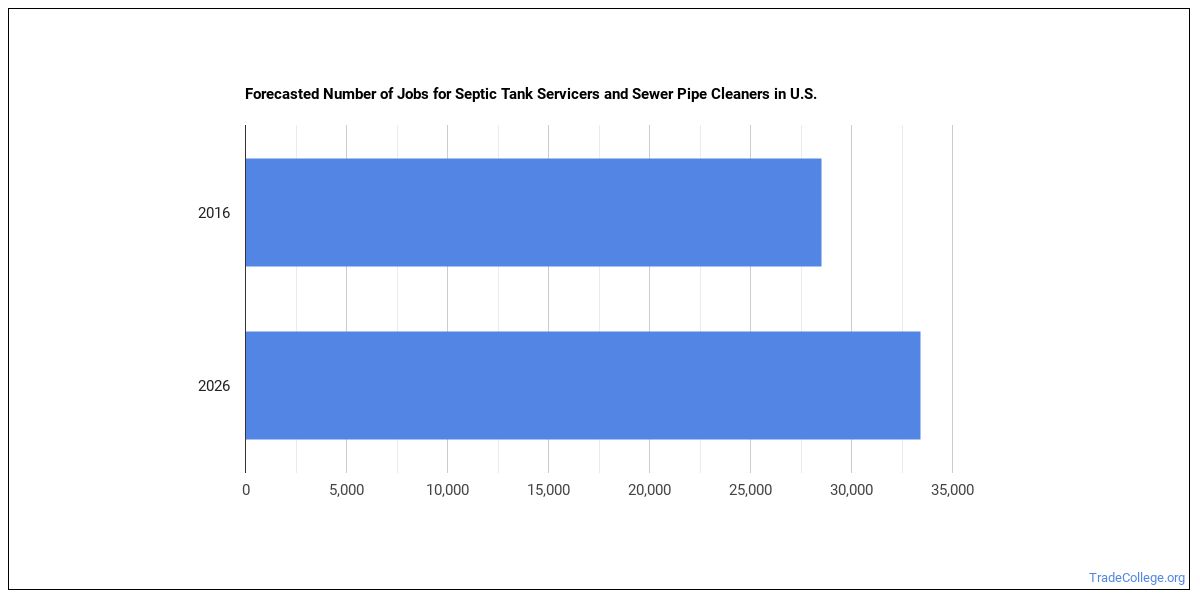
There are roughly 761,995 septic tank servicers and sewer pipe cleaners working in the United States today. Demand is forecast to grow by +3.8% over the projection horizon.
Septic Tank Servicers and Sewer Pipe Cleaners Pay
| Statistic | Value |
|---|---|
| Annual median | $66,706 |
| Hourly median | $32.07 |
| 10th percentile | $37,303 |
| 25th percentile | $52,004 |
| 75th percentile | $81,408 |
| 90th percentile | $96,109 |
Wages vary widely based on experience, location, and industry.

Pay by State
| State | Annual median salary |
|---|---|
| New Jersey | $63,420 |
| Washington | $61,570 |
| Nebraska | $60,790 |
| Maryland | $59,800 |
| Connecticut | $58,430 |
| Minnesota | $58,140 |
| North Dakota | $57,210 |
| New Hampshire | $56,180 |
| Wisconsin | $56,020 |
| Oregon | $55,900 |
| California | $54,080 |
| Ohio | $52,660 |
| Colorado | $52,530 |
| Hawaii | $52,120 |
| Pennsylvania | $52,000 |
| Iowa | $51,950 |
| Massachusetts | $51,350 |
| Illinois | $51,060 |
| New York | $50,910 |
| Alaska | $49,480 |
| Michigan | $49,440 |
| Montana | $49,410 |
| Utah | $48,720 |
| Missouri | $48,450 |
| Indiana | $48,380 |
| Nevada | $48,230 |
| Florida | $47,650 |
| Maine | $47,020 |
| South Dakota | $46,910 |
| Louisiana | $46,490 |
| Arizona | $46,450 |
| Kansas | $45,610 |
| Virginia | $45,380 |
| Kentucky | $44,500 |
| North Carolina | $44,390 |
| Idaho | $44,360 |
| Vermont | $44,180 |
| Wyoming | $44,180 |
| Guam | $44,030 |
| Texas | $44,000 |
| Tennessee | $43,850 |
| New Mexico | $43,680 |
| Delaware | $42,800 |
| Georgia | $42,510 |
| Alabama | $42,130 |
| South Carolina | $42,030 |
| Oklahoma | $40,910 |
| Mississippi | $37,700 |
| Arkansas | $32,980 |
| West Virginia | $28,010 |
Top-Paying U.S. Regions
Earnings for septic tank servicers and sewer pipe cleaners vary by region. Top regions by median wage:
| Region | Median annual wage | Share of U.S. jobs | Location quotient |
|---|---|---|---|
| Far Western US | $56,239 | 19.4% | 1.47 |
| Middle Atlantic | $52,535 | 13.0% | 1.01 |
| New England | $52,251 | 3.8% | 0.98 |
| Great Lakes | $51,542 | 16.6% | 1.24 |
| Plains States | $51,202 | 9.5% | 1.97 |
| Rocky Mountains | $49,162 | 5.7% | 1.81 |
| Southeast | $44,574 | 19.9% | 0.91 |
| Southwest | $43,580 | 12.2% | 1.13 |
Top Metro Areas
| Metro area | State | Median annual wage | Employment |
|---|---|---|---|
| Mount Vernon-Anacortes, WA | WA | $71,590 | 40 |
| Bellingham, WA | WA | $68,450 | 110 |
| Stockton-Lodi, CA | CA | $65,160 | 50 |
| Cedar Rapids, IA | IA | $64,320 | 60 |
| Bremerton-Silverdale-Port Orchard, WA | WA | $64,280 | 80 |
| Reno, NV | NV | $63,480 | 60 |
| Seattle-Tacoma-Bellevue, WA | WA | $62,830 | 780 |
| Cincinnati, OH-KY-IN | OH | $62,670 | 230 |
Industry Breakdown
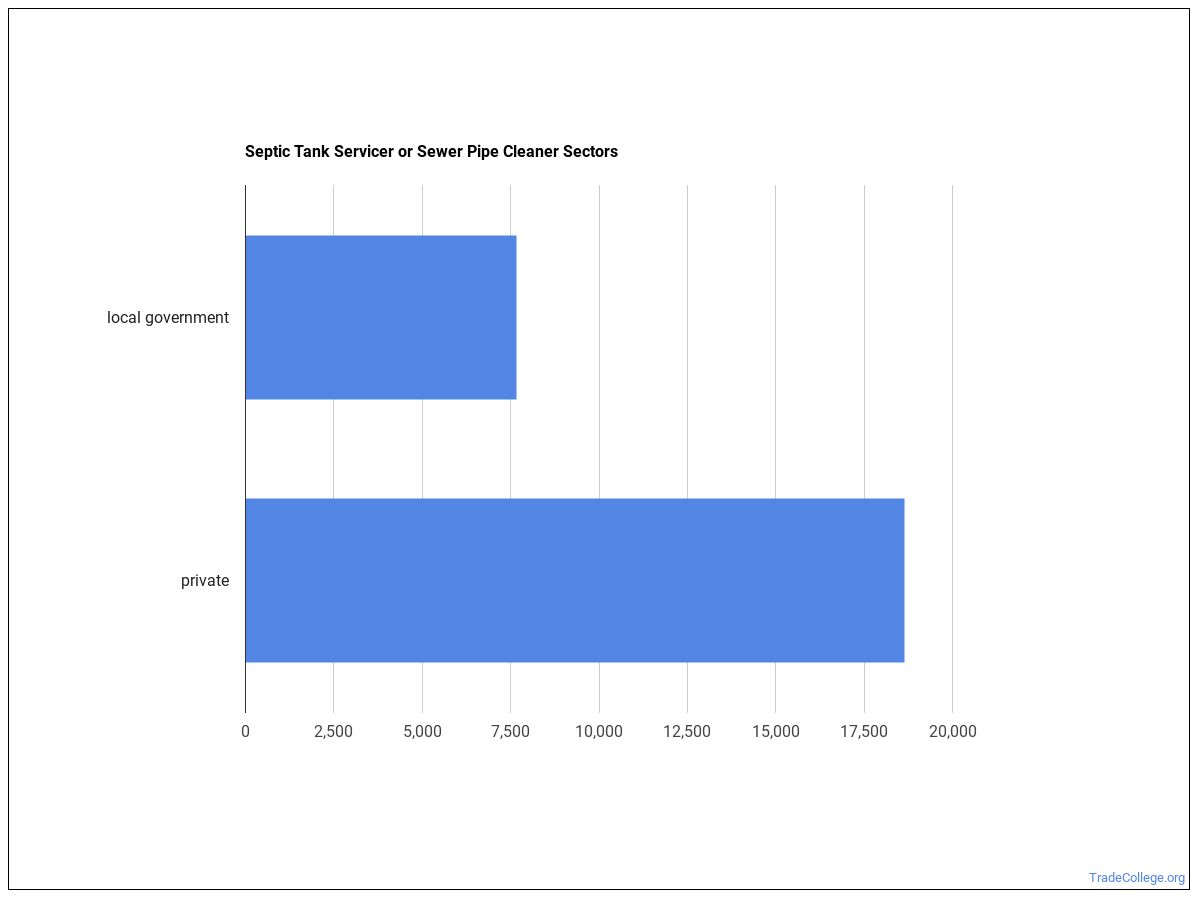
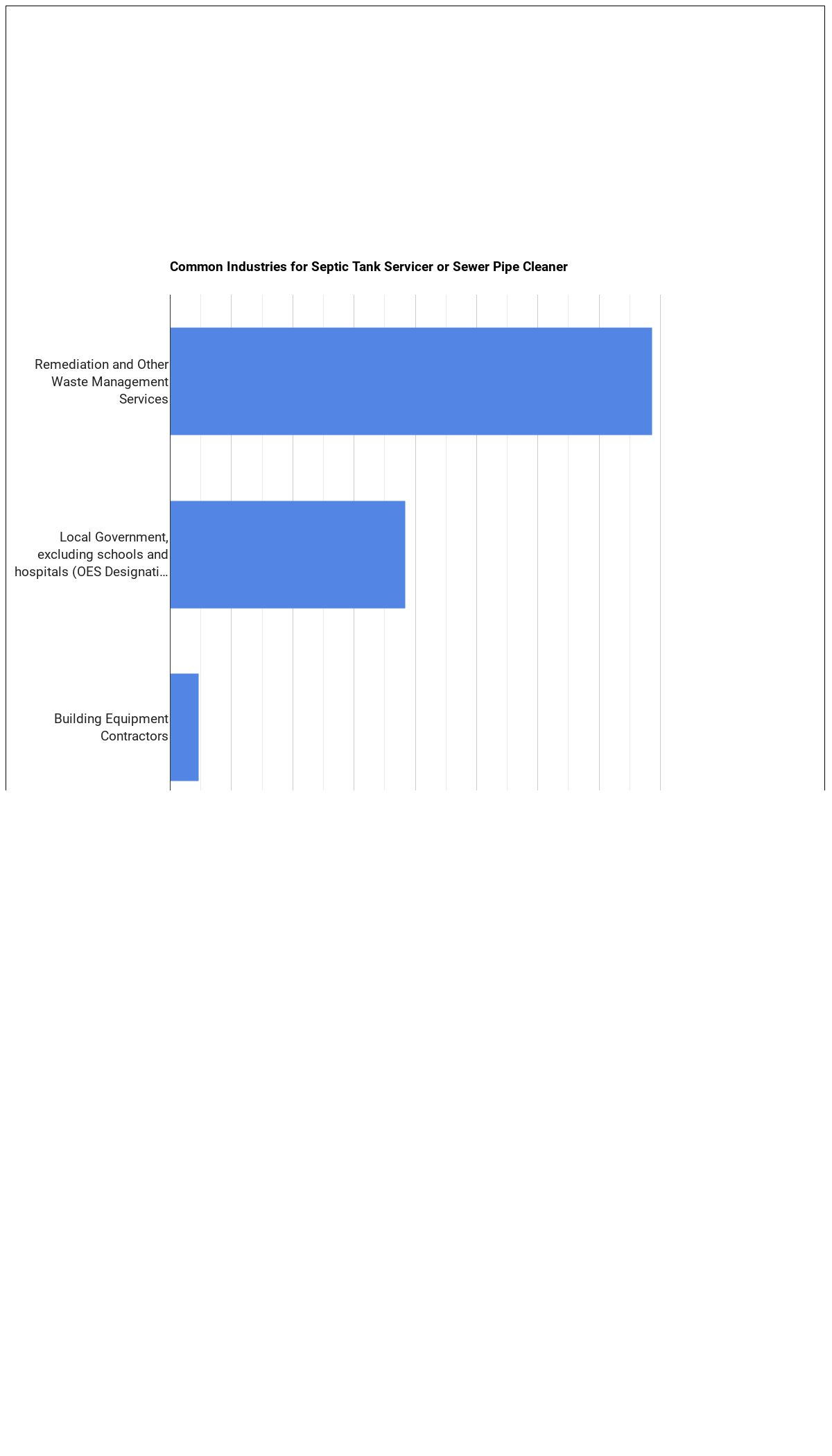
The bulk of septic tank servicers and sewer pipe cleaners are found across these industries:
| Industry | Employment | Median annual wage |
|---|---|---|
| Administrative and Support and Waste Management and Remediation Services | 16,640 | $47,540 |
| Construction | 5,280 | $50,860 |
| Professional, Scientific, and Technical Services | 440 | $60,740 |
| Utilities | 100 | $49,180 |
| Manufacturing | 70 | $48,940 |
Septic Tank Servicers and Sewer Pipe Cleaners work in the following industries:
Tech Stack
- Accounting software: Intuit QuickBooks (hot technology)
- Spreadsheet software: Microsoft Excel (hot technology)
- Word processing software: Microsoft Word (hot technology)
What the Workplace Is Like
The work environment for septic tank servicers and sewer pipe cleaners is shaped by the following characteristics:
- Outdoors, Exposed to All Weather Conditions
- Telephone Conversations
- Face-to-Face Discussions with Individuals and Within Teams
- Contact With Others
- Exposed to Contaminants
Education and Training
Typical septic tank servicers and sewer pipe cleaners positions require a high school diploma or equivalent as the typical entry-level education. This occupation sits in Some Preparation Needed (Job Zone 2), reflecting the level of preparation typically expected.
Other Careers to Consider
Similar Occupations
- Construction Laborers (Primary-Long)
- Paving, Surfacing, and Tamping Equipment Operators (Supplemental)
- Operating Engineers and Other Construction Equipment Operators (Primary-Long)
- Pipelayers (Primary-Short)
- Plumbers, Pipefitters, and Steamfitters (Primary-Short)
- Helpers–Pipelayers, Plumbers, Pipefitters, and Steamfitters (Primary-Short)
- Hazardous Materials Removal Workers (Supplemental)
- Highway Maintenance Workers (Supplemental)
Top Programs to Study For This Career
Students preparing for septic tank servicers and sewer pipe cleaners often complete programs in:
Construction Trades
1 programs across 1 majors
References
Data on this page comes from the following authoritative sources:
- U.S. Bureau of Labor Statistics — Occupational Employment and Wage Statistics (OEWS) for employment and wage data by state and industry.
- BLS Employment Projections for total employment and growth forecasts.
- O*NET (Occupational Information Network) for skills, knowledge, tasks, work activities, work context, technology, and education-zone data.
SOC code: 47-4071.00 (Septic Tank Servicers and Sewer Pipe Cleaners).

TradeCollege.org provides higher-education, college and university, degree, program, career, salary, and other helpful information to students, faculty, institutions, and other internet audiences. Presented information and data are subject to change. Inclusion on this website does not imply or represent a direct relationship with the company, school, or brand. Information, though believed correct at time of publication, may not be correct, and no warranty is provided. Contact the schools to verify any information before relying on it. Financial aid may be available for those who qualify. TradeCollege.org is a for-profit site, and the displayed options may include sponsored or recommended results, not necessarily based on your preferences.
© TradeCollege.org – All Rights Reserved.