Find Trade Colleges
Rotary Drill Operators, Oil and Gas: Job Description
Set up or operate a variety of drills to remove underground oil and gas, or remove core samples for testing during oil and gas exploration.
What Tasks Do Rotary Drill Operators, Oil and Gas Perform?
The core tasks performed by rotary drill operators, oil and gas cover:
- Train crews, and introduce procedures to make drill work more safe and effective.
- Observe pressure gauge and move throttles and levers to control the speed of rotary tables, and to regulate pressure of tools at bottoms of boreholes.
- Count sections of drill rod to determine depths of boreholes.
- Push levers and brake pedals to control gasoline, diesel, electric, or steam draw works that lower and raise drill pipes and casings in and out of wells.
- Connect sections of drill pipe, using hand tools and powered wrenches and tongs.
- Maintain records of footage drilled, location and nature of strata penetrated, materials and tools used, services rendered, and time required.
- Maintain and adjust machinery to ensure proper performance.
- Start and examine operation of slush pumps to ensure circulation and consistency of drilling fluid or mud in well.
Skills and Knowledge
Successful rotary drill operators, oil and gas rely on a mix of skills and domain knowledge.
Most Important Skills
The abilities most central to this role, rated on an importance scale of 0 to 5:
Top Knowledge Areas
Types of Rotary Drill Operators, Oil and Gas Jobs
This career also goes by job titles like:
- Blast Driller
- Cable Driller
- Cable Tool Driller
- Cable Tool Operator
- Clean Out Driller
- Core Drill Operator
- Core Driller
- Daylight Driller
Employment and Demand
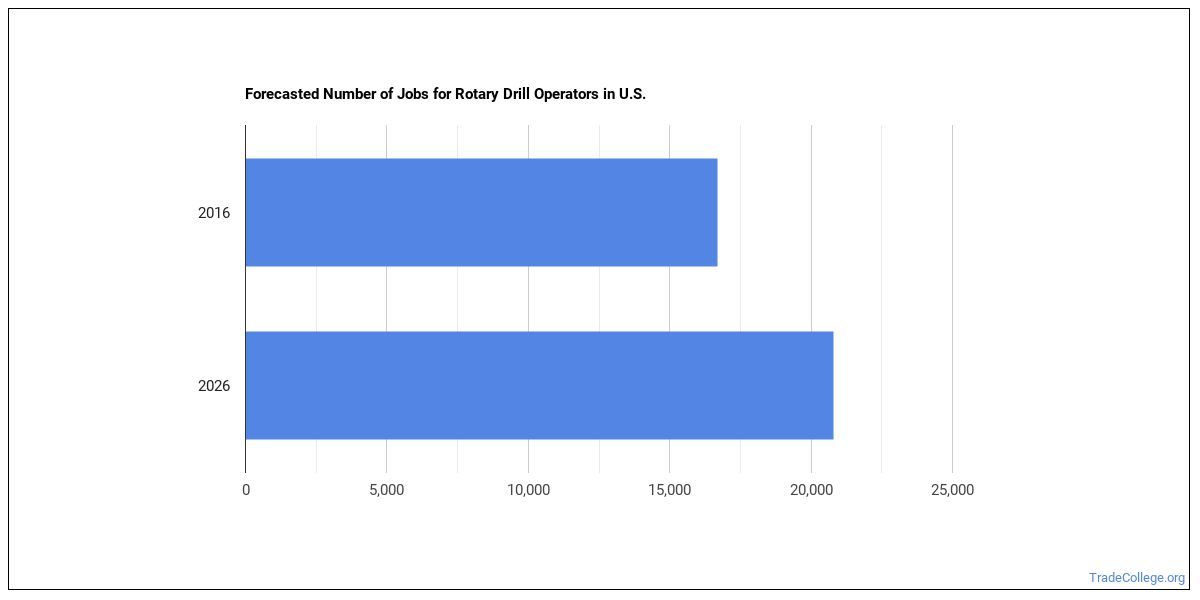
The U.S. employs around 374,803 rotary drill operators, oil and gas working in the United States today. This occupation is expected to grow by +8.6% over the projection horizon.
How Much Do Rotary Drill Operators, Oil and Gas Make?
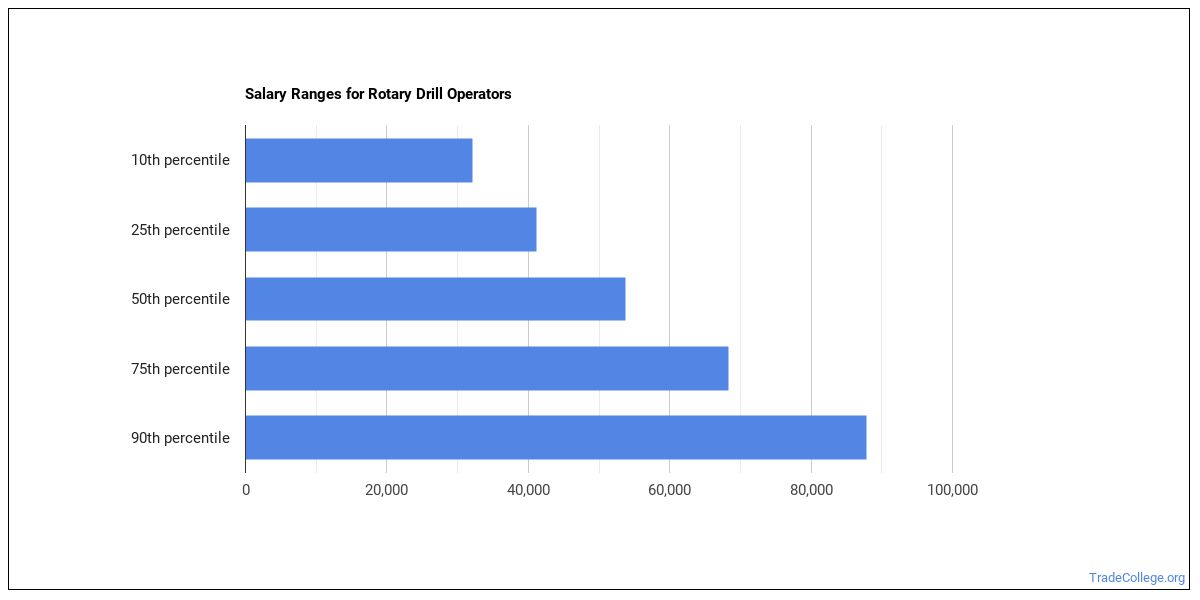
| Statistic | Value |
|---|---|
| Annual median | $69,933 |
| Hourly median | $33.62 |
| 10th percentile | $44,769 |
| 25th percentile | $57,351 |
| 75th percentile | $82,515 |
| 90th percentile | $95,097 |
Pay can vary substantially based on experience, location, and industry.
Pay by State
| State | Annual median salary |
|---|---|
| California | $99,470 |
| Alaska | $86,750 |
| New Mexico | $85,540 |
| Minnesota | $79,760 |
| Alabama | $77,240 |
| Colorado | $76,290 |
| Arizona | $75,540 |
| Florida | $75,410 |
| North Dakota | $69,560 |
| Utah | $68,660 |
| Arkansas | $67,800 |
| Texas | $66,430 |
| Oklahoma | $65,080 |
| Mississippi | $62,410 |
| Pennsylvania | $62,350 |
| Ohio | $61,380 |
| Louisiana | $60,930 |
| Virginia | $59,750 |
| Kansas | $58,580 |
| West Virginia | $58,040 |
| Wyoming | $56,600 |
| Michigan | $54,070 |
| South Carolina | $50,850 |
| North Carolina | $43,950 |
| Kentucky | $42,000 |
Pay by U.S. Region
Earnings for rotary drill operators, oil and gas shift depending on where you work. Top regions by median wage:
| Region | Median annual wage | Share of U.S. jobs | Location quotient |
|---|---|---|---|
| Far Western US | $95,741 | 4.6% | 2.04 |
| Southwest | $67,749 | 64.9% | 6.45 |
| Plains States | $67,015 | 3.9% | 4.85 |
| Rocky Mountains | $66,679 | 5.0% | 4.31 |
| Middle Atlantic | $62,350 | 3.5% | 0.86 |
| Southeast | $60,409 | 16.2% | 4.73 |
| Great Lakes | $58,568 | 2.1% | 0.32 |
Top Metro Areas
| Metro area | State | Median annual wage | Employment |
|---|---|---|---|
| Bakersfield-Delano, CA | CA | $101,350 | 200 |
| Austin-Round Rock-San Marcos, TX | TX | $82,380 | 60 |
| Houston-Pasadena-The Woodlands, TX | TX | $79,150 | 1,660 |
| Dallas-Fort Worth-Arlington, TX | TX | $78,220 | 430 |
| Tyler, TX | TX | $77,650 | 80 |
| Farmington, NM | NM | $76,960 | 60 |
| San Angelo, TX | TX | $73,690 | 50 |
| Oklahoma City, OK | OK | $72,530 | 580 |
Which Industries Hire Rotary Drill Operators, Oil and Gas
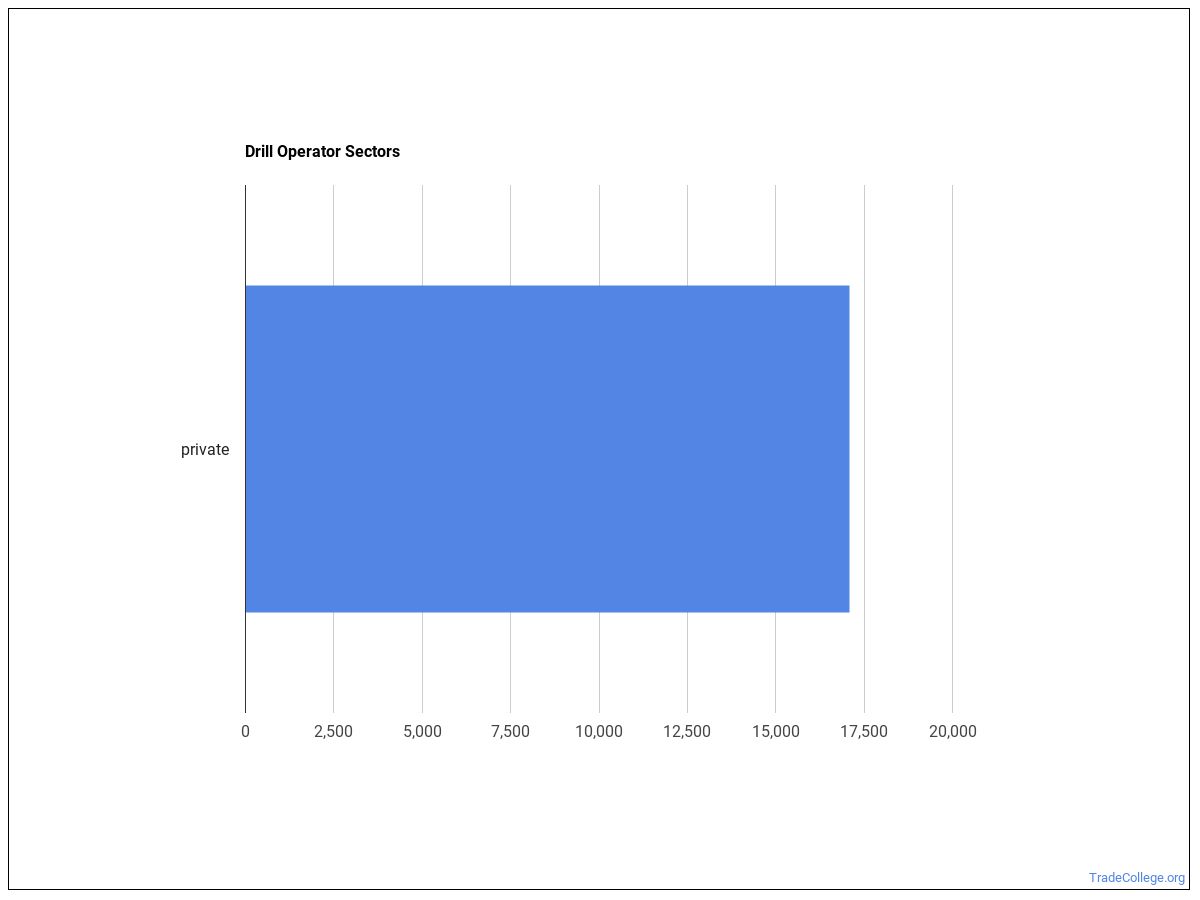
The largest employers of rotary drill operators, oil and gas are concentrated in the following sectors:
| Industry | Employment | Median annual wage |
|---|---|---|
| Mining, Quarrying, and Oil and Gas Extraction | 12,220 | $65,210 |
| Construction | 290 | $59,840 |
| Professional, Scientific, and Technical Services | 290 | $59,560 |
| Transportation and Warehousing | 100 | $79,690 |
| Manufacturing | 40 | $59,780 |
| Administrative and Support and Waste Management and Remediation Services | 40 | $66,190 |
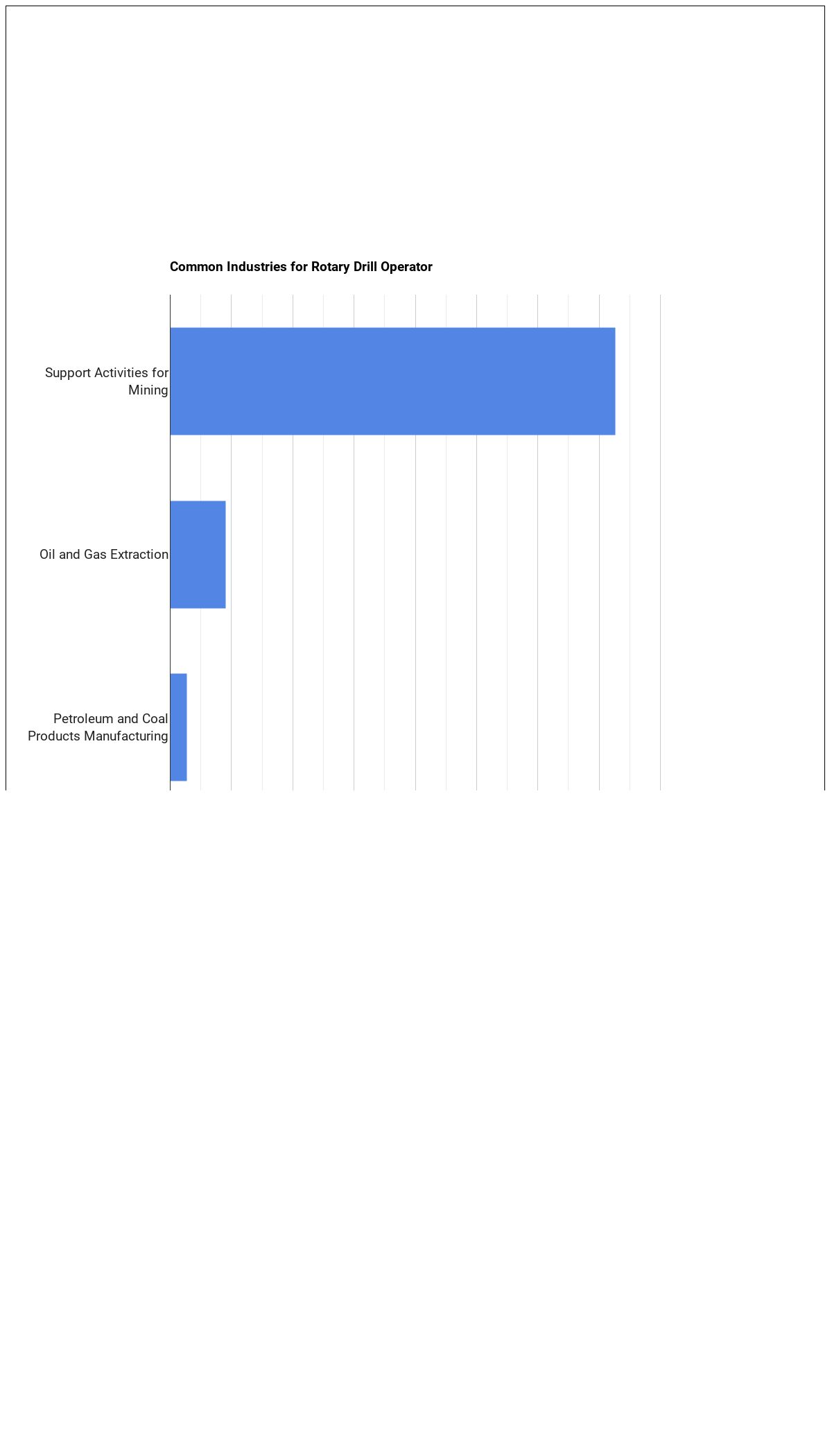
Below are examples of industries where rotary drill operators, oil and gas work:
Software Rotary Drill Operators, Oil and Gas Use
- Spreadsheet software: Microsoft Excel (hot technology)
- Office suite software: Microsoft Office software (hot technology)
- Word processing software: Microsoft Word (hot technology)
- Object or component oriented development software: Python (hot technology)
- Customer relationship management CRM software: Salesforce software (hot technology)
- Enterprise resource planning ERP software: SAP software (hot technology)
The Day-to-Day Environment
Daily working conditions for rotary drill operators, oil and gas reflects the following characteristics:
- Wear Common Protective or Safety Equipment such as Safety Shoes, Glasses, Gloves, Hearing Protection, Hard Hats, or Life Jackets
- Outdoors, Exposed to All Weather Conditions
- Face-to-Face Discussions with Individuals and Within Teams
- Exposed to Sounds, Noise Levels that are Distracting or Uncomfortable
- Work With or Contribute to a Work Group or Team
How to Become Rotary Drill Operators, Oil and Gas
Typical rotary drill operators, oil and gas positions require less than a high school diploma as the typical entry-level education. This career aligns with Some Preparation Needed (Job Zone 2), signaling the level of preparation typically expected.
Similar Occupations
Similar Occupations
- Operating Engineers and Other Construction Equipment Operators (Supplemental)
- Plumbers, Pipefitters, and Steamfitters (Supplemental)
- Derrick Operators, Oil and Gas (Primary-Long)
- Service Unit Operators, Oil and Gas (Primary-Short)
- Excavating and Loading Machine and Dragline Operators, Surface Mining (Supplemental)
- Earth Drillers, Except Oil and Gas (Primary-Short)
- Explosives Workers, Ordnance Handling Experts, and Blasters (Supplemental)
- Continuous Mining Machine Operators (Primary-Long)
Where to Study
Future rotary drill operators, oil and gas commonly pursue programs in:
Construction Trades
1 programs across 1 majors
References
Statistics shown above are sourced from the following authoritative sources:
- U.S. Bureau of Labor Statistics — Occupational Employment and Wage Statistics (OEWS) for employment and wage data by state and industry.
- BLS Employment Projections for total employment and growth forecasts.
- O*NET (Occupational Information Network) for skills, knowledge, tasks, work activities, work context, technology, and education-zone data.
SOC code: 47-5012.00 (Rotary Drill Operators, Oil and Gas).

TradeCollege.org provides higher-education, college and university, degree, program, career, salary, and other helpful information to students, faculty, institutions, and other internet audiences. Presented information and data are subject to change. Inclusion on this website does not imply or represent a direct relationship with the company, school, or brand. Information, though believed correct at time of publication, may not be correct, and no warranty is provided. Contact the schools to verify any information before relying on it. Financial aid may be available for those who qualify. TradeCollege.org is a for-profit site, and the displayed options may include sponsored or recommended results, not necessarily based on your preferences.
© TradeCollege.org – All Rights Reserved.