Find Trade Colleges
Pourers and Casters, Metal: Career Profile
Operate hand-controlled mechanisms to pour and regulate the flow of molten metal into molds to produce castings or ingots.
What Tasks Do Pourers and Casters, Metal Take On?
The core tasks performed by pourers and casters, metal span:
- Pour and regulate the flow of molten metal into molds and forms to produce ingots or other castings, using ladles or hand-controlled mechanisms.
- Read temperature gauges and observe color changes, adjusting furnace flames, torches, or electrical heating units as necessary to melt metal to specifications.
- Remove solidified steel or slag from pouring nozzles, using long bars or oxygen burners.
- Examine molds to ensure they are clean, smooth, and properly coated.
- Collect samples, or signal workers to sample metal for analysis.
- Load specified amounts of metal and flux into furnaces or clay crucibles.
- Position equipment such as ladles, grinding wheels, pouring nozzles, or crucibles, or signal other workers to position equipment.
- Skim slag or remove excess metal from ingots or equipment, using hand tools, strainers, rakes, or burners, collecting scrap for recycling.
What Pourers and Casters, Metal Need to Know
Effective pourers and casters, metal combine a mix of skills and domain knowledge.
Key Skills
These are the skills most important for this role, rated on an importance scale of 0 to 5:
Core Knowledge
Related Job Titles
Common job titles for this role include:
- Aluminum Pourer
- Billet Header
- Brass Pourer
- Buggy Ladle Tender
- Bull Ladle Tender
- Busher
- Caster
- Casting Machine Operator
Job Outlook
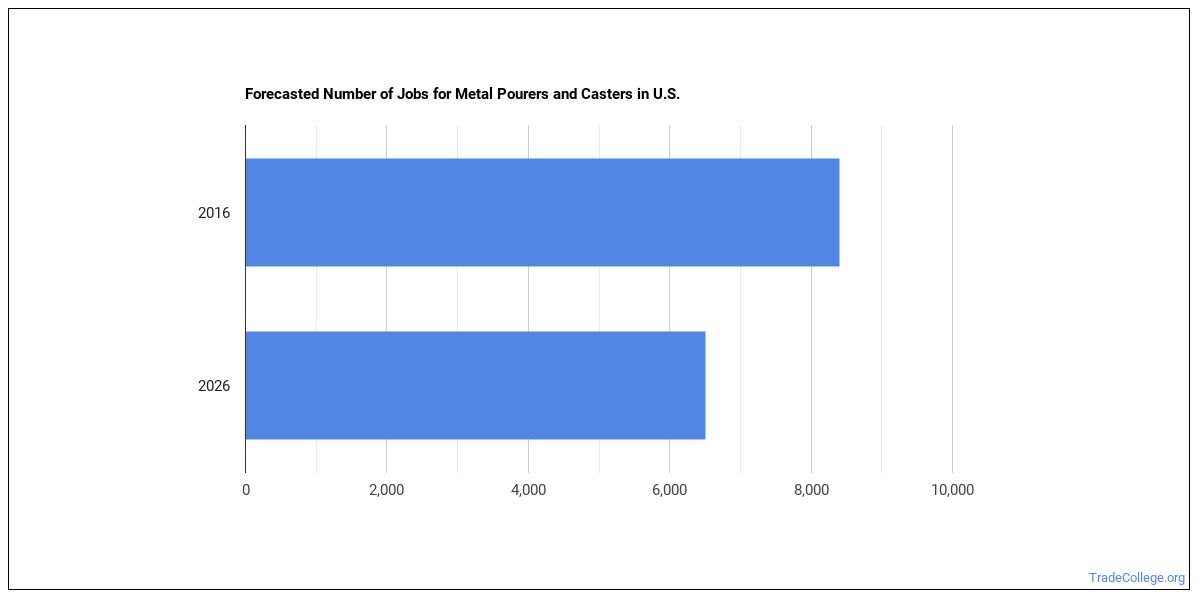
There are roughly 374,992 pourers and casters, metal working in the United States today. Demand is forecast to grow by +11.3% over the projection horizon.
Salary for Pourers and Casters, Metal
| Statistic | Value |
|---|---|
| Annual median | $48,955 |
| Hourly median | $23.54 |
| 10th percentile | $29,491 |
| 25th percentile | $39,223 |
| 75th percentile | $58,686 |
| 90th percentile | $68,418 |
Compensation varies based on experience, location, and industry.

Pay by State
| State | Annual median salary |
|---|---|
| Florida | $62,080 |
| Massachusetts | $58,910 |
| North Carolina | $58,640 |
| Michigan | $57,690 |
| Georgia | $56,190 |
| Illinois | $56,090 |
| Iowa | $54,320 |
| Indiana | $54,110 |
| Oregon | $50,230 |
| New York | $49,720 |
| Texas | $48,800 |
| Ohio | $47,310 |
| Missouri | $47,210 |
| Tennessee | $47,100 |
| Wisconsin | $46,170 |
| Virginia | $45,480 |
| Kentucky | $44,700 |
| West Virginia | $44,700 |
| Utah | $44,450 |
| Pennsylvania | $44,060 |
| California | $40,770 |
| Arkansas | $40,300 |
| Alabama | $39,210 |
Where Pourers and Casters, Metal Earn the Most
Compensation for pourers and casters, metal shift depending on where you work. Top regions by median wage:
| Region | Median annual wage | Share of U.S. jobs | Location quotient |
|---|---|---|---|
| New England | $58,910 | 2.2% | 0.87 |
| Great Lakes | $52,445 | 50.4% | 4.95 |
| Plains States | $50,765 | 4.1% | 1.44 |
| Southwest | $48,800 | 8.9% | 0.92 |
| Southeast | $44,761 | 14.6% | 1.67 |
| Rocky Mountains | $44,450 | 0.7% | 0.59 |
| Middle Atlantic | $44,374 | 13.3% | 2.83 |
| Far Western US | $42,600 | 5.7% | 0.45 |
Top Metro Areas
| Metro area | State | Median annual wage | Employment |
|---|---|---|---|
| Boston-Cambridge-Newton, MA-NH | MA | $64,090 | 90 |
| Chicago-Naperville-Elgin, IL-IN | IL | $59,850 | 490 |
| Providence-Warwick, RI-MA | RI | $53,720 | 40 |
| Dallas-Fort Worth-Arlington, TX | TX | $49,770 | 110 |
| Allentown-Bethlehem-Easton, PA-NJ | PA | $48,930 | 70 |
| Indianapolis-Carmel-Greenwood, IN | IN | $48,320 | 140 |
| Lancaster, PA | PA | $46,070 | 30 |
| Elkhart-Goshen, IN | IN | $45,440 | 40 |
Which Industries Hire Pourers and Casters, Metal
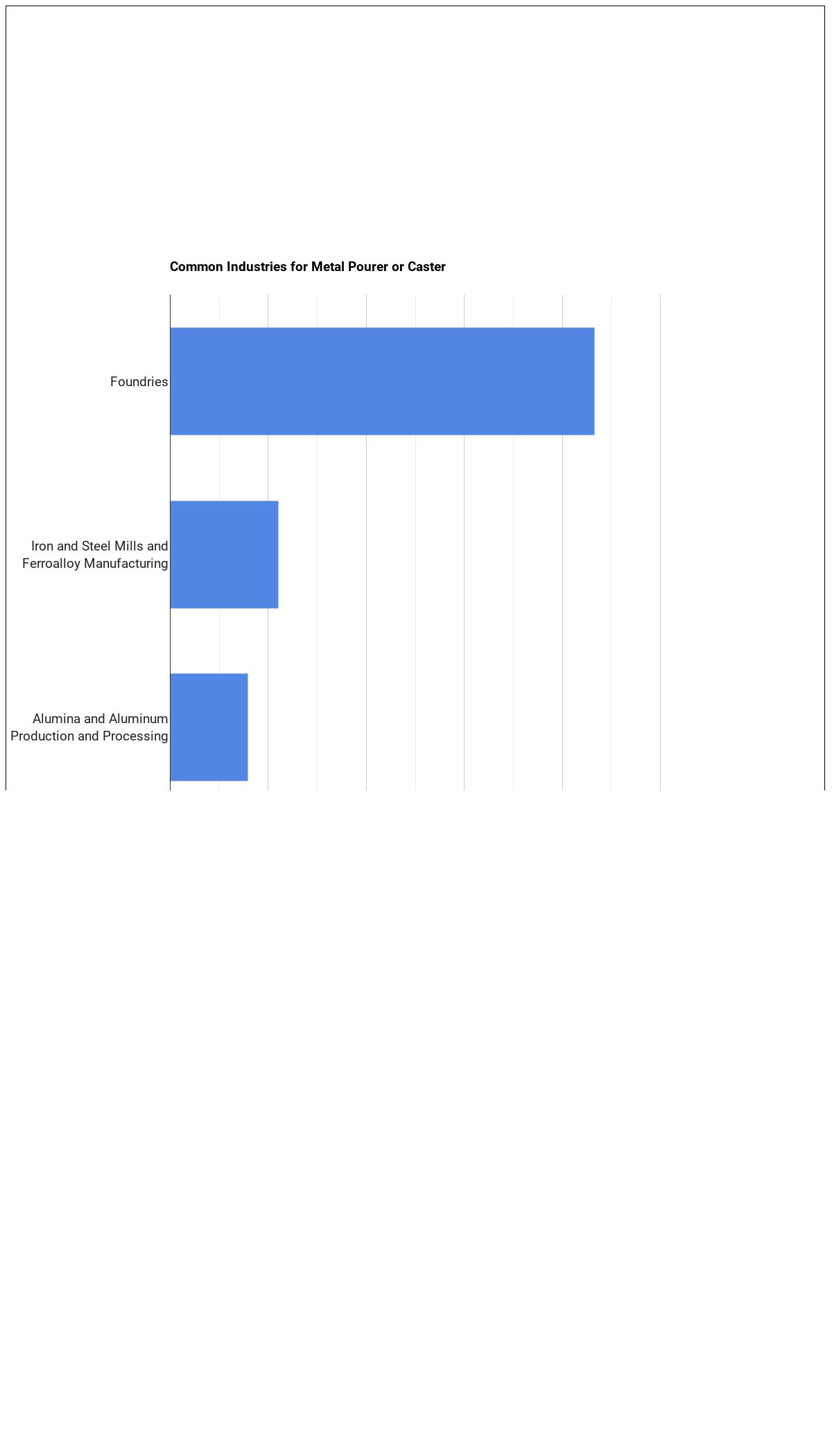
The bulk of pourers and casters, metal are concentrated in the following sectors:
| Industry | Employment | Median annual wage |
|---|---|---|
| Manufacturing | 5,720 | $48,990 |
| Administrative and Support and Waste Management and Remediation Services | 70 | $37,300 |

Pourers and Casters, Metal work in the following industries:
Software Pourers and Casters, Metal Use
- Spreadsheet software: Microsoft Excel (hot technology)
- Electronic mail software: Microsoft Outlook (hot technology)
- Presentation software: Microsoft PowerPoint (hot technology)
- Word processing software: Microsoft Word (hot technology)
Work Environment
The on-the-job environment of pourers and casters, metal tends to involve the following characteristics:
- Wear Common Protective or Safety Equipment such as Safety Shoes, Glasses, Gloves, Hearing Protection, Hard Hats, or Life Jackets
- Indoors, Not Environmentally Controlled
- Spend Time Standing
- Face-to-Face Discussions with Individuals and Within Teams
- Exposed to Minor Burns, Cuts, Bites, or Stings
How to Become Pourers and Casters, Metal
Most pourers and casters, metal positions require a high school diploma or equivalent as the typical entry-level education. This occupation sits in Some Preparation Needed (Job Zone 2), reflecting the level of preparation typically expected.
Other Careers to Consider
Similar Occupations
- Maintenance Workers, Machinery (Supplemental)
- Refractory Materials Repairers, Except Brickmasons (Supplemental)
- Extruding and Drawing Machine Setters, Operators, and Tenders, Metal and Plastic (Supplemental)
- Forging Machine Setters, Operators, and Tenders, Metal and Plastic (Primary-Short)
- Rolling Machine Setters, Operators, and Tenders, Metal and Plastic (Primary-Short)
- Cutting, Punching, and Press Machine Setters, Operators, and Tenders, Metal and Plastic (Supplemental)
- Grinding, Lapping, Polishing, and Buffing Machine Tool Setters, Operators, and Tenders, Metal and Plastic (Supplemental)
- Metal-Refining Furnace Operators and Tenders (Primary-Long)
References
Statistics shown above are sourced from the following authoritative sources:
- U.S. Bureau of Labor Statistics — Occupational Employment and Wage Statistics (OEWS) for employment and wage data by state and industry.
- BLS Employment Projections for total employment and growth forecasts.
- O*NET (Occupational Information Network) for skills, knowledge, tasks, work activities, work context, technology, and education-zone data.
SOC code: 51-4052.00 (Pourers and Casters, Metal).

TradeCollege.org provides higher-education, college and university, degree, program, career, salary, and other helpful information to students, faculty, institutions, and other internet audiences. Presented information and data are subject to change. Inclusion on this website does not imply or represent a direct relationship with the company, school, or brand. Information, though believed correct at time of publication, may not be correct, and no warranty is provided. Contact the schools to verify any information before relying on it. Financial aid may be available for those who qualify. TradeCollege.org is a for-profit site, and the displayed options may include sponsored or recommended results, not necessarily based on your preferences.
© TradeCollege.org – All Rights Reserved.