Find Trade Colleges
Fallers: Career Profile
Use axes or chainsaws to fell trees using knowledge of tree characteristics and cutting techniques to control direction of fall and minimize tree damage.
The Daily Work of Fallers Perform?
The day-to-day responsibilities of fallers span:
- Stop saw engines, pull cutting bars from cuts, and run to safety as tree falls.
- Appraise trees for certain characteristics, such as twist, rot, and heavy limb growth, and gauge amount and direction of lean, to determine how to control the direction of a tree's fall with the least damage.
- Saw back-cuts, leaving sufficient sound wood to control direction of fall.
- Clear brush from work areas and escape routes, and cut saplings and other trees from direction of falls, using axes, chainsaws, or bulldozers.
- Measure felled trees and cut them into specified log lengths, using chain saws and axes.
- Assess logs after cutting to ensure that the quality and length are correct.
- Determine position, direction, and depth of cuts to be made, and placement of wedges or jacks.
- Control the direction of a tree's fall by scoring cutting lines with axes, sawing undercuts along scored lines with chainsaws, knocking slabs from cuts with single-bit axes, and driving wedges.
What Fallers Need to Know
Top fallers combine a mix of skills and domain knowledge.
Most Important Skills
These are the skills most central to this role, rated on an importance scale of 0 to 5:
Knowledge Areas
Other Fallers Job Titles
Common job titles for this role include:
- All-Round Logger
- Arborist
- Arborist Assistant
- Arborist Climber
- Arborist Representative
- Axman
- Certified Arborist
- Chain Saw Operator
Employment and Demand
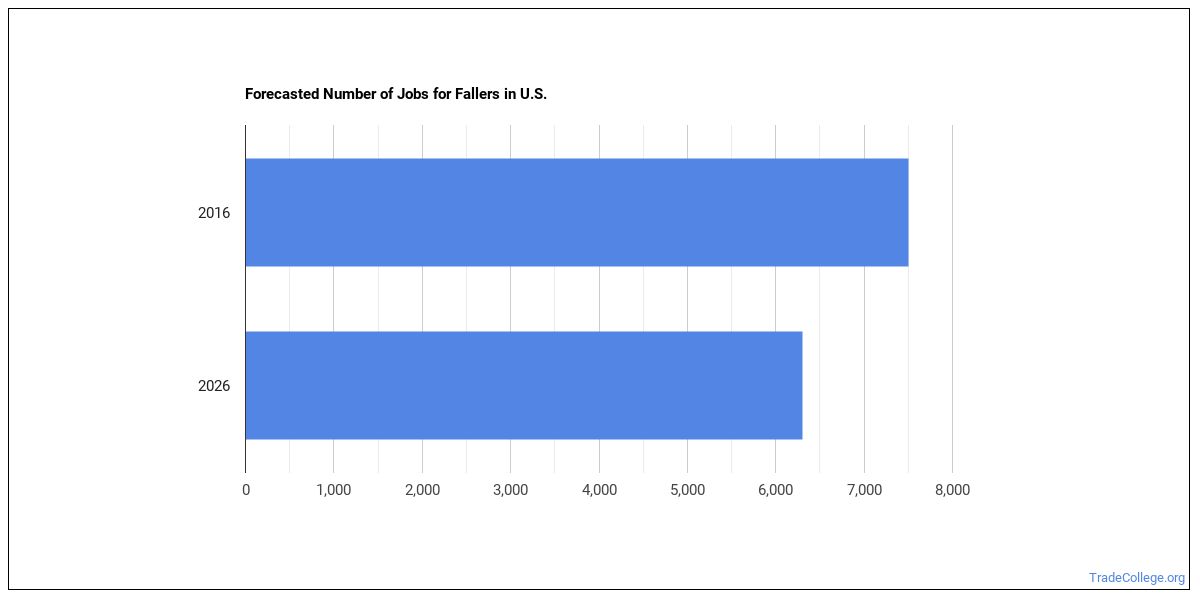
The U.S. employs around 47,788 fallers working in the United States today. Demand is forecast to grow by +2.9% over the projection horizon.
Fallers Pay
| Statistic | Value |
|---|---|
| Annual median | $29,983 |
| Hourly median | $14.42 |
| 10th percentile | $21,113 |
| 25th percentile | $25,548 |
| 75th percentile | $34,419 |
| 90th percentile | $38,854 |
Wages vary widely based on experience, location, and industry.

Fallers Salary by State
| State | Annual median salary |
|---|---|
| Oregon | $84,770 |
| Washington | $76,220 |
| Idaho | $73,700 |
| Arkansas | $64,170 |
| California | $62,020 |
| Indiana | $61,140 |
| South Carolina | $60,050 |
| Maryland | $58,570 |
| Minnesota | $58,260 |
| Alabama | $57,090 |
| New Hampshire | $56,920 |
| Montana | $55,890 |
| Ohio | $53,900 |
| Michigan | $52,010 |
| North Carolina | $51,860 |
| Mississippi | $51,790 |
| Wisconsin | $49,840 |
| Tennessee | $47,850 |
| Virginia | $47,070 |
| Pennsylvania | $43,470 |
| Colorado | $43,440 |
| Georgia | $38,970 |
| New York | $35,820 |
Pay by U.S. Region
Pay for fallers shift depending on where you work. The following regions pay the most:
| Region | Median annual wage | Share of U.S. jobs | Location quotient |
|---|---|---|---|
| Far Western US | $74,185 | 22.8% | 2.60 |
| New England | $56,920 | 1.3% | 2.02 |
| Great Lakes | $52,855 | 18.1% | 3.83 |
| Rocky Mountains | $51,221 | 2.7% | 2.34 |
| Southeast | $49,326 | 52.7% | 3.40 |
| Middle Atlantic | $43,470 | 2.3% | 0.44 |
Top Metro Areas
| Metro area | State | Median annual wage | Employment |
|---|---|---|---|
| Medford, OR | OR | $135,600 | 30 |
| Portland-Vancouver-Hillsboro, OR-WA | OR | $84,590 | 50 |
| Boise City, ID | ID | $61,940 | |
| Richmond, VA | VA | $47,120 | 50 |
| Lynchburg, VA | VA | $46,140 | 40 |
Which Industries Hire Fallers
The largest employers of fallers are concentrated in the following sectors:
| Industry | Employment | Median annual wage |
|---|---|---|
| Agriculture, Forestry, Fishing and Hunting | 2,620 | $56,980 |
| Administrative and Support and Waste Management and Remediation Services | 1,140 | $52,890 |

Below are examples of industries where fallers work:

Software Fallers Use
- Spreadsheet software: Microsoft Excel (hot technology)
- Office suite software: Microsoft Office software (hot technology)
- Electronic mail software: Microsoft Outlook (hot technology)
- Presentation software: Microsoft PowerPoint (hot technology)
- Word processing software: Microsoft Word (hot technology)
What the Workplace Is Like
The work environment for fallers tends to involve the following characteristics:
- Wear Common Protective or Safety Equipment such as Safety Shoes, Glasses, Gloves, Hearing Protection, Hard Hats, or Life Jackets
- Outdoors, Exposed to All Weather Conditions
- Exposed to Hazardous Equipment
- Spend Time Using Your Hands to Handle, Control, or Feel Objects, Tools, or Controls
- Freedom to Make Decisions
Getting Started in This Career
Typical fallers positions require less than a high school diploma as the typical entry-level education. This career aligns with Some Preparation Needed (Job Zone 2), signaling the level of preparation typically expected.
Similar Occupations
Similar Occupations
- Foresters (Supplemental)
- Forest and Conservation Technicians (Primary-Long)
- Landscaping and Groundskeeping Workers (Primary-Long)
- Tree Trimmers and Pruners (Primary-Short)
- First-Line Supervisors of Farming, Fishing, and Forestry Workers (Supplemental)
- Agricultural Equipment Operators (Primary-Long)
- Farmworkers and Laborers, Crop, Nursery, and Greenhouse (Primary-Long)
- Forest and Conservation Workers (Primary-Short)
Sources
Data on this page comes from the following authoritative sources:
- U.S. Bureau of Labor Statistics — Occupational Employment and Wage Statistics (OEWS) for employment and wage data by state and industry.
- BLS Employment Projections for total employment and growth forecasts.
- O*NET (Occupational Information Network) for skills, knowledge, tasks, work activities, work context, technology, and education-zone data.
SOC code: 45-4021.00 (Fallers).

TradeCollege.org provides higher-education, college and university, degree, program, career, salary, and other helpful information to students, faculty, institutions, and other internet audiences. Presented information and data are subject to change. Inclusion on this website does not imply or represent a direct relationship with the company, school, or brand. Information, though believed correct at time of publication, may not be correct, and no warranty is provided. Contact the schools to verify any information before relying on it. Financial aid may be available for those who qualify. TradeCollege.org is a for-profit site, and the displayed options may include sponsored or recommended results, not necessarily based on your preferences.
© TradeCollege.org – All Rights Reserved.