Find Trade Colleges
Electromechanical Equipment Assemblers: Career Profile
Assemble or modify electromechanical equipment or devices, such as servomechanisms, gyros, dynamometers, magnetic drums, tape drives, brakes, control linkage, actuators, and appliances.
What Tasks Do Electromechanical Equipment Assemblers Perform?
The day-to-day responsibilities of electromechanical equipment assemblers span:
- Inspect, test, and adjust completed units to ensure that units meet specifications, tolerances, and customer order requirements.
- Position, align, and adjust parts for proper fit and assembly.
- Assemble parts or units, and position, align, and fasten units to assemblies, subassemblies, or frames, using hand tools and power tools.
- Connect cables, tubes, and wiring, according to specifications.
- Measure parts to determine tolerances, using precision measuring instruments such as micrometers, calipers, and verniers.
- Read blueprints and specifications to determine component parts and assembly sequences of electromechanical units.
- Attach name plates and mark identifying information on parts.
- Disassemble units to replace parts or to crate them for shipping.
Key Skills and Knowledge
Effective electromechanical equipment assemblers draw on a mix of skills and domain knowledge.
Most Important Skills
The abilities that matter most in this role, rated on an importance scale of 0 to 5:
Knowledge Areas
Types of Electromechanical Equipment Assemblers Jobs
This career also goes by job titles like:
- Air-Conditioning Coil Assembler (AC Coil Assembler)
- Appliance Assembler
- Assembler
- Bearing Ring Assembler
- Bench Precision Assembler
- Burglar Alarm Assembler
- Electrical Assembler
- Electrical Machine Builder
Job Outlook
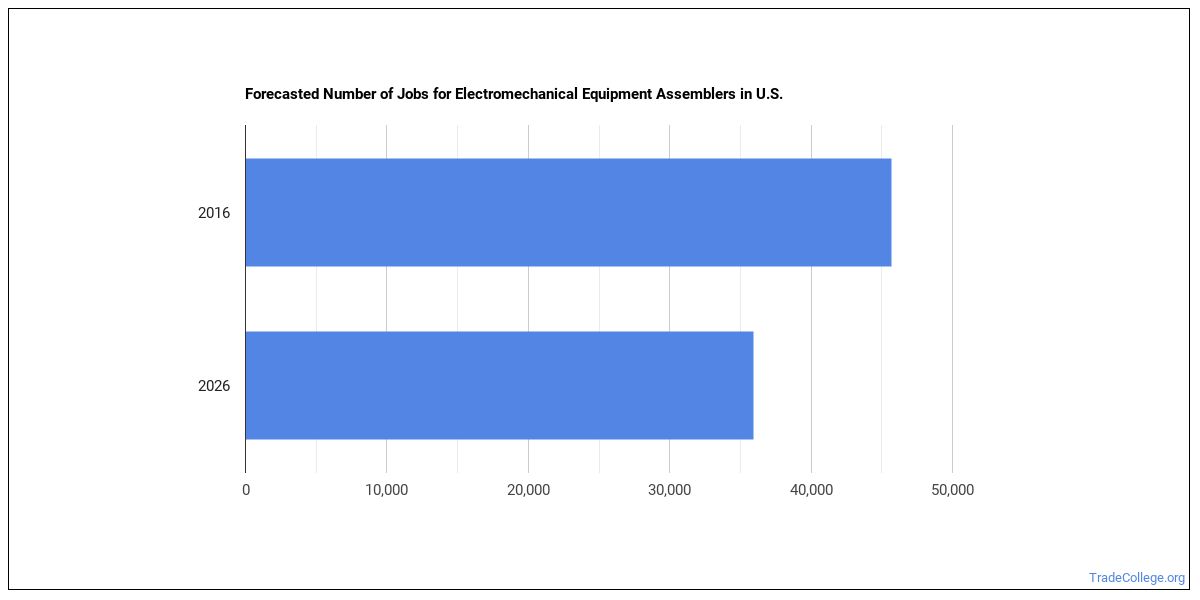
The U.S. employs around 147,767 electromechanical equipment assemblers working in the United States today. Employment is projected to decline by -4.0% over the projection horizon.
Salary for Electromechanical Equipment Assemblers
| Statistic | Value |
|---|---|
| Annual median | $68,500 |
| Hourly median | $32.93 |
| 10th percentile | $47,352 |
| 25th percentile | $57,926 |
| 75th percentile | $79,074 |
| 90th percentile | $89,648 |
Compensation varies based on experience, location, and industry.

Tools and Technology
- Computer aided design CAD software: Autodesk AutoCAD (hot technology)
- Spreadsheet software: Microsoft Excel (hot technology)
- Office suite software: Microsoft Office software (hot technology)
- Word processing software: Microsoft Word (hot technology)
- Enterprise resource planning ERP software: SAP software (hot technology)
Work Environment
The on-the-job environment of electromechanical equipment assemblers tends to involve the following characteristics:
- Indoors, Environmentally Controlled
- Wear Common Protective or Safety Equipment such as Safety Shoes, Glasses, Gloves, Hearing Protection, Hard Hats, or Life Jackets
- Face-to-Face Discussions with Individuals and Within Teams
- Spend Time Using Your Hands to Handle, Control, or Feel Objects, Tools, or Controls
- Work With or Contribute to a Work Group or Team
How to Become Electromechanical Equipment Assemblers
Typical electromechanical equipment assemblers positions require a high school diploma or equivalent as the typical entry-level education. The role falls in Some Preparation Needed (Job Zone 2), indicating the level of preparation typically expected.
Related Careers
Similar Occupations
- Electronics Engineers, Except Computer (Supplemental)
- Electrical and Electronic Engineering Technologists and Technicians (Primary-Long)
- Robotics Technicians (Primary-Long)
- Calibration Technologists and Technicians (Primary-Long)
- Electric Motor, Power Tool, and Related Repairers (Primary-Short)
- Electrical and Electronics Installers and Repairers, Transportation Equipment (Supplemental)
- Electrical and Electronics Repairers, Commercial and Industrial Equipment (Primary-Long)
- Control and Valve Installers and Repairers, Except Mechanical Door (Supplemental)
References
This profile draws on the following authoritative sources:
- U.S. Bureau of Labor Statistics — Occupational Employment and Wage Statistics (OEWS) for employment and wage data by state and industry.
- BLS Employment Projections for total employment and growth forecasts.
- O*NET (Occupational Information Network) for skills, knowledge, tasks, work activities, work context, technology, and education-zone data.
SOC code: 51-2023.00 (Electromechanical Equipment Assemblers).

TradeCollege.org provides higher-education, college and university, degree, program, career, salary, and other helpful information to students, faculty, institutions, and other internet audiences. Presented information and data are subject to change. Inclusion on this website does not imply or represent a direct relationship with the company, school, or brand. Information, though believed correct at time of publication, may not be correct, and no warranty is provided. Contact the schools to verify any information before relying on it. Financial aid may be available for those who qualify. TradeCollege.org is a for-profit site, and the displayed options may include sponsored or recommended results, not necessarily based on your preferences.
© TradeCollege.org – All Rights Reserved.