Find Trade Colleges
Dredge Operators: Career Overview
Operate dredge to remove sand, gravel, or other materials in order to excavate and maintain navigable channels in waterways.
What Do Dredge Operators Take On?
The core tasks performed by dredge operators span:
- Move levers to position dredges for excavation, to engage hydraulic pumps, to raise and lower suction booms, and to control rotation of cutterheads.
- Start and stop engines to operate equipment.
- Start power winches that draw in or let out cables to change positions of dredges, or pull in and let out cables manually.
- Pump water to clear machinery pipelines.
- Lower anchor poles to verify depths of excavations, using winches, or scan depth gauges to determine depths of excavations.
- Direct or assist workers placing shore anchors and cables, laying additional pipes from dredges to shore, and pumping water from pontoons.
Skills and Knowledge
Successful dredge operators combine a mix of skills and domain knowledge.
Most Important Skills
These are the skills that matter most in this role, rated on an importance scale of 0 to 5:
Core Knowledge
Other Dredge Operators Job Titles
People in this occupation may also be known by titles such as:
- Dredge Boat Engineer
- Dredge Deckhand
- Dredge Engineer
- Dredge Hand
- Dredge Lever Operator
- Dredge Mate
- Dredge Operator
- Dredge Worker
Job Outlook
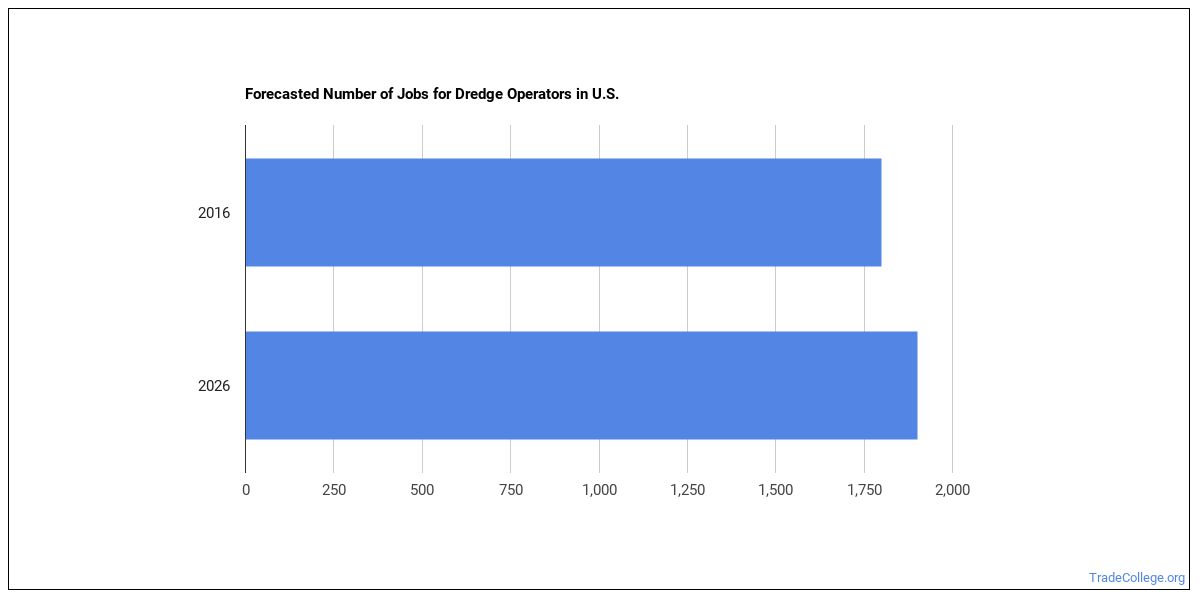
There are about 835,620 dredge operators working in the United States today. This occupation is expected to grow by +12.3% over the projection horizon.
How Much Do Dredge Operators Make?
| Statistic | Value |
|---|---|
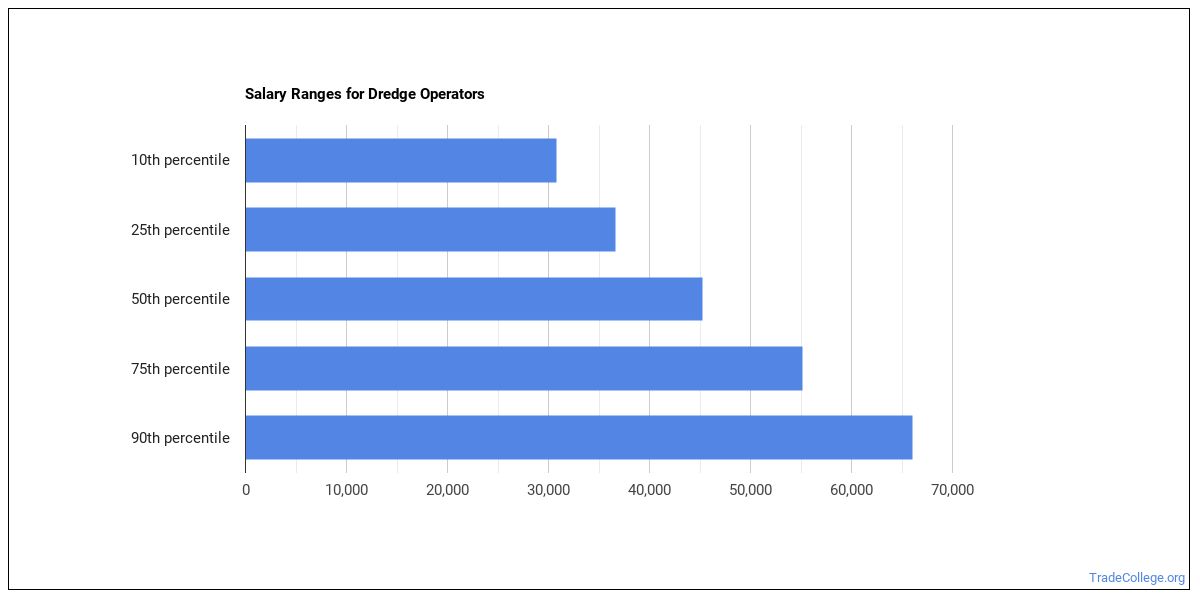
| Annual median | $55,307 |
| Hourly median | $26.59 |
| 10th percentile | $34,954 |
| 25th percentile | $45,130 |
| 75th percentile | $65,484 |
| 90th percentile | $75,660 |
Pay can vary substantially based on experience, location, and industry.
How Much Do Dredge Operators Make in Different U.S. States?
| State | Annual median salary |
|---|---|
| New Jersey | $70,400 |
| Iowa | $60,400 |
| Indiana | $55,470 |
| Florida | $52,640 |
| Ohio | $51,210 |
| Alabama | $51,110 |
| Louisiana | $47,360 |
| North Carolina | $46,650 |
| Nebraska | $43,320 |
Pay by U.S. Region
Compensation for dredge operators shift depending on where you work. The following regions pay the most:
| Region | Median annual wage | Share of U.S. jobs | Location quotient |
|---|---|---|---|
| Middle Atlantic | $70,400 | 16.0% | 2.73 |
| Plains States | $54,706 | 18.0% | 5.68 |
| Great Lakes | $53,103 | 18.0% | 1.50 |
| Southeast | $49,942 | 48.0% | 4.45 |
Top Industries Employing Dredge Operators
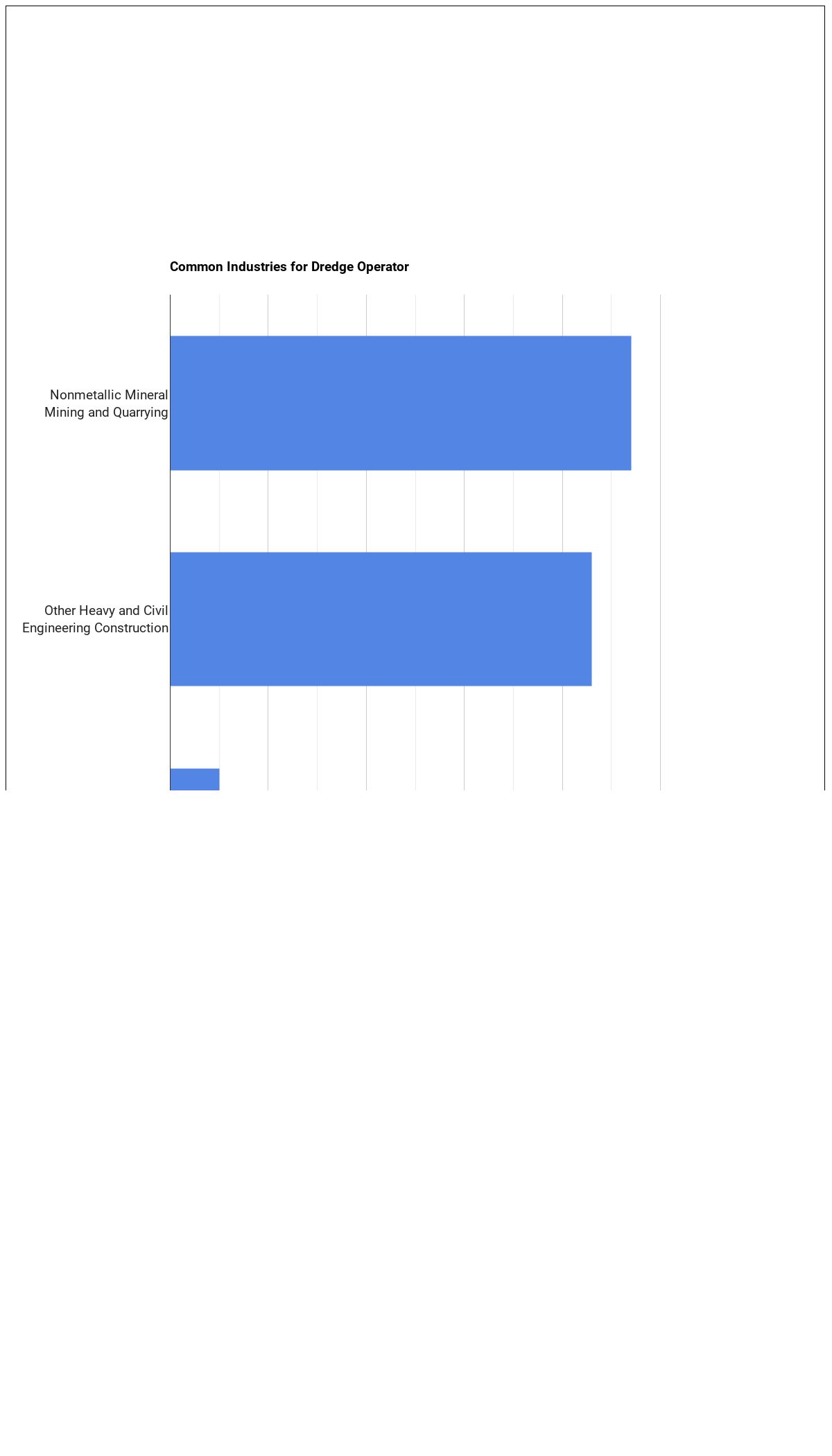
Most dredge operators work in these industries:
| Industry | Employment | Median annual wage |
|---|---|---|
| Construction | 510 | $47,360 |
| Mining, Quarrying, and Oil and Gas Extraction | 320 | $56,940 |

The table below shows some of the most common industries where those employed in this career field work.
Tools and Technology
- Mobile location based services software: Global positioning system GPS software
- Industrial control software: HYPACK DREDGEPACK
- Industrial control software: Programmable logic controller PLC software
- Data base user interface and query software: Teledyne Odom Hydrographic ODOM eChart
- Map creation software: Trimble HYDROpro
- Internet browser software: Web browser software
What the Workplace Is Like
The work environment for dredge operators tends to involve the following characteristics:
- Wear Common Protective or Safety Equipment such as Safety Shoes, Glasses, Gloves, Hearing Protection, Hard Hats, or Life Jackets
- Face-to-Face Discussions with Individuals and Within Teams
- Spend Time Using Your Hands to Handle, Control, or Feel Objects, Tools, or Controls
- Outdoors, Exposed to All Weather Conditions
- Exposed to Sounds, Noise Levels that are Distracting or Uncomfortable
Getting Started in This Career
Most dredge operators positions require a high school diploma or equivalent as the typical entry-level education. This career aligns with Some Preparation Needed (Job Zone 2), reflecting the level of preparation typically expected.
Similar Occupations
Similar Occupations
- Construction Laborers (Supplemental)
- Pile Driver Operators (Supplemental)
- Operating Engineers and Other Construction Equipment Operators (Primary-Short)
- Derrick Operators, Oil and Gas (Primary-Long)
- Rotary Drill Operators, Oil and Gas (Primary-Short)
- Service Unit Operators, Oil and Gas (Supplemental)
- Excavating and Loading Machine and Dragline Operators, Surface Mining (Primary-Short)
- Earth Drillers, Except Oil and Gas (Primary-Long)
Top Programs to Study For This Career
Students preparing for dredge operators commonly pursue programs in:
Transportation and Materials Moving
1 programs across 1 majors
Sources
This profile draws on the following authoritative sources:
- U.S. Bureau of Labor Statistics — Occupational Employment and Wage Statistics (OEWS) for employment and wage data by state and industry.
- BLS Employment Projections for total employment and growth forecasts.
- O*NET (Occupational Information Network) for skills, knowledge, tasks, work activities, work context, technology, and education-zone data.
SOC code: 53-7031.00 (Dredge Operators).

TradeCollege.org provides higher-education, college and university, degree, program, career, salary, and other helpful information to students, faculty, institutions, and other internet audiences. Presented information and data are subject to change. Inclusion on this website does not imply or represent a direct relationship with the company, school, or brand. Information, though believed correct at time of publication, may not be correct, and no warranty is provided. Contact the schools to verify any information before relying on it. Financial aid may be available for those who qualify. TradeCollege.org is a for-profit site, and the displayed options may include sponsored or recommended results, not necessarily based on your preferences.
© TradeCollege.org – All Rights Reserved.