Find Trade Colleges
Tool and Die Makers: Career Profile
Analyze specifications, lay out metal stock, set up and operate machine tools, and fit and assemble parts to make and repair dies, cutting tools, jigs, fixtures, gauges, and machinists' hand tools.
What Do Tool and Die Makers Do?
The day-to-day responsibilities of tool and die makers span:
- Verify dimensions, alignments, and clearances of finished parts for conformance to specifications, using measuring instruments such as calipers, gauge blocks, micrometers, or dial indicators.
- Set up and operate conventional or computer numerically controlled machine tools such as lathes, milling machines, or grinders to cut, bore, grind, or otherwise shape parts to prescribed dimensions and finishes.
- Visualize and compute dimensions, sizes, shapes, and tolerances of assemblies, based on specifications.
- Study blueprints, sketches, models, or specifications to plan sequences of operations for fabricating tools, dies, or assemblies.
- Fit and assemble parts to make, repair, or modify dies, jigs, gauges, and tools, using machine tools, hand tools, or welders.
- Inspect finished dies for smoothness, contour conformity, and defects.
- Select metals to be used from a range of metals and alloys, based on properties such as hardness or heat tolerance.
- Lift, position, and secure machined parts on surface plates or worktables, using hoists, vises, v-blocks, or angle plates.
Key Skills and Knowledge
Top tool and die makers combine a mix of skills and domain knowledge.
Most Important Skills
These are the skills that matter most in this role, rated on an importance scale of 0 to 5:
Top Knowledge Areas
Types of Tool and Die Makers Jobs
Common job titles for this role include:
- Bench Tool Maker
- Broach Setter
- Cam Maker
- Carbide Operator
- Carbide Tool Maker
- Cutlery and Tools Saw Maker
- Die Assembler
- Die Baker
Employment and Demand
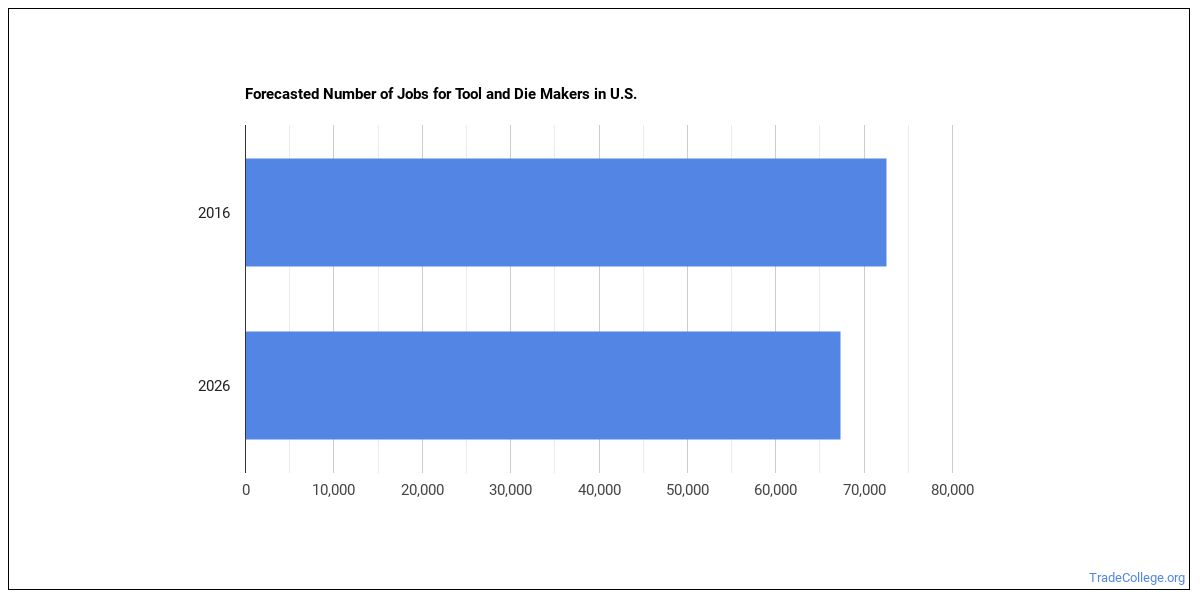
There are about 499,911 tool and die makers working in the United States today. Employment is projected to decline by -4.3% over the projection horizon.
Salary for Tool and Die Makers
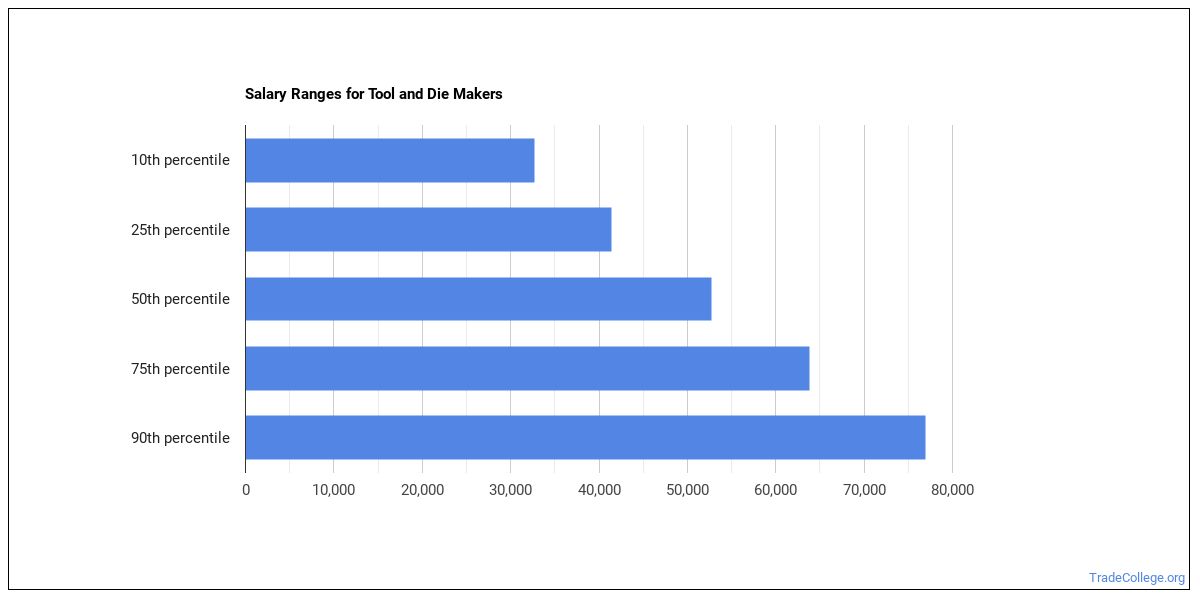
| Statistic | Value |
|---|---|
| Annual median | $46,356 |
| Hourly median | $22.29 |
| 10th percentile | $25,770 |
| 25th percentile | $36,063 |
| 75th percentile | $56,649 |
| 90th percentile | $66,942 |
Wages vary widely based on experience, location, and industry.
Pay by State
| State | Annual median salary |
|---|---|
| Kansas | $81,230 |
| Washington | $78,310 |
| California | $77,800 |
| Maine | $76,500 |
| Connecticut | $76,310 |
| New Jersey | $75,920 |
| Oregon | $69,580 |
| New Hampshire | $68,210 |
| New York | $67,790 |
| Arizona | $67,580 |
| Utah | $66,660 |
| South Carolina | $66,300 |
| North Dakota | $65,980 |
| Wisconsin | $65,850 |
| Massachusetts | $65,840 |
| Minnesota | $65,400 |
| Nebraska | $64,810 |
| Kentucky | $64,620 |
| Oklahoma | $64,080 |
| Michigan | $64,030 |
| Indiana | $63,590 |
| Alabama | $63,500 |
| Rhode Island | $63,150 |
| Colorado | $62,970 |
| Florida | $62,570 |
| Ohio | $62,540 |
| Iowa | $61,840 |
| Georgia | $61,260 |
| North Carolina | $61,130 |
| Missouri | $60,940 |
| Virginia | $60,800 |
| Tennessee | $60,690 |
| Illinois | $60,610 |
| Pennsylvania | $59,540 |
| Nevada | $59,420 |
| Vermont | $59,000 |
| South Dakota | $55,570 |
| Texas | $54,550 |
| Idaho | $54,540 |
| Maryland | $53,520 |
| Mississippi | $52,230 |
| Arkansas | $50,380 |
| West Virginia | $49,620 |
| Louisiana | $45,220 |
| Puerto Rico | $36,410 |
Where Tool and Die Makers Earn the Most
Earnings for tool and die makers differ across the country. These regions lead on median pay:
| Region | Median annual wage | Share of U.S. jobs | Location quotient |
|---|---|---|---|
| Far Western US | $75,861 | 5.7% | 0.54 |
| New England | $71,217 | 6.3% | 1.99 |
| Plains States | $65,529 | 8.8% | 1.33 |
| Middle Atlantic | $63,989 | 9.1% | 0.96 |
| Rocky Mountains | $63,418 | 0.7% | 0.21 |
| Great Lakes | $63,254 | 46.8% | 3.81 |
| Southeast | $61,659 | 18.0% | 1.45 |
| Southwest | $57,632 | 3.9% | 0.34 |
Highest-Paying Metro Areas for Tool and Die Makers
| Metro area | State | Median annual wage | Employment |
|---|---|---|---|
| Seattle-Tacoma-Bellevue, WA | WA | $103,200 | 840 |
| San Jose-Sunnyvale-Santa Clara, CA | CA | $98,080 | 40 |
| Albany-Schenectady-Troy, NY | NY | $90,140 | 70 |
| San Diego-Chula Vista-Carlsbad, CA | CA | $86,920 | 90 |
| San Francisco-Oakland-Fremont, CA | CA | $85,290 | 90 |
| Buffalo-Cheektowaga, NY | NY | $84,900 | 280 |
| Bay City, MI | MI | $84,610 | 30 |
| Kansas City, MO-KS | MO | $82,950 | 550 |
Industry Breakdown
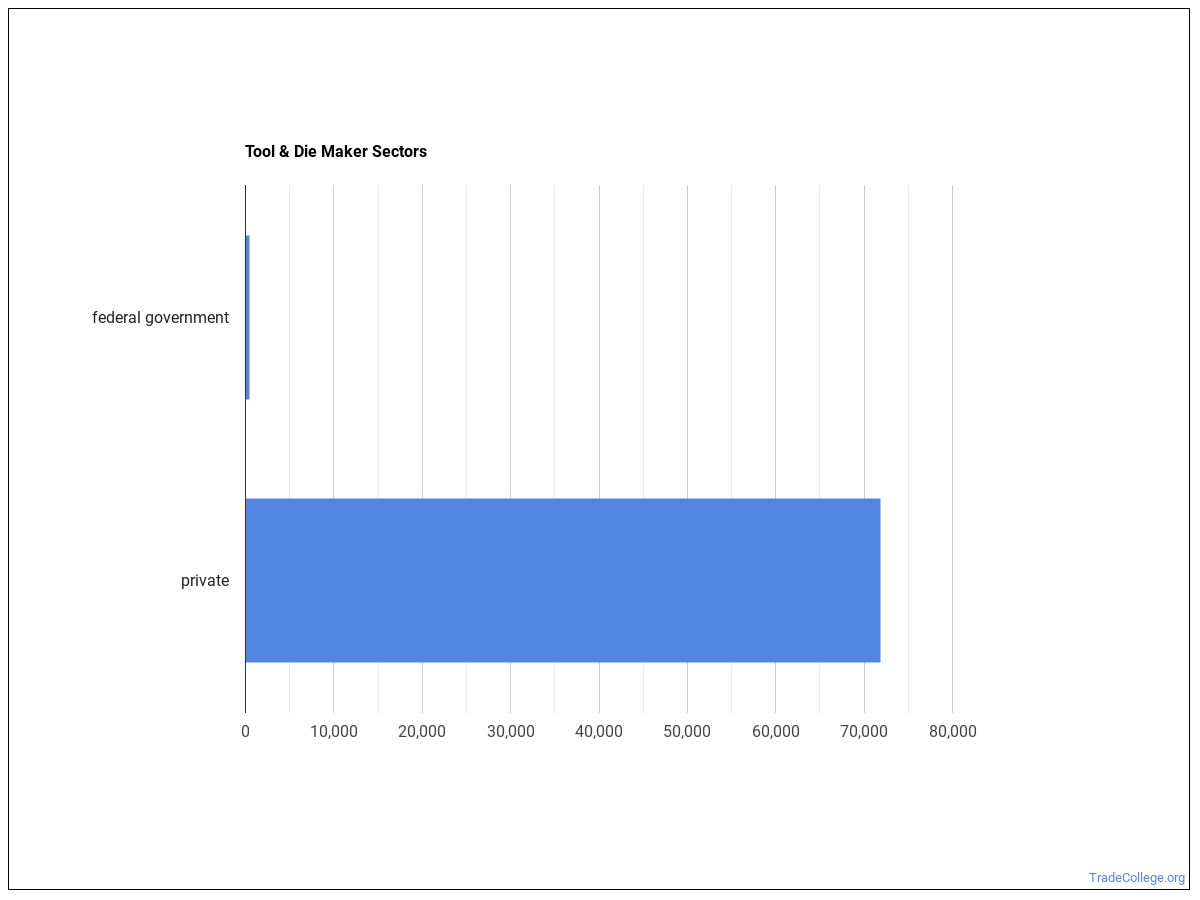
The bulk of tool and die makers work in these industries:
| Industry | Employment | Median annual wage |
|---|---|---|
| Manufacturing | 51,580 | $63,390 |
| Administrative and Support and Waste Management and Remediation Services | 1,060 | $42,670 |
| Wholesale Trade | 990 | $51,610 |
| Professional, Scientific, and Technical Services | 410 | $77,370 |
| Management of Companies and Enterprises | 250 | $66,020 |
| Construction | 100 | $53,210 |
| Transportation and Warehousing | 60 | $53,340 |
| Other Services (except Public Administration) | 60 | $80,480 |
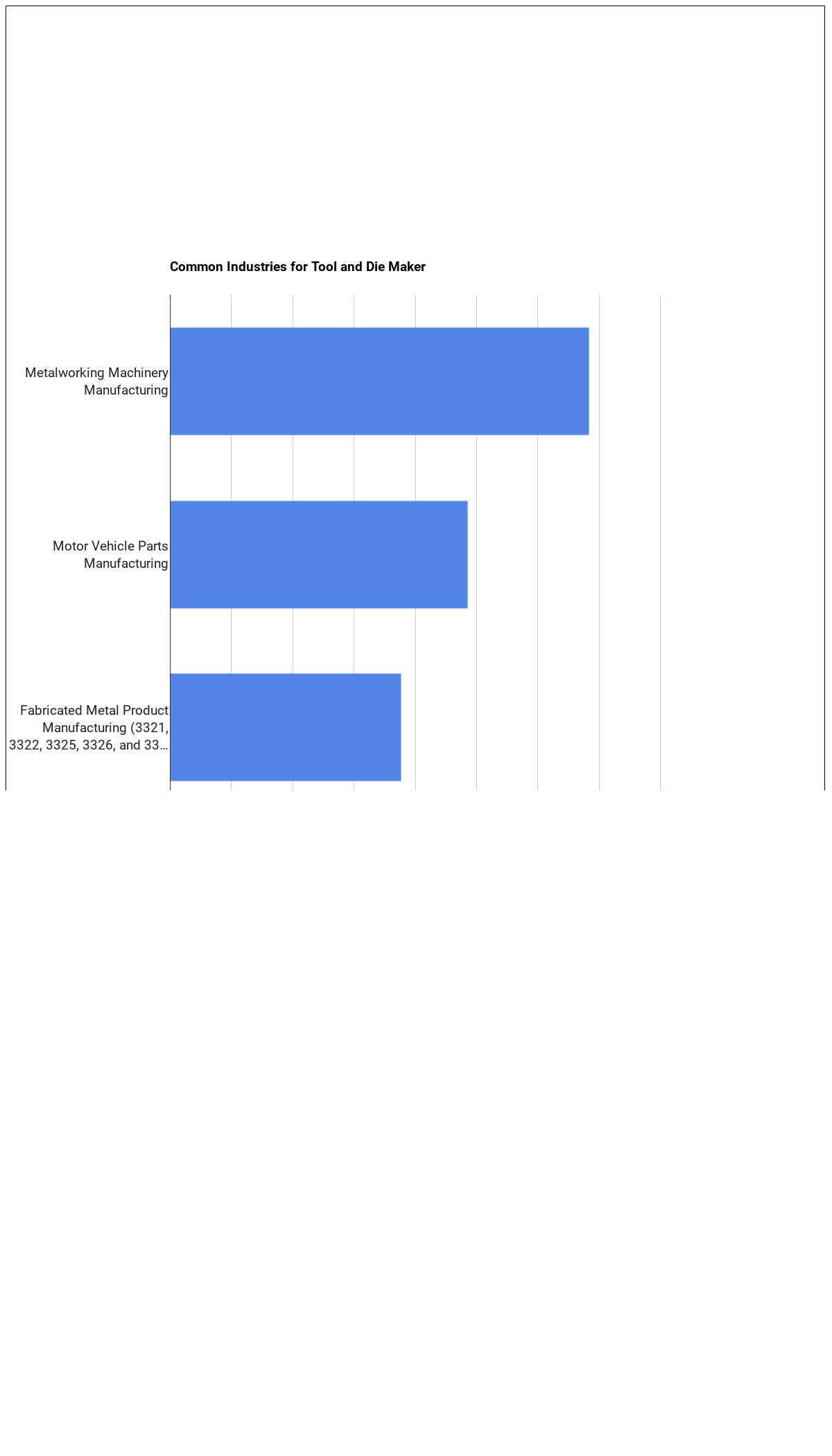
Below are examples of industries where tool and die makers work:
Tools and Technology
- Computer aided design CAD software: Autodesk AutoCAD (hot technology)
- Computer aided design CAD software: Bentley MicroStation (hot technology)
- Computer aided design CAD software: Dassault Systemes SolidWorks (hot technology)
- Spreadsheet software: Microsoft Excel (hot technology)
- Office suite software: Microsoft Office software (hot technology)
- Electronic mail software: Microsoft Outlook (hot technology)
- Presentation software: Microsoft PowerPoint (hot technology)
- Project management software: Microsoft Project (hot technology)
- Word processing software: Microsoft Word (hot technology)
- Enterprise resource planning ERP software: SAP software (hot technology)
The Day-to-Day Environment
The work environment for tool and die makers is shaped by the following characteristics:
- Wear Common Protective or Safety Equipment such as Safety Shoes, Glasses, Gloves, Hearing Protection, Hard Hats, or Life Jackets
- Importance of Being Exact or Accurate
- Freedom to Make Decisions
- Face-to-Face Discussions with Individuals and Within Teams
- Determine Tasks, Priorities and Goals
Getting Started in This Career
Most tool and die makers positions require some college, no degree as the typical entry-level education. This career aligns with Medium Preparation Needed (Job Zone 3), indicating the level of preparation typically expected.
Other Careers to Consider
Similar Occupations
- Industrial Machinery Mechanics (Supplemental)
- Structural Metal Fabricators and Fitters (Supplemental)
- Forging Machine Setters, Operators, and Tenders, Metal and Plastic (Primary-Short)
- Rolling Machine Setters, Operators, and Tenders, Metal and Plastic (Supplemental)
- Cutting, Punching, and Press Machine Setters, Operators, and Tenders, Metal and Plastic (Primary-Long)
- Drilling and Boring Machine Tool Setters, Operators, and Tenders, Metal and Plastic (Supplemental)
- Grinding, Lapping, Polishing, and Buffing Machine Tool Setters, Operators, and Tenders, Metal and Plastic (Supplemental)
- Lathe and Turning Machine Tool Setters, Operators, and Tenders, Metal and Plastic (Primary-Long)
Top Programs to Study For This Career
Aspiring tool and die makers often complete programs in:
Precision Production
1 programs across 1 majors
Sources
Data on this page comes from the following authoritative sources:
- U.S. Bureau of Labor Statistics — Occupational Employment and Wage Statistics (OEWS) for employment and wage data by state and industry.
- BLS Employment Projections for total employment and growth forecasts.
- O*NET (Occupational Information Network) for skills, knowledge, tasks, work activities, work context, technology, and education-zone data.
SOC code: 51-4111.00 (Tool and Die Makers).

TradeCollege.org provides higher-education, college and university, degree, program, career, salary, and other helpful information to students, faculty, institutions, and other internet audiences. Presented information and data are subject to change. Inclusion on this website does not imply or represent a direct relationship with the company, school, or brand. Information, though believed correct at time of publication, may not be correct, and no warranty is provided. Contact the schools to verify any information before relying on it. Financial aid may be available for those who qualify. TradeCollege.org is a for-profit site, and the displayed options may include sponsored or recommended results, not necessarily based on your preferences.
© TradeCollege.org – All Rights Reserved.