Find Trade Colleges
Sound Engineering Technicians: Career Profile
Assemble and operate equipment to record, synchronize, mix, edit, or reproduce sound, including music, voices, or sound effects, for theater, video, film, television, podcasts, sporting events, and other productions.
What Do Sound Engineering Technicians Do?
The core tasks performed by sound engineering technicians span:
- Confer with producers, performers, and others to determine and achieve the desired sound for a production, such as a musical recording or a film.
- Regulate volume level and sound quality during recording sessions, using control consoles.
- Record speech, music, and other sounds on recording media, using recording equipment.
- Separate instruments, vocals, and other sounds, and combine sounds during the mixing or postproduction stage.
- Set up, test, and adjust recording equipment for recording sessions and live performances.
- Report equipment problems and ensure that required repairs are made.
- Prepare for recording sessions by performing such activities as selecting and setting up microphones.
- Mix and edit voices, music, and taped sound effects for live performances and for prerecorded events, using sound mixing boards.
What Sound Engineering Technicians Need to Know
Successful sound engineering technicians rely on a mix of skills and domain knowledge.
Key Skills
These are the skills most central to this role, rated on an importance scale of 0 to 5:
Knowledge Areas
Types of Sound Engineering Technicians Jobs
This career also goes by job titles like:
- Acoustical Consultant
- Acoustical Engineer
- Audio DSP Engineer (Audio Digital Signal Processor Engineer)
- Audio Engineer
- Audio Operator
- Audio Recording Engineer
- Audio Technician (Audio Tech)
- Audio Video Engineer
Employment and Demand
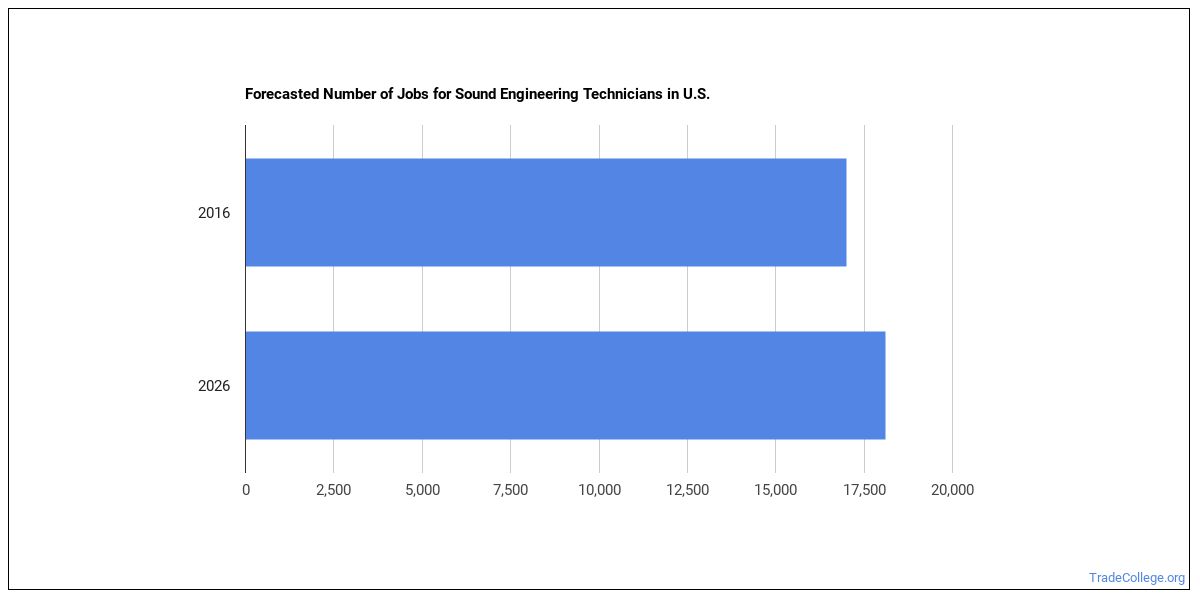
The U.S. employs around 295,507 sound engineering technicians working in the United States today. Employment is projected to decline by -0.5% over the projection horizon.
Salary for Sound Engineering Technicians
| Statistic | Value |
|---|---|
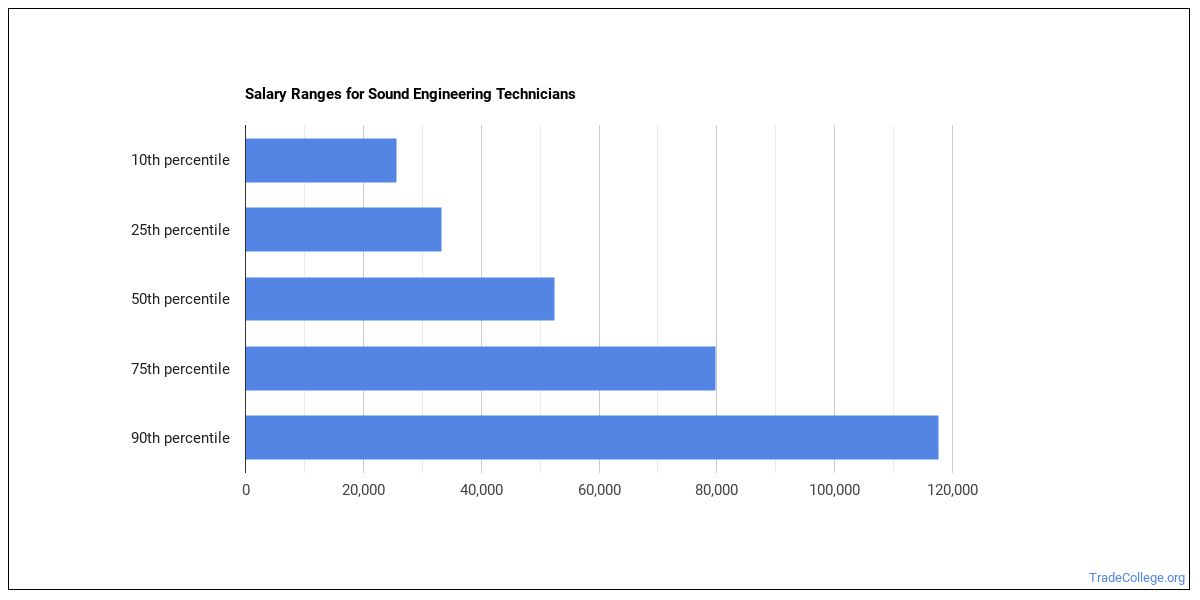
| Annual median | $66,427 |
| Hourly median | $31.94 |
| 10th percentile | $44,644 |
| 25th percentile | $55,536 |
| 75th percentile | $77,319 |
| 90th percentile | $88,210 |
Compensation varies based on experience, location, and industry.
Pay by State
| State | Annual median salary |
|---|---|
| New Jersey | $111,580 |
| Washington | $110,950 |
| District of Columbia | $101,550 |
| Arizona | $97,380 |
| New York | $87,180 |
| Nevada | $81,720 |
| California | $78,020 |
| Alabama | $77,420 |
| Maryland | $71,310 |
| Tennessee | $69,990 |
| Colorado | $66,580 |
| New Hampshire | $62,400 |
| Florida | $62,310 |
| Minnesota | $62,050 |
| Massachusetts | $61,650 |
| Nebraska | $60,680 |
| Texas | $59,370 |
| New Mexico | $59,190 |
| Indiana | $58,040 |
| Ohio | $57,630 |
| North Carolina | $57,550 |
| Connecticut | $57,050 |
| Illinois | $56,340 |
| Oklahoma | $55,920 |
| Montana | $54,830 |
| Kentucky | $54,070 |
| Pennsylvania | $53,970 |
| Georgia | $52,650 |
| Louisiana | $52,240 |
| Michigan | $51,790 |
| Wisconsin | $50,980 |
| Oregon | $50,220 |
| Iowa | $50,220 |
| Missouri | $48,800 |
| Virginia | $47,580 |
| South Carolina | $42,370 |
| Utah | $32,880 |
| Puerto Rico | $27,790 |
Pay by U.S. Region
Compensation for sound engineering technicians differ across the country. These regions lead on median pay:
| Region | Median annual wage | Share of U.S. jobs | Location quotient |
|---|---|---|---|
| Middle Atlantic | $85,518 | 20.4% | 1.66 |
| Far Western US | $80,205 | 34.3% | 2.29 |
| Southwest | $73,330 | 5.2% | 0.57 |
| New England | $61,180 | 2.2% | 0.67 |
| Southeast | $60,160 | 17.2% | 0.98 |
| Great Lakes | $55,769 | 12.5% | 1.04 |
| Plains States | $51,940 | 3.4% | 0.96 |
| Rocky Mountains | $44,937 | 4.0% | 1.62 |
Highest-Paying Metro Areas for Sound Engineering Technicians
| Metro area | State | Median annual wage | Employment |
|---|---|---|---|
| Seattle-Tacoma-Bellevue, WA | WA | $119,600 | 290 |
| San Francisco-Oakland-Fremont, CA | CA | $98,220 | 340 |
| Syracuse, NY | NY | $97,850 | 40 |
| New York-Newark-Jersey City, NY-NJ | NY | $92,630 | 1,500 |
| Nashville-Davidson–Murfreesboro–Franklin, TN | TN | $85,690 | 330 |
| Buffalo-Cheektowaga, NY | NY | $83,080 | 70 |
| Las Vegas-Henderson-North Las Vegas, NV | NV | $80,470 | 140 |
| Los Angeles-Long Beach-Anaheim, CA | CA | $77,620 | 2,800 |
Top Industries Employing Sound Engineering Technicians
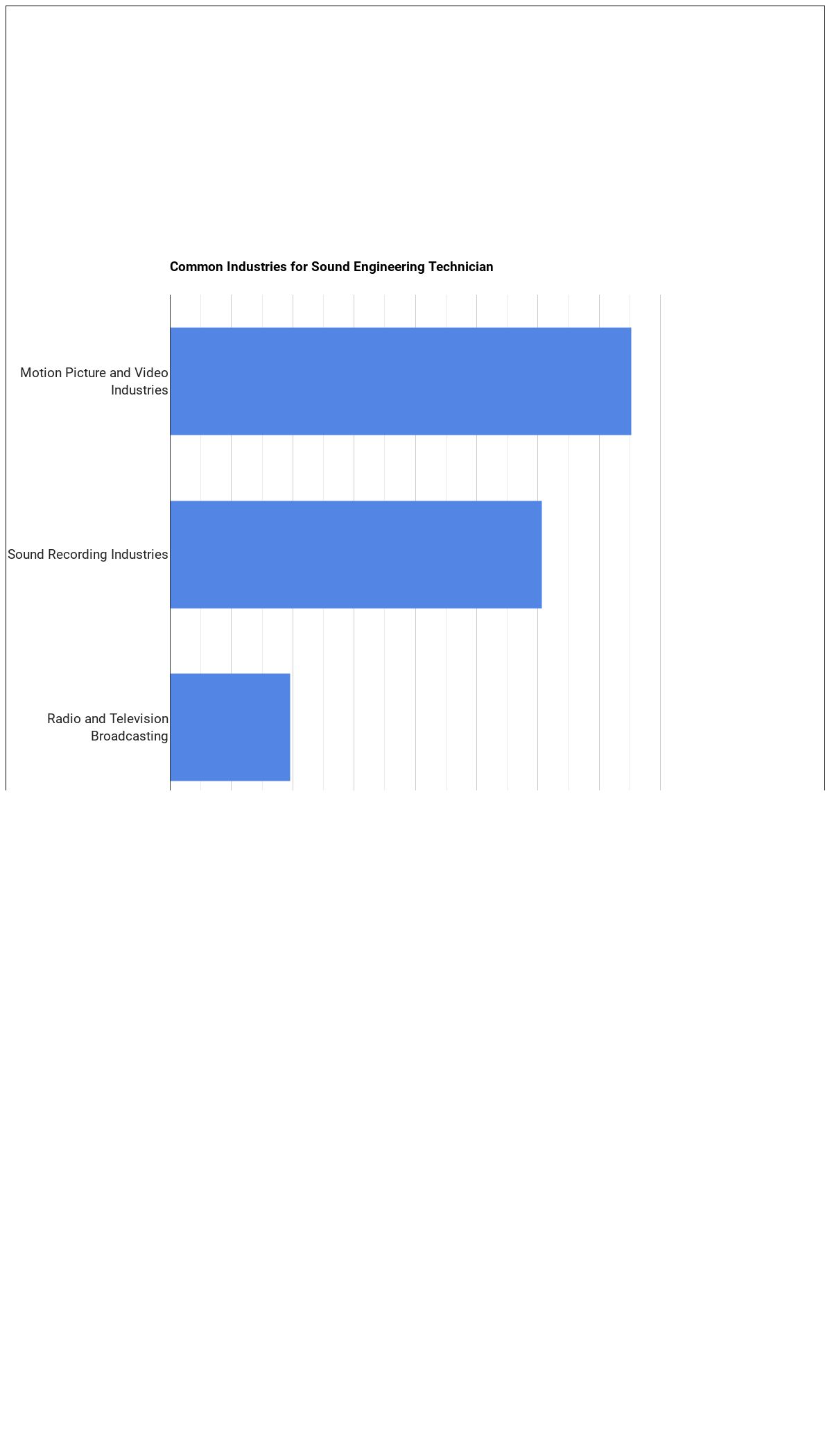
Most sound engineering technicians are concentrated in the following sectors:
| Industry | Employment | Median annual wage |
|---|---|---|
| Information | 6,750 | $77,590 |
| Arts, Entertainment, and Recreation | 2,200 | $58,380 |
| Professional, Scientific, and Technical Services | 680 | $91,170 |
| Educational Services | 650 | $46,770 |
| Administrative and Support and Waste Management and Remediation Services | 540 | $97,450 |
| Other Services (except Public Administration) | 370 | $34,320 |
| Real Estate and Rental and Leasing | 180 | $56,340 |
| Manufacturing | 130 | $86,880 |

Below are examples of industries where sound engineering technicians work:
Software Sound Engineering Technicians Use
- Document management software: Adobe Acrobat (hot technology)
- Graphics or photo imaging software: Adobe Creative Cloud software (hot technology)
- Desktop publishing software: Adobe InDesign (hot technology)
- Graphics or photo imaging software: Adobe Photoshop (hot technology)
- Operating system software: Apple macOS (hot technology)
- Computer aided design CAD software: Autodesk AutoCAD (hot technology)
- Web page creation and editing software: Facebook (hot technology)
- File versioning software: Git (hot technology)
- Operating system software: Linux (hot technology)
- Spreadsheet software: Microsoft Excel (hot technology)
- Office suite software: Microsoft Office software (hot technology)
- Presentation software: Microsoft PowerPoint (hot technology)
The Day-to-Day Environment
The work environment for sound engineering technicians reflects the following characteristics:
- Indoors, Environmentally Controlled
- Importance of Being Exact or Accurate
- Level of Competition
- Face-to-Face Discussions with Individuals and Within Teams
Education and Training
Entry-level sound engineering technicians positions require a high school diploma or equivalent as the typical entry-level education. The role falls in Medium Preparation Needed (Job Zone 3), indicating the level of preparation typically expected.
Similar Occupations
Similar Occupations
- Software Developers (Supplemental)
- Electronics Engineers, Except Computer (Supplemental)
- Radio Frequency Identification Device Specialists (Supplemental)
- Aerospace Engineering and Operations Technologists and Technicians (Supplemental)
- Electrical and Electronic Engineering Technologists and Technicians (Primary-Short)
- Robotics Technicians (Supplemental)
- Calibration Technologists and Technicians (Primary-Long)
- Producers and Directors (Supplemental)
Where to Study
Students preparing for sound engineering technicians commonly pursue programs in:
Engineering Technologies and Engineering-Related Fields
1 programs across 1 majors
References
Data on this page comes from the following authoritative sources:
- U.S. Bureau of Labor Statistics — Occupational Employment and Wage Statistics (OEWS) for employment and wage data by state and industry.
- BLS Employment Projections for total employment and growth forecasts.
- O*NET (Occupational Information Network) for skills, knowledge, tasks, work activities, work context, technology, and education-zone data.
SOC code: 27-4014.00 (Sound Engineering Technicians).

TradeCollege.org provides higher-education, college and university, degree, program, career, salary, and other helpful information to students, faculty, institutions, and other internet audiences. Presented information and data are subject to change. Inclusion on this website does not imply or represent a direct relationship with the company, school, or brand. Information, though believed correct at time of publication, may not be correct, and no warranty is provided. Contact the schools to verify any information before relying on it. Financial aid may be available for those who qualify. TradeCollege.org is a for-profit site, and the displayed options may include sponsored or recommended results, not necessarily based on your preferences.
© TradeCollege.org – All Rights Reserved.