Find Trade Colleges
Radio, Cellular, and Tower Equipment Installers and Repairers: Career Profile
Repair, install, or maintain mobile or stationary radio transmitting, broadcasting, and receiving equipment, and two-way radio communications systems used in cellular telecommunications, mobile broadband, ship-to-shore, aircraft-to-ground communications, and radio equipment in service and emergency vehicles. May test and analyze network coverage.
What Do Radio, Cellular, and Tower Equipment Installers and Repairers Do?
The day-to-day responsibilities of radio, cellular, and tower equipment installers and repairers cover:
- Inspect completed work to ensure all hardware is tight, antennas are level, hangers are properly fastened, proper support is in place, or adequate weather proofing has been installed.
- Run appropriate power, ground, or coaxial cables.
- Test operation of tower transmission components, using sweep testing tools or software.
- Install all necessary transmission equipment components, including antennas or antenna mounts, surge arrestors, transmission lines, connectors, or tower-mounted amplifiers (TMAs).
- Read work orders, blueprints, plans, datasheets or site drawings to determine work to be done.
- Replace existing antennas with new antennas as directed.
- Bolt equipment into place, using hand or power tools.
- Install, connect, or test underground or aboveground grounding systems.
What Radio, Cellular, and Tower Equipment Installers and Repairers Need to Know
Successful radio, cellular, and tower equipment installers and repairers rely on a mix of skills and domain knowledge.
Top Skills
These are the skills most important for this role, rated on an importance scale of 0 to 5:
Top Knowledge Areas
Other Radio, Cellular, and Tower Equipment Installers and Repairers Job Titles
People in this occupation may also be known by titles such as:
- Avionics Repair Technician (Avionics Repair Tech)
- Broadcasting Equipment Mechanic
- Cell Tower Technician (Cell Tower Tech)
- Cellular Equipment Installer (Cell Equipment Installer)
- Cellular Equipment Repairer (Cell Equipment Repairer)
- Cellular Tower Climber (Cell Tower Climber)
- Certified Tower Climber
- Communications Security Repairer
How Many Radio, Cellular, and Tower Equipment Installers and Repairers Are There?
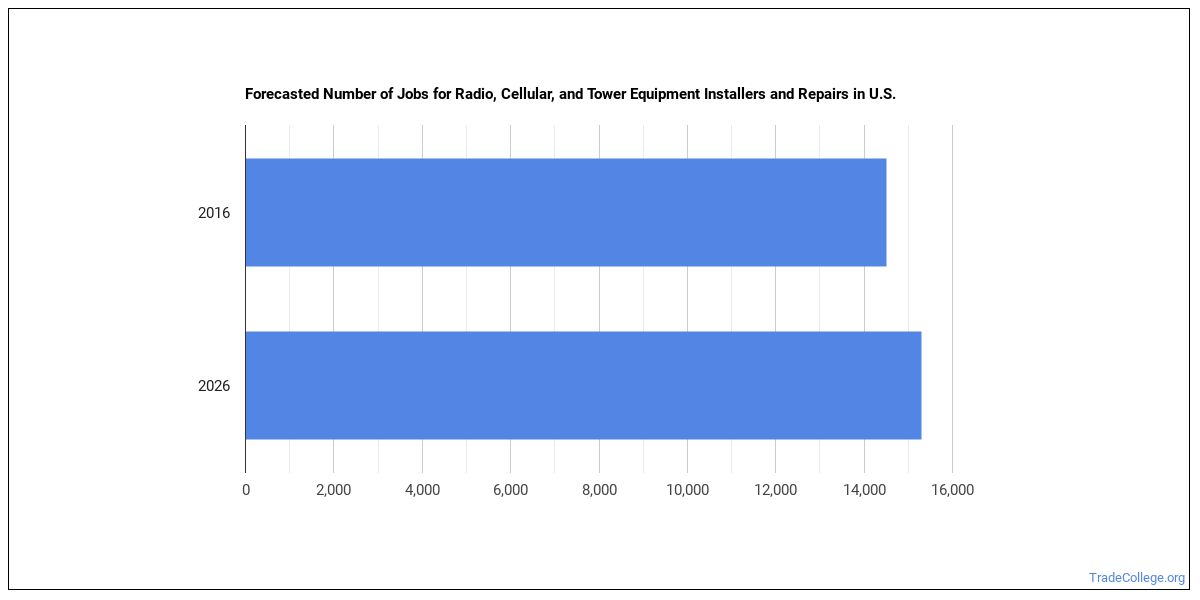
There are about 364,432 radio, cellular, and tower equipment installers and repairers working in the United States today. This occupation is expected to grow by +11.3% over the projection horizon.
Salary for Radio, Cellular, and Tower Equipment Installers and Repairers
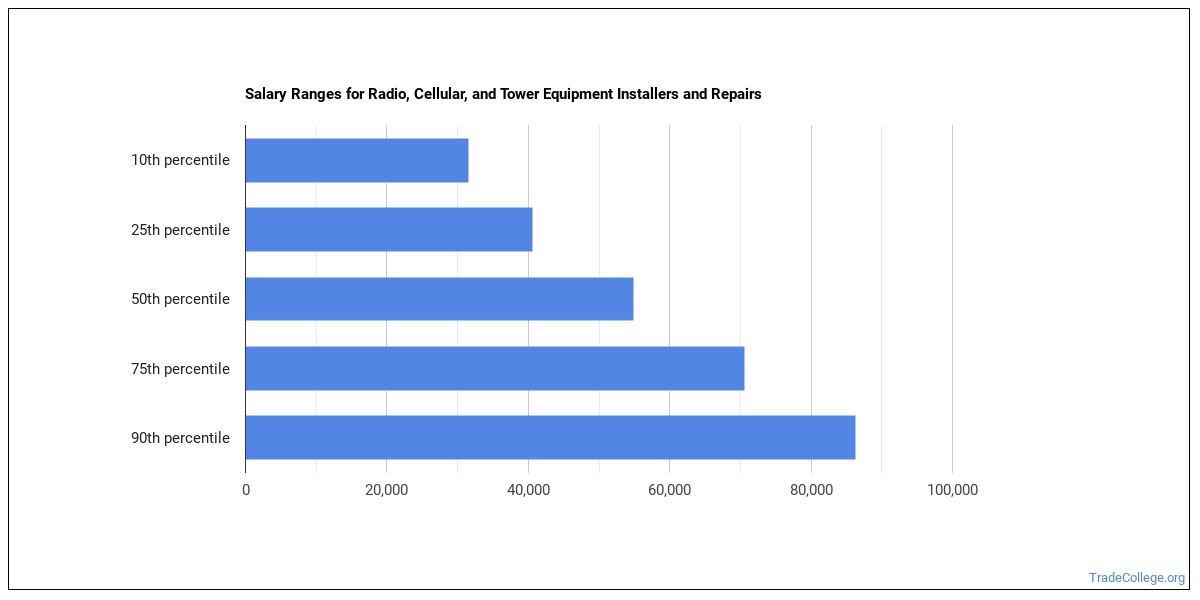
| Statistic | Value |
|---|---|
| Annual median | $37,281 |
| Hourly median | $17.92 |
| 10th percentile | $25,866 |
| 25th percentile | $31,574 |
| 75th percentile | $42,989 |
| 90th percentile | $48,696 |
Compensation varies based on experience, location, and industry.
Radio, Cellular, and Tower Equipment Installers and Repairers Salary by State
| State | Annual median salary |
|---|---|
| New York | $103,010 |
| Wisconsin | $102,550 |
| Pennsylvania | $101,400 |
| Maryland | $98,360 |
| Connecticut | $96,990 |
| Arizona | $95,350 |
| Utah | $86,040 |
| Alabama | $85,750 |
| Nevada | $84,540 |
| New Jersey | $83,420 |
| California | $79,340 |
| New Mexico | $77,880 |
| South Carolina | $77,100 |
| Washington | $74,130 |
| Minnesota | $72,950 |
| Ohio | $68,640 |
| Hawaii | $68,500 |
| Georgia | $67,070 |
| Michigan | $64,650 |
| Virginia | $64,400 |
| Massachusetts | $64,210 |
| Kansas | $63,750 |
| Nebraska | $62,870 |
| Indiana | $62,540 |
| Kentucky | $62,310 |
| Oklahoma | $60,690 |
| Illinois | $59,690 |
| Texas | $59,500 |
| Iowa | $59,450 |
| Delaware | $58,320 |
| New Hampshire | $58,240 |
| Colorado | $57,700 |
| Oregon | $56,860 |
| Vermont | $55,200 |
| Tennessee | $52,080 |
| South Dakota | $51,550 |
| Florida | $51,260 |
| Louisiana | $51,240 |
| Maine | $50,610 |
| West Virginia | $48,260 |
| Missouri | $47,310 |
| North Carolina | $45,970 |
| Montana | $38,340 |
| Puerto Rico | $37,980 |
| Guam | $36,660 |
Pay by U.S. Region
Compensation for radio, cellular, and tower equipment installers and repairers shift depending on where you work. The following regions pay the most:
| Region | Median annual wage | Share of U.S. jobs | Location quotient |
|---|---|---|---|
| Middle Atlantic | $92,461 | 16.1% | 1.42 |
| Far Western US | $72,555 | 18.0% | 1.48 |
| Great Lakes | $68,972 | 8.6% | 0.86 |
| Southwest | $67,770 | 10.3% | 1.10 |
| New England | $58,772 | 7.5% | 2.52 |
| Plains States | $58,280 | 6.2% | 1.11 |
| Rocky Mountains | $57,651 | 5.7% | 2.05 |
| Southeast | $57,335 | 26.7% | 1.40 |
Where the Jobs Cluster
| Metro area | State | Median annual wage | Employment |
|---|---|---|---|
| Baltimore-Columbia-Towson, MD | MD | $102,550 | 110 |
| Columbus, OH | OH | $102,550 | 60 |
| Phoenix-Mesa-Chandler, AZ | AZ | $102,550 | 100 |
| San Francisco-Oakland-Fremont, CA | CA | $102,050 | 80 |
| New York-Newark-Jersey City, NY-NJ | NY | $101,390 | 570 |
| Pittsburgh, PA | PA | $100,930 | 70 |
| Hartford-West Hartford-East Hartford, CT | CT | $98,250 | |
| Los Angeles-Long Beach-Anaheim, CA | CA | $85,790 | 210 |
Top Industries Employing Radio, Cellular, and Tower Equipment Installers and Repairers
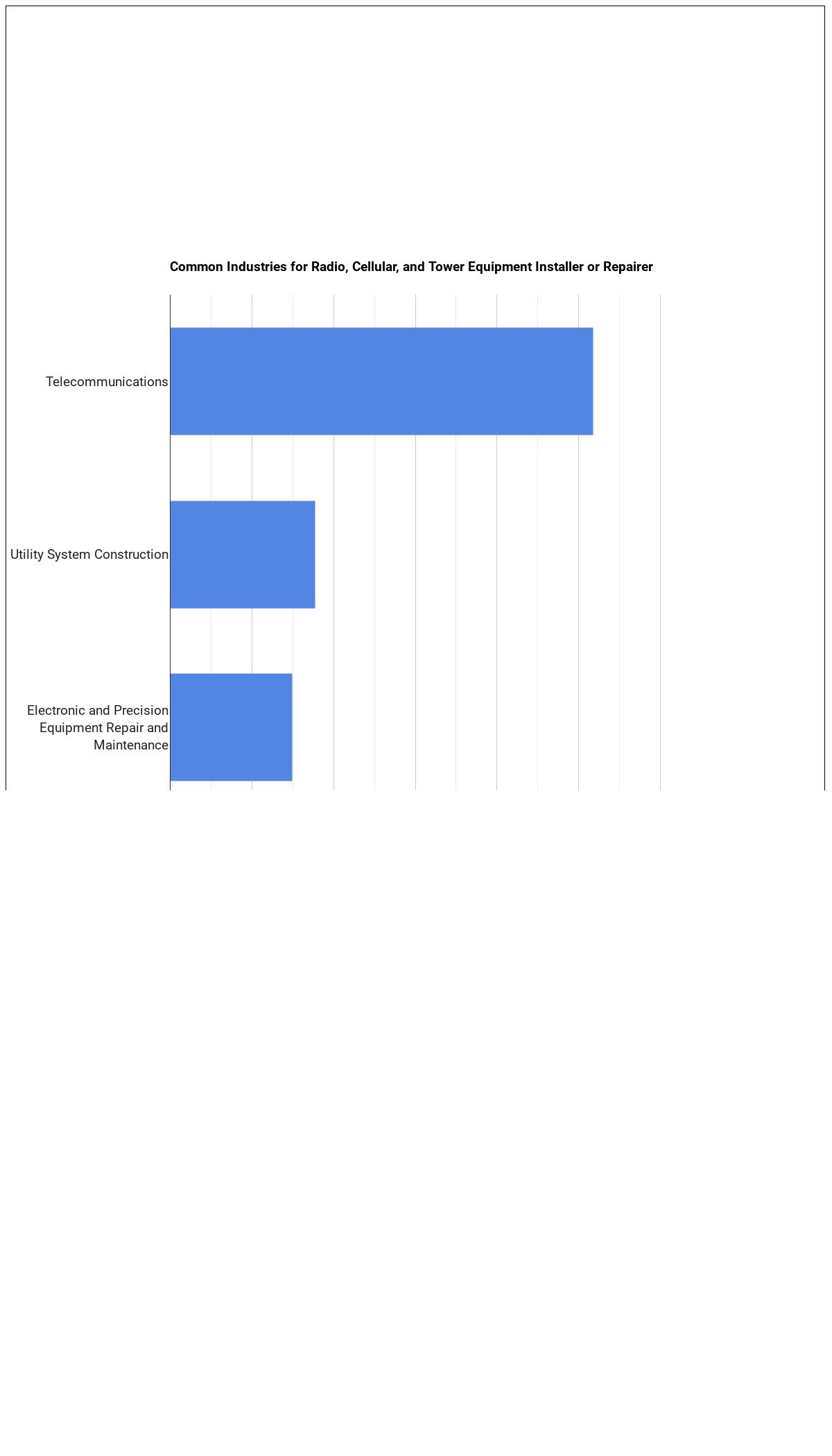
The largest employers of radio, cellular, and tower equipment installers and repairers work in these industries:
| Industry | Employment | Median annual wage |
|---|---|---|
| Information | 3,480 | $81,430 |
| Construction | 2,260 | $58,490 |
| Wholesale Trade | 1,060 | $49,760 |
| Other Services (except Public Administration) | 1,040 | $48,520 |
| Professional, Scientific, and Technical Services | 680 | $66,640 |
| Retail Trade | 480 | $61,070 |
| Management of Companies and Enterprises | 400 | $96,130 |
| Manufacturing | 180 | $64,530 |

Below are examples of industries where radio, cellular, and tower equipment installers and repairers work:
Software Radio, Cellular, and Tower Equipment Installers and Repairers Use
- Spreadsheet software: Microsoft Excel (hot technology)
- Office suite software: Microsoft Office software (hot technology)
- Electronic mail software: Microsoft Outlook (hot technology)
- Presentation software: Microsoft PowerPoint (hot technology)
- Project management software: Microsoft Project (hot technology)
- Operating system software: Microsoft Windows (hot technology)
- Word processing software: Microsoft Word (hot technology)
Work Environment
Daily working conditions for radio, cellular, and tower equipment installers and repairers is shaped by the following characteristics:
- Face-to-Face Discussions with Individuals and Within Teams
- Work With or Contribute to a Work Group or Team
- Spend Time Using Your Hands to Handle, Control, or Feel Objects, Tools, or Controls
- Importance of Being Exact or Accurate
- Telephone Conversations
Getting Started in This Career
Most radio, cellular, and tower equipment installers and repairers positions require a high school diploma or equivalent as the typical entry-level education. The role falls in Medium Preparation Needed (Job Zone 3), signaling the level of preparation typically expected.
Similar Occupations
Similar Occupations
- Telecommunications Engineering Specialists (Supplemental)
- Electronics Engineers, Except Computer (Supplemental)
- Radio Frequency Identification Device Specialists (Primary-Short)
- Electrical and Electronic Engineering Technologists and Technicians (Primary-Long)
- Broadcast Technicians (Supplemental)
- Lighting Technicians (Supplemental)
- Telecommunications Equipment Installers and Repairers, Except Line Installers (Primary-Short)
- Avionics Technicians (Primary-Long)
Degree Programs
Students preparing for radio, cellular, and tower equipment installers and repairers commonly pursue programs in:
Mechanic and Repair Technologies/Technicians
1 programs across 1 majors
About the Data
Data on this page comes from the following authoritative sources:
- U.S. Bureau of Labor Statistics — Occupational Employment and Wage Statistics (OEWS) for employment and wage data by state and industry.
- BLS Employment Projections for total employment and growth forecasts.
- O*NET (Occupational Information Network) for skills, knowledge, tasks, work activities, work context, technology, and education-zone data.
SOC code: 49-2021.00 (Radio, Cellular, and Tower Equipment Installers and Repairers).

TradeCollege.org provides higher-education, college and university, degree, program, career, salary, and other helpful information to students, faculty, institutions, and other internet audiences. Presented information and data are subject to change. Inclusion on this website does not imply or represent a direct relationship with the company, school, or brand. Information, though believed correct at time of publication, may not be correct, and no warranty is provided. Contact the schools to verify any information before relying on it. Financial aid may be available for those who qualify. TradeCollege.org is a for-profit site, and the displayed options may include sponsored or recommended results, not necessarily based on your preferences.
© TradeCollege.org – All Rights Reserved.