Find Trade Colleges
Power Distributors and Dispatchers: Job Description
Coordinate, regulate, or distribute electricity or steam.
What Do Power Distributors and Dispatchers Take On?
The core tasks performed by power distributors and dispatchers include:
- Coordinate with engineers, planners, field personnel, or other utility workers to provide information such as clearances, switching orders, or distribution process changes.
- Respond to emergencies, such as transformer or transmission line failures, and route current around affected areas.
- Control, monitor, or operate equipment that regulates or distributes electricity or steam, using data obtained from instruments or computers.
- Direct personnel engaged in controlling or operating distribution equipment or machinery, such as instructing control room operators to start boilers or generators.
- Distribute or regulate the flow of power between entities, such as generating stations, substations, distribution lines, or users, keeping track of the status of circuits or connections.
- Manipulate controls to adjust or activate power distribution equipment or machines.
- Prepare switching orders that will isolate work areas without causing power outages, referring to drawings of power systems.
- Monitor and record switchboard or control board readings to ensure that electrical or steam distribution equipment is operating properly.
Skills and Knowledge
Effective power distributors and dispatchers draw on a mix of skills and domain knowledge.
Key Skills
The competencies that matter most in this role, rated on an importance scale of 0 to 5:
Knowledge Areas
Types of Power Distributors and Dispatchers Jobs
People in this occupation may also be known by titles such as:
- Auxiliary Operator
- Board Operator
- Control Area Operator
- Control Board Operator
- Control Operator
- Control Room Operator
- DSO (Distribution System Operator)
- Dispatcher
Job Outlook
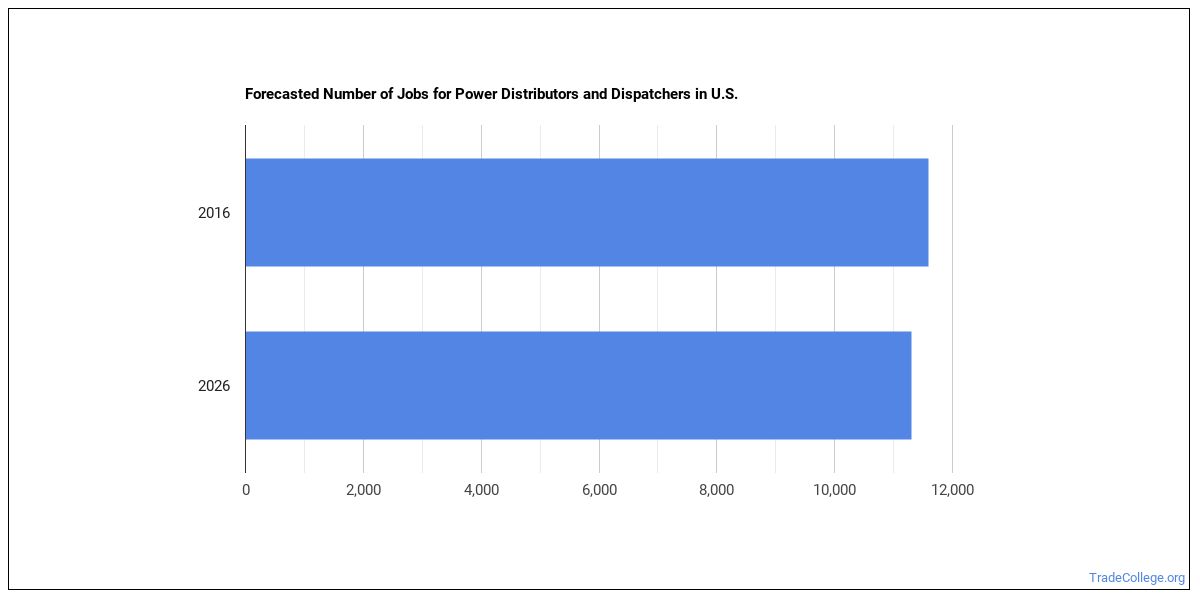
The U.S. employs around 169,715 power distributors and dispatchers working in the United States today. Demand is forecast to grow by +12.0% over the projection horizon.
Power Distributors and Dispatchers Pay
| Statistic | Value |
|---|---|
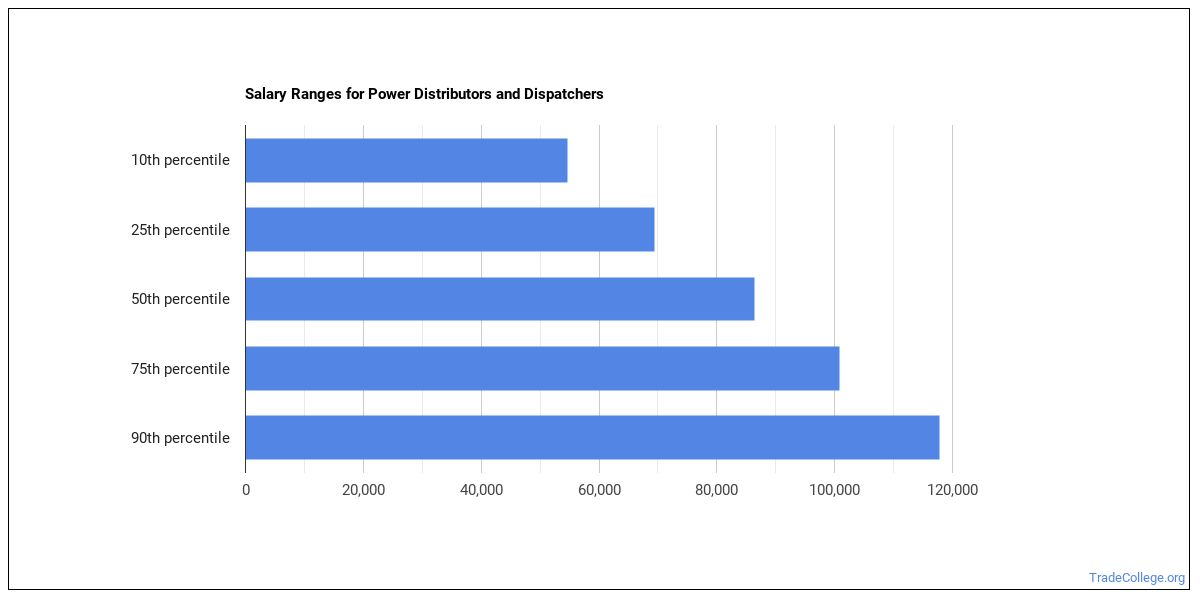
| Annual median | $46,558 |
| Hourly median | $22.38 |
| 10th percentile | $32,294 |
| 25th percentile | $39,426 |
| 75th percentile | $53,690 |
| 90th percentile | $60,822 |
Wages vary widely based on experience, location, and industry.
Pay by State
| State | Annual median salary |
|---|---|
| Washington | $139,170 |
| Idaho | $136,550 |
| Connecticut | $134,050 |
| Nevada | $133,910 |
| Oregon | $130,100 |
| New York | $128,680 |
| Minnesota | $122,620 |
| Georgia | $121,970 |
| Maine | $116,810 |
| California | $116,360 |
| Colorado | $116,220 |
| Wyoming | $115,010 |
| Arkansas | $113,770 |
| Nebraska | $113,560 |
| Kansas | $113,230 |
| New Jersey | $112,340 |
| North Dakota | $112,310 |
| Alabama | $110,970 |
| Indiana | $110,160 |
| Michigan | $109,230 |
| Mississippi | $107,110 |
| Texas | $105,970 |
| Massachusetts | $105,750 |
| Wisconsin | $104,550 |
| Kentucky | $102,180 |
| Missouri | $102,140 |
| Florida | $101,870 |
| Virginia | $100,830 |
| Maryland | $100,710 |
| Utah | $100,620 |
| Oklahoma | $100,510 |
| Pennsylvania | $98,870 |
| West Virginia | $98,690 |
| Ohio | $88,810 |
| Tennessee | $88,400 |
| North Carolina | $87,420 |
| South Carolina | $85,380 |
| Illinois | $83,960 |
Where Power Distributors and Dispatchers Earn the Most
Pay for power distributors and dispatchers shift depending on where you work. Top regions by median wage:
| Region | Median annual wage | Share of U.S. jobs | Location quotient |
|---|---|---|---|
| Far Western US | $125,789 | 16.9% | 1.24 |
| Rocky Mountains | $118,175 | 3.1% | 1.10 |
| New England | $113,702 | 6.3% | 1.60 |
| Plains States | $113,576 | 5.4% | 1.14 |
| Middle Atlantic | $105,972 | 13.5% | 1.49 |
| Southeast | $102,467 | 21.7% | 1.37 |
| Great Lakes | $96,122 | 19.0% | 1.54 |
| Southwest | $89,772 | 14.2% | 1.15 |
Top Metro Areas
| Metro area | State | Median annual wage | Employment |
|---|---|---|---|
| San Diego-Chula Vista-Carlsbad, CA | CA | $166,600 | 120 |
| Sacramento-Roseville-Folsom, CA | CA | $160,630 | 70 |
| Seattle-Tacoma-Bellevue, WA | WA | $159,820 | 80 |
| Atlanta-Sandy Springs-Roswell, GA | GA | $145,780 | 100 |
| Indianapolis-Carmel-Greenwood, IN | IN | $134,130 | 60 |
| Birmingham, AL | AL | $134,020 | 110 |
| Las Vegas-Henderson-North Las Vegas, NV | NV | $133,910 | 80 |
| Little Rock-North Little Rock-Conway, AR | AR | $129,590 | 170 |
Industry Breakdown
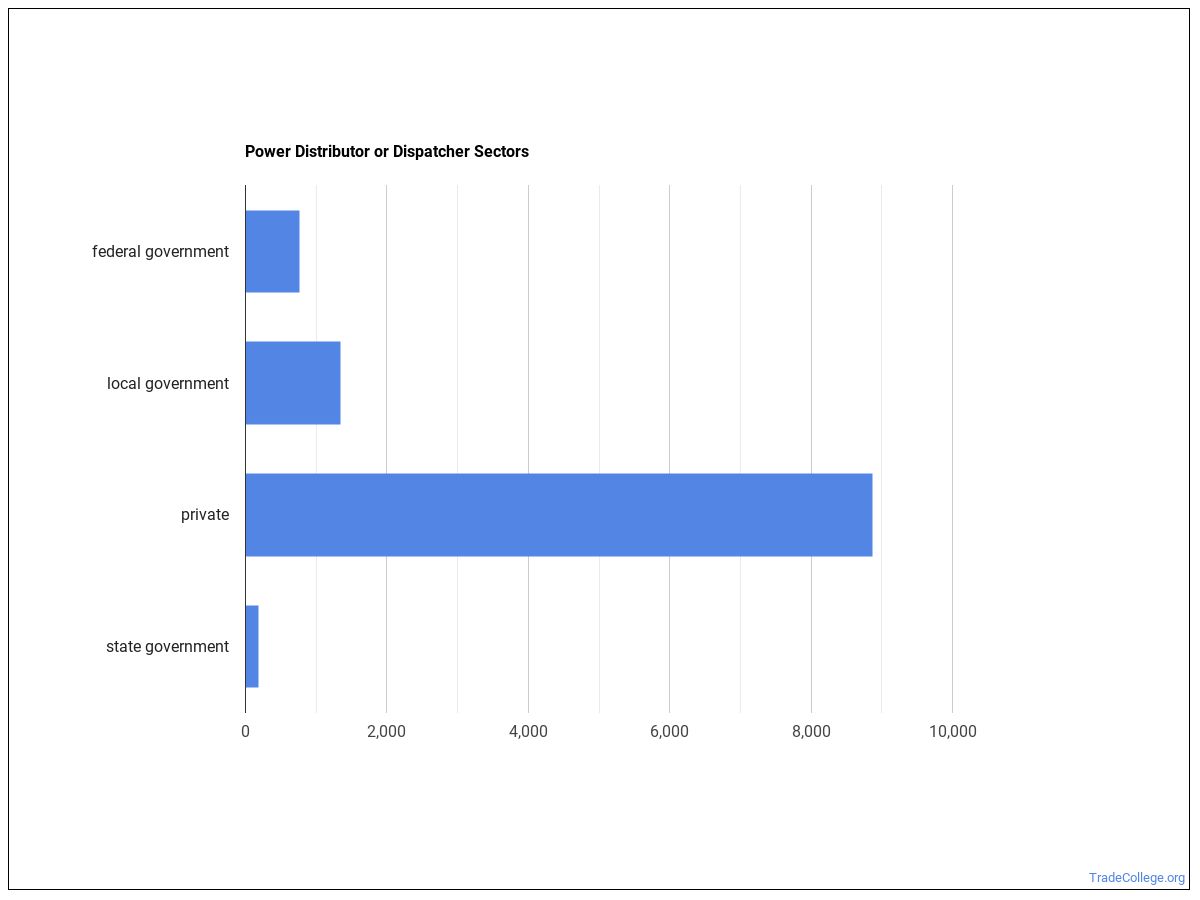
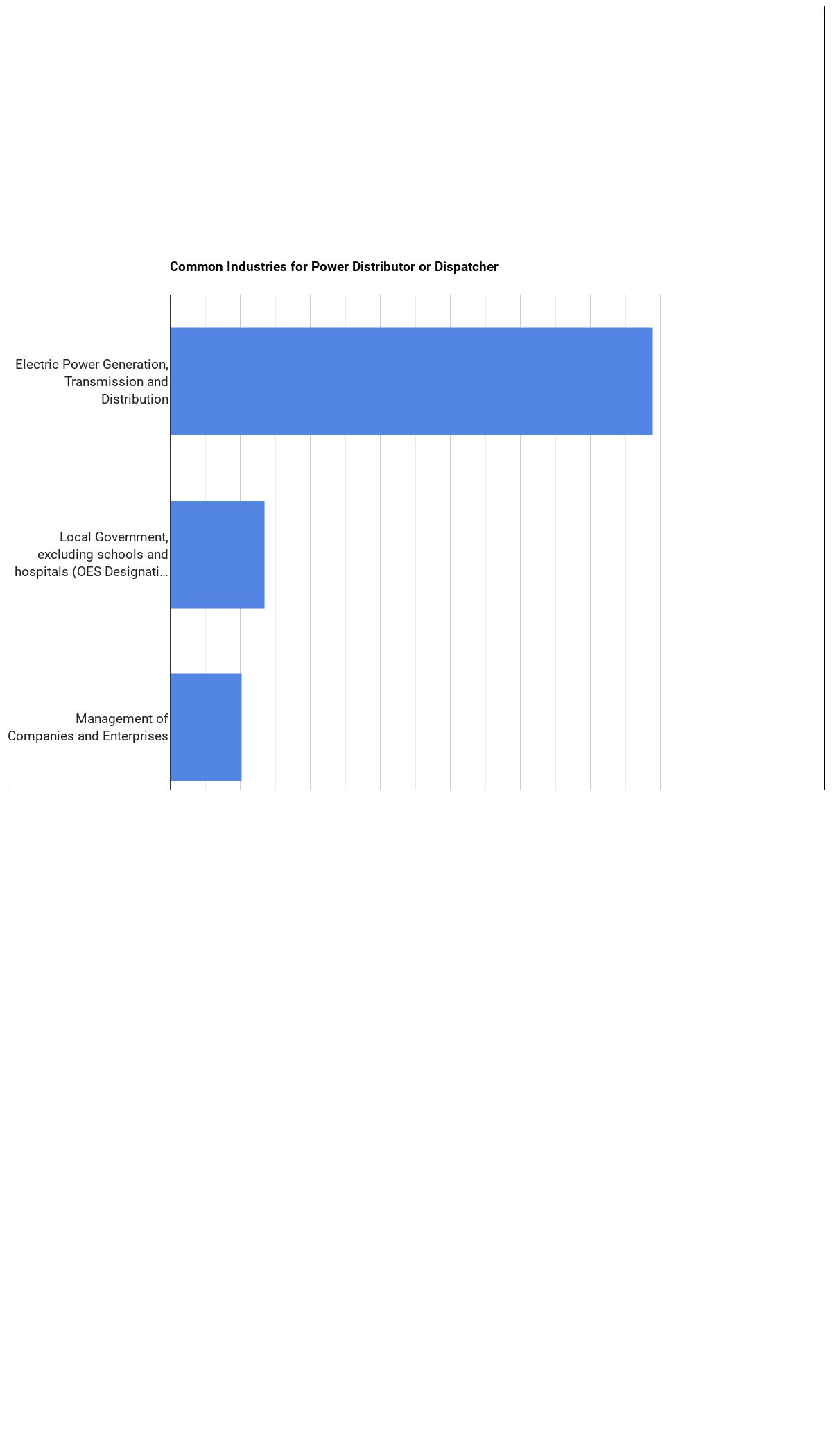
Most power distributors and dispatchers work in these industries:
| Industry | Employment | Median annual wage |
|---|---|---|
| Utilities | 6,330 | $106,160 |
| Management of Companies and Enterprises | 980 | $108,870 |
| Educational Services | 150 | $79,750 |
| Administrative and Support and Waste Management and Remediation Services | 50 | $90,140 |
| Manufacturing | 30 | $75,360 |
| Professional, Scientific, and Technical Services | 30 | $166,840 |
Below are examples of industries where power distributors and dispatchers work:
Tools and Technology
- Data base user interface and query software: Microsoft Access (hot technology)
- Spreadsheet software: Microsoft Excel (hot technology)
- Office suite software: Microsoft Office software (hot technology)
- Electronic mail software: Microsoft Outlook (hot technology)
- Presentation software: Microsoft PowerPoint (hot technology)
- Word processing software: Microsoft Word (hot technology)
- Enterprise resource planning ERP software: SAP software (hot technology)
The Day-to-Day Environment
The on-the-job environment of power distributors and dispatchers reflects the following characteristics:
- Telephone Conversations
- Consequence of Error
- Impact of Decisions on Co-workers or Company Results
- Contact With Others
- Importance of Being Exact or Accurate
How to Become Power Distributors and Dispatchers
Most power distributors and dispatchers positions require some college, no degree as the typical entry-level education. The role falls in Medium Preparation Needed (Job Zone 3), reflecting the level of preparation typically expected.
Related Careers
Similar Occupations
- Biomass Power Plant Managers (Supplemental)
- Electrical Engineers (Supplemental)
- Electronics Engineers, Except Computer (Supplemental)
- Mechanical Engineers (Supplemental)
- Electrical and Electronic Engineering Technologists and Technicians (Primary-Long)
- Broadcast Technicians (Supplemental)
- Lighting Technicians (Supplemental)
- Telecommunications Equipment Installers and Repairers, Except Line Installers (Supplemental)
Sources
This profile draws on the following authoritative sources:
- U.S. Bureau of Labor Statistics — Occupational Employment and Wage Statistics (OEWS) for employment and wage data by state and industry.
- BLS Employment Projections for total employment and growth forecasts.
- O*NET (Occupational Information Network) for skills, knowledge, tasks, work activities, work context, technology, and education-zone data.
SOC code: 51-8012.00 (Power Distributors and Dispatchers).

TradeCollege.org provides higher-education, college and university, degree, program, career, salary, and other helpful information to students, faculty, institutions, and other internet audiences. Presented information and data are subject to change. Inclusion on this website does not imply or represent a direct relationship with the company, school, or brand. Information, though believed correct at time of publication, may not be correct, and no warranty is provided. Contact the schools to verify any information before relying on it. Financial aid may be available for those who qualify. TradeCollege.org is a for-profit site, and the displayed options may include sponsored or recommended results, not necessarily based on your preferences.
© TradeCollege.org – All Rights Reserved.