Find Trade Colleges
Life As a Pesticide Applicator
Position Description Mix or apply pesticides, herbicides, fungicides, or insecticides through sprays, dusts, vapors, soil incorporation, or chemical application on trees, shrubs, lawns, or botanical crops. Usually requires specific training and State or Federal certification.
A Day in the Life of a Pesticide Applicator
- Plant grass with seed spreaders and operate straw blowers to cover seeded areas with mixtures of asphalt and straw.
- Fill sprayer tanks with water and chemicals, according to formulas.
- Provide driving instructions to truck drivers to ensure complete coverage of designated areas, using hand and horn signals.
- Mix pesticides, herbicides, or fungicides for application to trees, shrubs, lawns, or botanical crops.
- Connect hoses and nozzles selected according to terrain, distribution pattern requirements, types of infestations, and velocities.
- Identify lawn or plant diseases to determine the appropriate course of treatment.
Featured schools near , edit
What Every Pesticide Applicator Should Know
Pesticide Applicators state the following job skills are important in their day-to-day work.
Active Listening: Giving full attention to what other people are saying, taking time to understand the points being made, asking questions as appropriate, and not interrupting at inappropriate times.
Speaking: Talking to others to convey information effectively.
Critical Thinking: Using logic and reasoning to identify the strengths and weaknesses of alternative solutions, conclusions or approaches to problems.
Time Management: Managing one’s own time and the time of others.
Reading Comprehension: Understanding written sentences and paragraphs in work related documents.
Social Perceptiveness: Being aware of others’ reactions and understanding why they react as they do.
Related Job Titles
- Chemical Applicator
- Lawn Specialist
- Hydro-Sprayer Operator
- Fruit Sprayer
- Weed Inspector
What Kind of Pesticide Applicator Job Opportunities Are There?
In 2016, there was an estimated number of 38,000 jobs in the United States for Pesticide Applicator. New jobs are being produced at a rate of 7.9% which is above the national average. The Bureau of Labor Statistics predicts 3,000 new jobs for Pesticide Applicator by 2026. Due to new job openings and attrition, there will be an average of 5,000 job openings in this field each year.
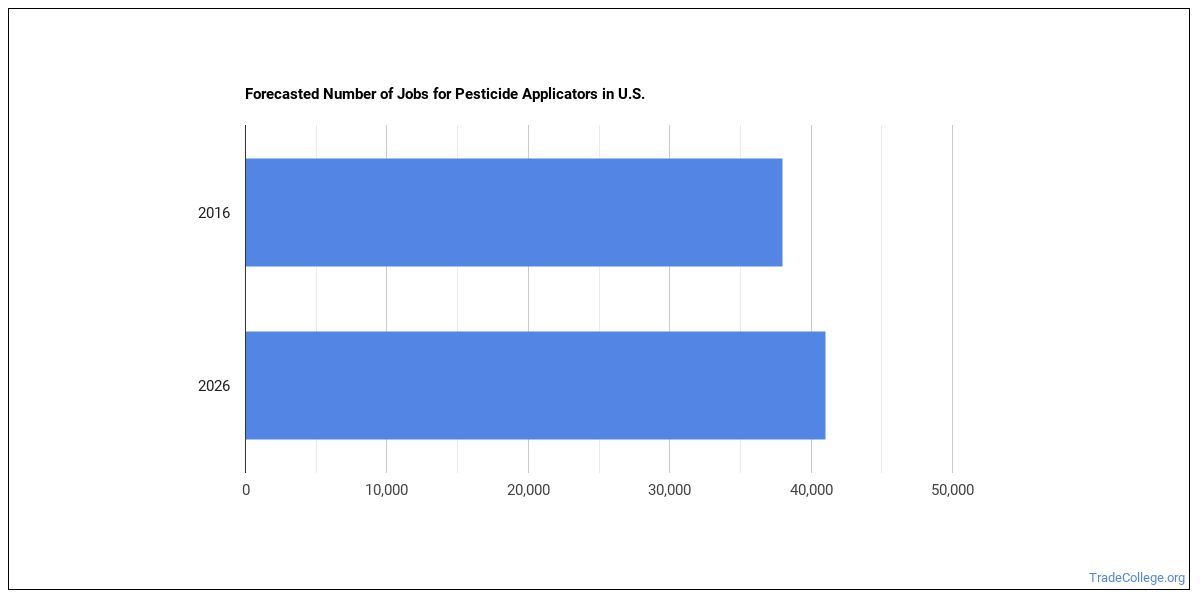
The states with the most job growth for Pesticide Applicator are Nevada, Washington, and Tennessee. Watch out if you plan on working in Ohio, Illinois, or Alaska. These states have the worst job growth for this type of profession.
Do Pesticide Applicators Make A Lot Of Money?
The typical yearly salary for Pesticide Applicators is somewhere between $23,890 and $56,370.
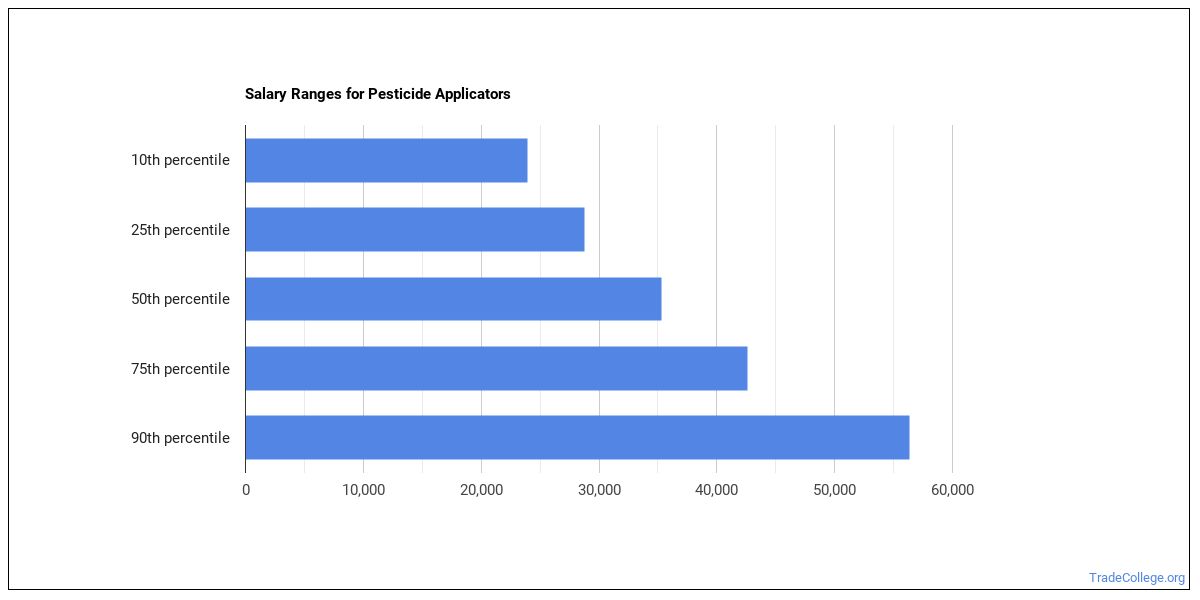
Pesticide Applicators who work in Vermont, Hawaii, or Oregon, make the highest salaries.
How much do Pesticide Applicators make in each U.S. state?
| State | Annual Mean Salary |
|---|---|
| Alabama | $33,140 |
| Arizona | $38,580 |
| Arkansas | $29,520 |
| California | $50,560 |
| Colorado | $38,600 |
| Connecticut | $40,240 |
| Delaware | $33,640 |
| Florida | $31,790 |
| Georgia | $36,960 |
| Hawaii | $40,900 |
| Illinois | $39,930 |
| Indiana | $41,180 |
| Iowa | $36,670 |
| Kansas | $34,680 |
| Kentucky | $31,790 |
| Louisiana | $29,700 |
| Maryland | $40,560 |
| Massachusetts | $33,230 |
| Michigan | $32,600 |
| Minnesota | $39,220 |
| Mississippi | $28,950 |
| Missouri | $38,510 |
| Montana | $34,450 |
| Nebraska | $34,880 |
| Nevada | $31,960 |
| New Hampshire | $38,840 |
| New Jersey | $36,970 |
| New Mexico | $34,930 |
| New York | $42,530 |
| North Carolina | $37,470 |
| North Dakota | $43,820 |
| Ohio | $34,600 |
| Oklahoma | $37,220 |
| Oregon | $51,040 |
| Pennsylvania | $37,480 |
| South Carolina | $34,930 |
| South Dakota | $33,360 |
| Tennessee | $35,070 |
| Texas | $35,650 |
| Utah | $34,940 |
| Vermont | $54,520 |
| Virginia | $35,790 |
| Washington | $37,920 |
| West Virginia | $35,170 |
| Wisconsin | $35,080 |
| Wyoming | $38,500 |
What Tools do Pesticide Applicators Use?
Although they’re not necessarily needed for all jobs, the following technologies are used by many Pesticide Applicators:
How to Become a Pesticide Applicator
Learn what Pesticide Applicator education requirements there are.
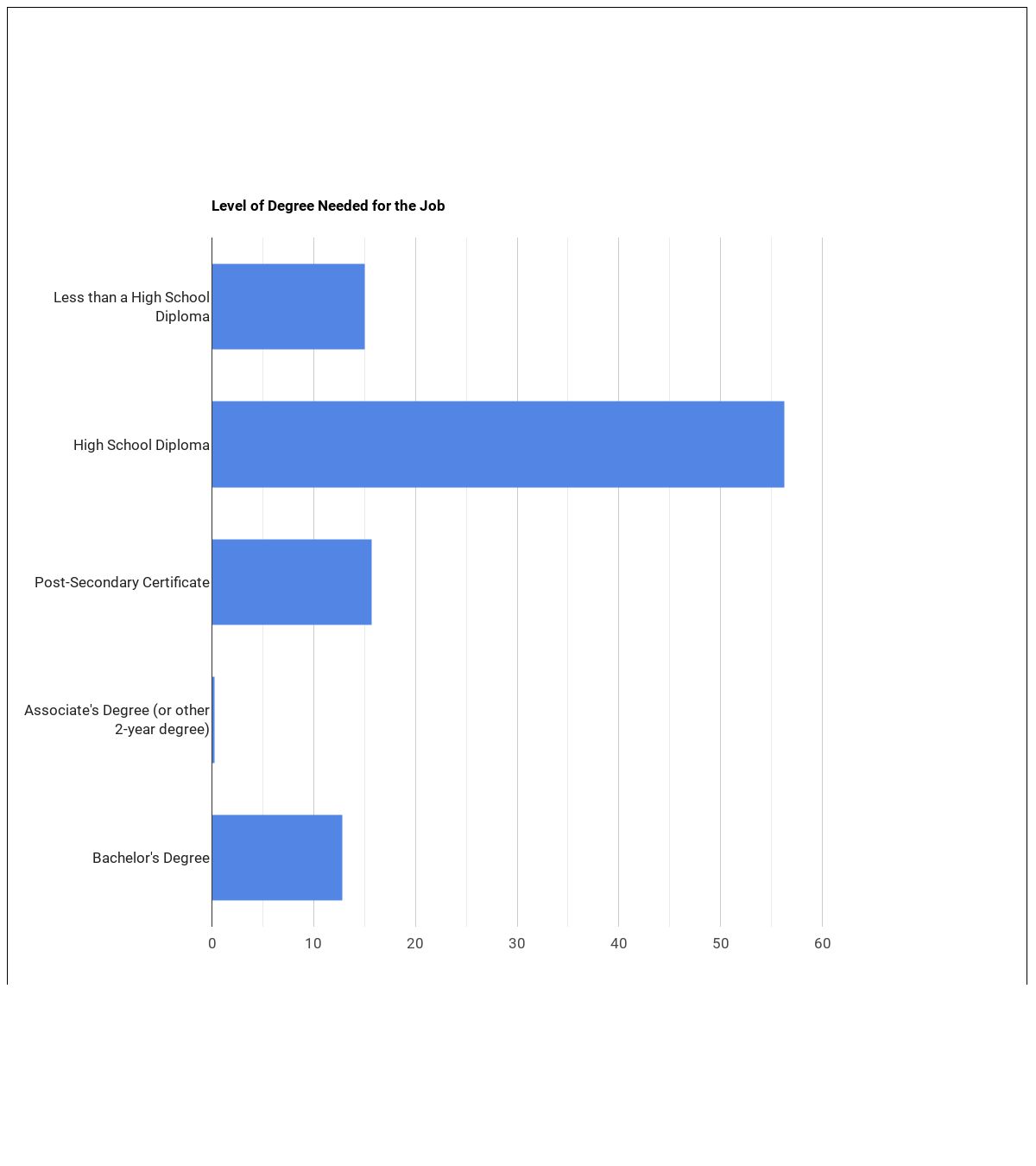
How many years of work experience do I need?

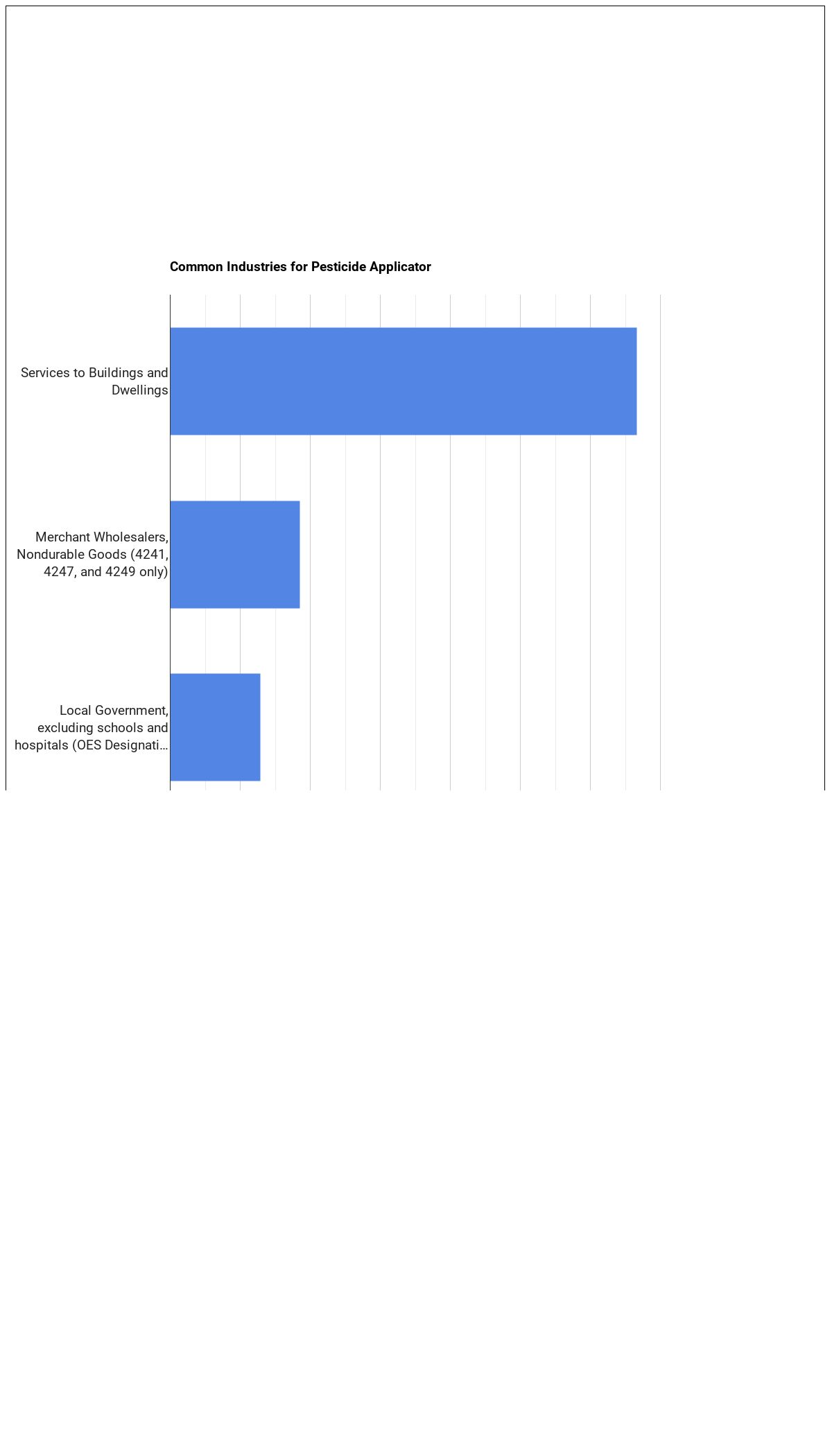
Pesticide Applicators Sector
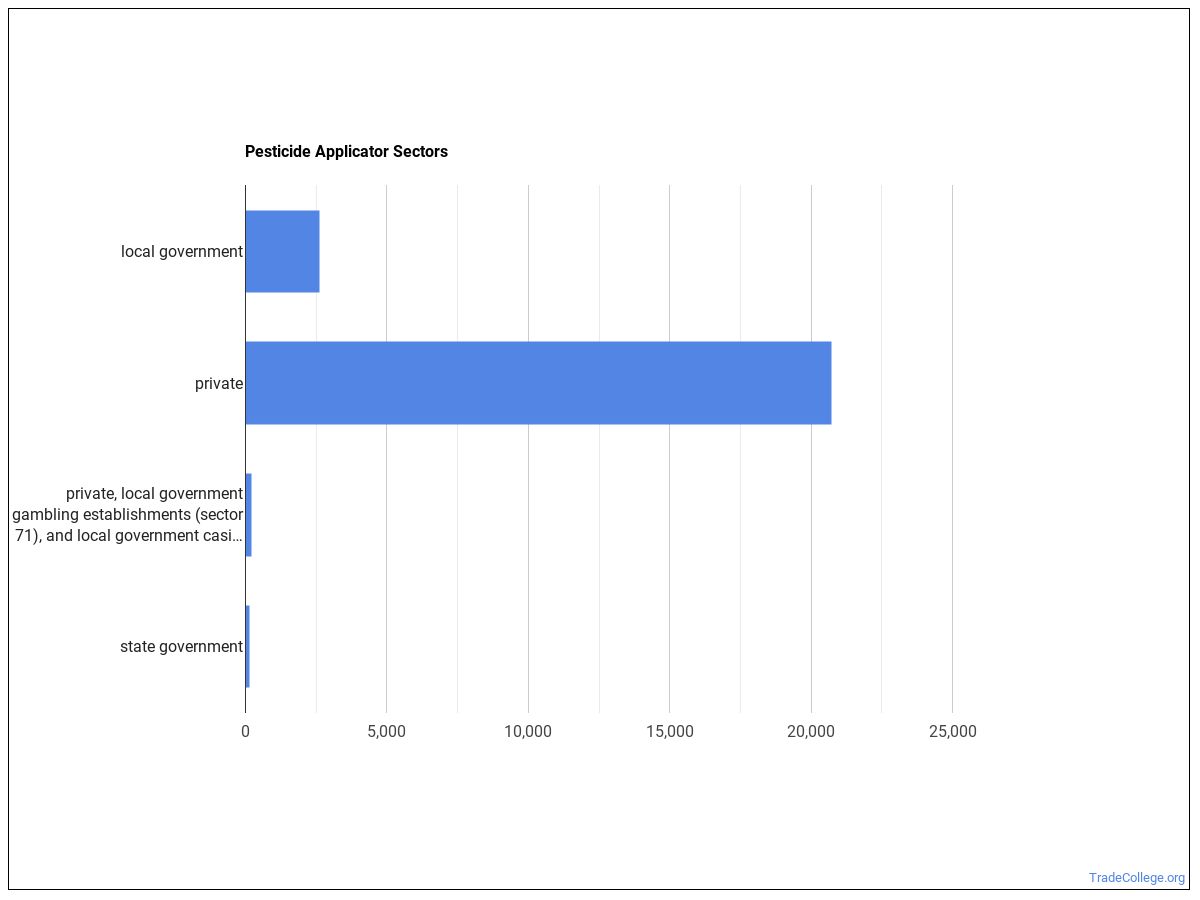
The table below shows the approximate number of Pesticide Applicators employed by various industries.
Related Careers
Those thinking about becoming a Pesticide Applicator might also be interested in the following careers:
- Cutting and Slicing Machine Setters, Operators, and Tenders
- Extruding and Forming Machine Setters, Operators, and Tenders, Synthetic and Glass Fibers
- Locomotive Firers
References:
Image Credit: {} via Creative Commons CC0
More about our data sources and methodologies.

TradeCollege.org provides higher-education, college and university, degree, program, career, salary, and other helpful information to students, faculty, institutions, and other internet audiences. Presented information and data are subject to change. Inclusion on this website does not imply or represent a direct relationship with the company, school, or brand. Information, though believed correct at time of publication, may not be correct, and no warranty is provided. Contact the schools to verify any information before relying on it. Financial aid may be available for those who qualify. TradeCollege.org is a for-profit site, and the displayed options may include sponsored or recommended results, not necessarily based on your preferences.
© TradeCollege.org – All Rights Reserved.