Find Trade Colleges
Ophthalmic Medical Technologists: Career Overview
Assist ophthalmologists by performing ophthalmic clinical functions and ophthalmic photography. Provide instruction and supervision to other ophthalmic personnel. Assist with minor surgical procedures, applying aseptic techniques and preparing instruments. May perform eye exams, administer eye medications, and instruct patients in care and use of corrective lenses.
The Daily Work of Ophthalmic Medical Technologists Do?
Typical responsibilities of ophthalmic medical technologists cover:
- Conduct tonometry or tonography tests to measure intraocular pressure.
- Take and document patients' medical histories.
- Take anatomical or functional ocular measurements, such as axial length measurements, of the eye or surrounding tissue.
- Measure visual acuity, including near, distance, pinhole, or dynamic visual acuity, using appropriate tests.
- Administer topical ophthalmic or oral medications.
- Measure and record lens power, using lensometers.
- Calculate corrections for refractive errors.
- Collect ophthalmic measurements or other diagnostic information, using ultrasound equipment, such as A-scan ultrasound biometry or B-scan ultrasonography equipment.
Key Skills and Knowledge
Successful ophthalmic medical technologists draw on a mix of skills and domain knowledge.
Key Skills
These are the skills that matter most in this role, rated on an importance scale of 0 to 5:
Knowledge Areas
Other Ophthalmic Medical Technologists Job Titles
People in this occupation may also be known by titles such as:
- Angiographer
- Angiography Technologist
- Certified Diagnostic Ophthalmic Sonographer (CDOS)
- Certified Ophthalmic Medical Technologist (COMT)
- Certified Ophthalmic Technologist
- Certified Retinal Angiographer
- Medical Technologist
- Ocular Care Technologist
How Many Ophthalmic Medical Technologists Are There?
The U.S. employs around 2,658,986 ophthalmic medical technologists working in the United States today. Demand is forecast to grow by +9.4% over the projection horizon.

How Much Do Ophthalmic Medical Technologists Make?
| Statistic | Value |
|---|---|
| Annual median | $153,819 |
| Hourly median | $73.95 |
| 10th percentile | $88,602 |
| 25th percentile | $121,211 |
| 75th percentile | $186,427 |
| 90th percentile | $219,035 |
Compensation varies based on experience, location, and industry.
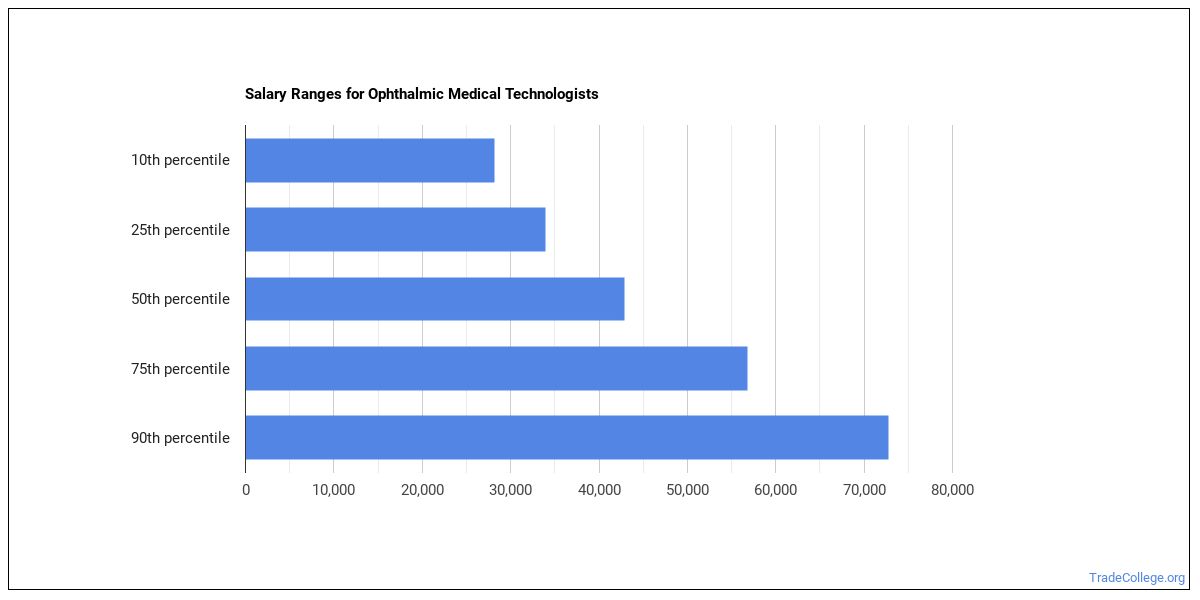
Pay by State
| State | Annual median salary |
|---|---|
| Wyoming | $65,560 |
| Delaware | $64,860 |
| Washington | $59,960 |
| Kansas | $59,780 |
| Maine | $58,820 |
| California | $58,310 |
| Oregon | $58,240 |
| Massachusetts | $58,210 |
| New York | $57,690 |
| Hawaii | $56,260 |
| New Jersey | $56,100 |
| Rhode Island | $55,840 |
| New Hampshire | $55,350 |
| Arizona | $55,200 |
| Minnesota | $55,070 |
| Colorado | $54,080 |
| Montana | $53,450 |
| District of Columbia | $53,020 |
| Vermont | $52,470 |
| South Dakota | $51,460 |
| Georgia | $51,020 |
| Alaska | $49,900 |
| Kentucky | $49,900 |
| Illinois | $49,570 |
| Wisconsin | $49,370 |
| Nevada | $49,270 |
| Connecticut | $49,120 |
| West Virginia | $49,000 |
| Virginia | $48,380 |
| Michigan | $47,550 |
| Texas | $47,410 |
| Indiana | $47,300 |
| Idaho | $47,130 |
| Tennessee | $47,000 |
| Ohio | $46,730 |
| Maryland | $46,550 |
| New Mexico | $46,440 |
| North Dakota | $46,020 |
| Iowa | $46,010 |
| Pennsylvania | $45,700 |
| North Carolina | $45,100 |
| Nebraska | $44,480 |
| Utah | $44,360 |
| Florida | $43,980 |
| Alabama | $43,370 |
| Missouri | $41,860 |
| Oklahoma | $41,080 |
| South Carolina | $40,420 |
| Arkansas | $39,260 |
| Mississippi | $38,290 |
| Louisiana | $37,630 |
| Puerto Rico | $36,400 |
Where Ophthalmic Medical Technologists Earn the Most
Earnings for ophthalmic medical technologists differ across the country. The following regions pay the most:
| Region | Median annual wage | Share of U.S. jobs | Location quotient |
|---|---|---|---|
| Far Western US | $57,645 | 19.4% | 1.21 |
| New England | $56,248 | 4.2% | 0.93 |
| Middle Atlantic | $52,050 | 15.6% | 1.12 |
| Rocky Mountains | $50,355 | 2.9% | 0.76 |
| Great Lakes | $47,965 | 14.9% | 1.12 |
| Southwest | $47,761 | 11.8% | 0.94 |
| Plains States | $46,192 | 7.1% | 1.28 |
| Southeast | $44,657 | 23.6% | 1.07 |
Highest-Paying Metro Areas for Ophthalmic Medical Technologists
| Metro area | State | Median annual wage | Employment |
|---|---|---|---|
| San Jose-Sunnyvale-Santa Clara, CA | CA | $74,600 | 1,330 |
| Topeka, KS | KS | $71,680 | 50 |
| San Francisco-Oakland-Fremont, CA | CA | $70,850 | 2,990 |
| Bellingham, WA | WA | $69,340 | 90 |
| Flagstaff, AZ | AZ | $66,800 | 60 |
| Albany, OR | OR | $66,300 | 40 |
| Vallejo, CA | CA | $64,910 | 240 |
| Lexington-Fayette, KY | KY | $64,530 | 570 |
Which Industries Hire Ophthalmic Medical Technologists
The largest employers of ophthalmic medical technologists are found across these industries:
| Industry | Employment | Median annual wage |
|---|---|---|
| Health Care and Social Assistance | 155,430 | $48,230 |
| Educational Services | 3,190 | $61,290 |
| Administrative and Support and Waste Management and Remediation Services | 3,170 | $51,750 |
| Management of Companies and Enterprises | 1,670 | $49,320 |
| Finance and Insurance | 1,340 | $53,250 |
| Professional, Scientific, and Technical Services | 1,310 | $62,190 |
| Retail Trade | 900 | $47,610 |
| Wholesale Trade | 880 | $58,760 |
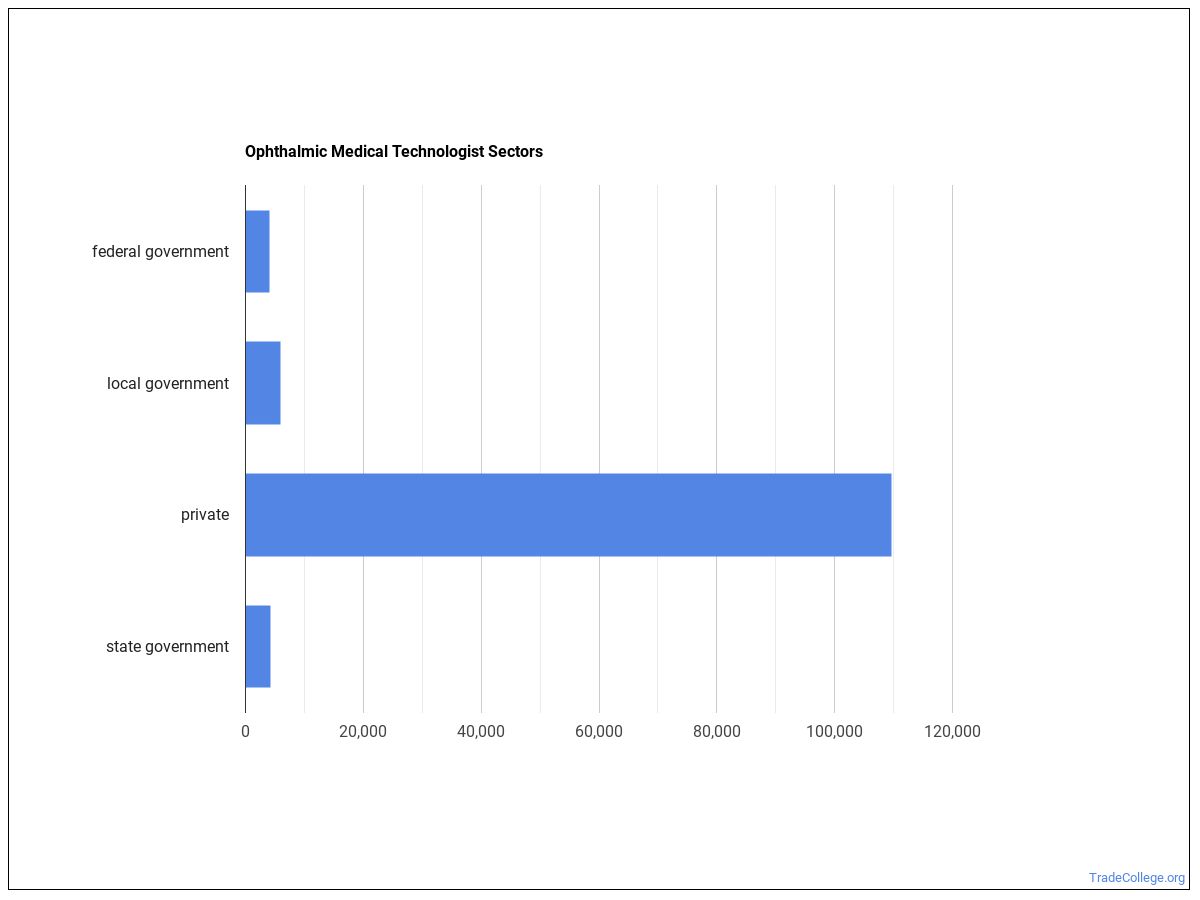
The table below shows some of the most common industries where those employed in this career field work.

Tech Stack
- Computer aided design CAD software: Autodesk AutoCAD (hot technology)
- Web platform development software: JavaScript (hot technology)
- Spreadsheet software: Microsoft Excel (hot technology)
- Office suite software: Microsoft Office software (hot technology)
- Electronic mail software: Microsoft Outlook (hot technology)
- Word processing software: Microsoft Word (hot technology)
- Enterprise resource planning ERP software: SAP software (hot technology)
What the Workplace Is Like
The on-the-job environment of ophthalmic medical technologists tends to involve the following characteristics:
- Indoors, Environmentally Controlled
- Face-to-Face Discussions with Individuals and Within Teams
- Contact With Others
- Work With or Contribute to a Work Group or Team
How to Become Ophthalmic Medical Technologists
Most ophthalmic medical technologists positions require a high school diploma or equivalent as the typical entry-level education. The role falls in Medium Preparation Needed (Job Zone 3), reflecting the level of preparation typically expected.
Other Careers to Consider
Similar Occupations
- Optometrists (Supplemental)
- Anesthesiologist Assistants (Supplemental)
- Radiation Therapists (Supplemental)
- Cardiologists (Supplemental)
- Dermatologists (Supplemental)
- Radiologists (Supplemental)
- Ophthalmologists, Except Pediatric (Supplemental)
- Orthopedic Surgeons, Except Pediatric (Supplemental)
Degree Programs
Students preparing for ophthalmic medical technologists typically earn programs in:
Health Professions and Related Programs
14 programs across 3 majors
Sources
This profile draws on the following authoritative sources:
- U.S. Bureau of Labor Statistics — Occupational Employment and Wage Statistics (OEWS) for employment and wage data by state and industry.
- BLS Employment Projections for total employment and growth forecasts.
- O*NET (Occupational Information Network) for skills, knowledge, tasks, work activities, work context, technology, and education-zone data.
SOC code: 29-2099.05 (Health Technologists and Technicians, All Other).

TradeCollege.org provides higher-education, college and university, degree, program, career, salary, and other helpful information to students, faculty, institutions, and other internet audiences. Presented information and data are subject to change. Inclusion on this website does not imply or represent a direct relationship with the company, school, or brand. Information, though believed correct at time of publication, may not be correct, and no warranty is provided. Contact the schools to verify any information before relying on it. Financial aid may be available for those who qualify. TradeCollege.org is a for-profit site, and the displayed options may include sponsored or recommended results, not necessarily based on your preferences.
© TradeCollege.org – All Rights Reserved.