Find Trade Colleges
Medical and Clinical Laboratory Technicians: Career Profile
Perform routine medical laboratory tests for the diagnosis, treatment, and prevention of disease. May work under the supervision of a medical technologist.
What Do Medical and Clinical Laboratory Technicians Take On?
The core tasks performed by medical and clinical laboratory technicians span:
- Conduct chemical analyses of body fluids, such as blood or urine, using microscope or automatic analyzer to detect abnormalities or diseases and enter findings into computer.
- Analyze the results of tests or experiments to ensure conformity to specifications, using special mechanical or electrical devices.
- Set up, maintain, calibrate, clean, and test sterility of medical laboratory equipment.
- Prepare standard volumetric solutions or reagents to be combined with samples, following standardized formulas or experimental procedures.
- Collect blood or tissue samples from patients, observing principles of asepsis to obtain blood sample.
- Supervise or instruct other technicians or laboratory assistants.
What Medical and Clinical Laboratory Technicians Need to Know
Successful medical and clinical laboratory technicians combine a mix of skills and domain knowledge.
Most Important Skills
These are the skills that matter most in this role, rated on an importance scale of 0 to 5:
Core Knowledge
Other Medical and Clinical Laboratory Technicians Job Titles
People in this occupation may also be known by titles such as:
- Biotechnician
- Blood Bank Laboratory Technician
- Blood Typer
- Blood and Plasma Laboratory Assistant
- Blood or Blood Bank Technician
- Catheterization Laboratory Technician (Catheterization Lab Tech)
- Certified Clinical Laboratory Technician
- Certified Dialysis Technician
Employment and Demand
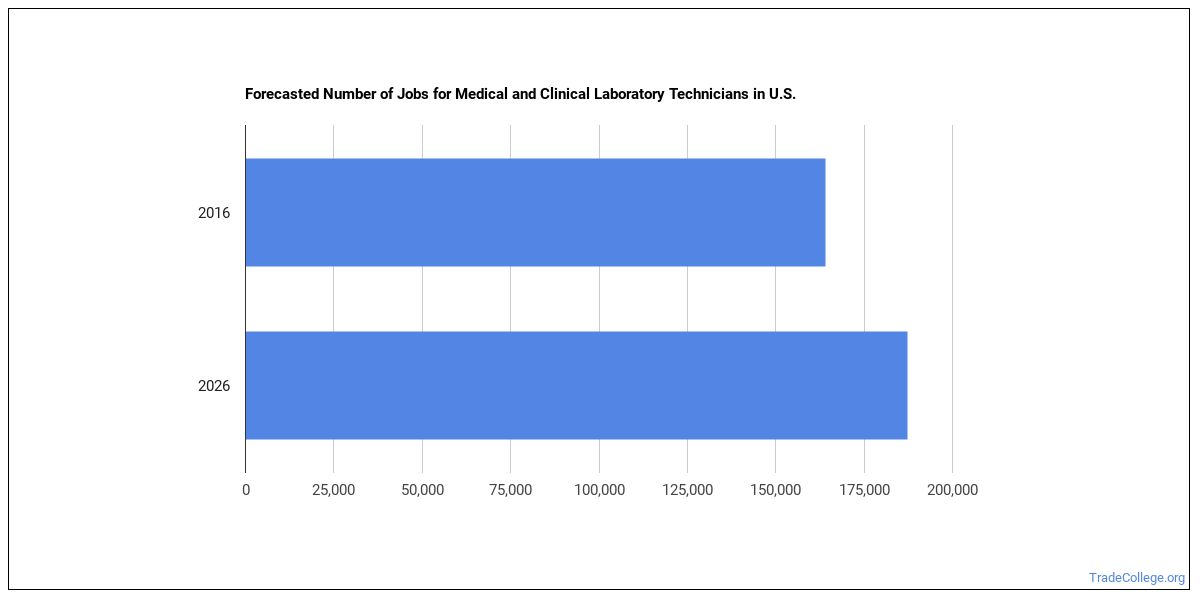
There are roughly 1,379,632 medical and clinical laboratory technicians working in the United States today. Demand is forecast to grow by +12.4% over the projection horizon.
Medical and Clinical Laboratory Technicians Pay
| Statistic | Value |
|---|---|
| Annual median | $155,908 |
| Hourly median | $74.96 |
| 10th percentile | $91,233 |
| 25th percentile | $123,571 |
| 75th percentile | $188,246 |
| 90th percentile | $220,583 |
Wages vary widely based on experience, location, and industry.

Tools and Technology
- Word processing software: Google Docs (hot technology)
- Medical software: MEDITECH software (hot technology)
- Spreadsheet software: Microsoft Excel (hot technology)
- Office suite software: Microsoft Office software (hot technology)
- Electronic mail software: Microsoft Outlook (hot technology)
- Presentation software: Microsoft PowerPoint (hot technology)
- Word processing software: Microsoft Word (hot technology)
- Enterprise resource planning ERP software: SAP software (hot technology)
Work Environment
Daily working conditions for medical and clinical laboratory technicians is shaped by the following characteristics:
- Face-to-Face Discussions with Individuals and Within Teams
- Indoors, Environmentally Controlled
- Importance of Being Exact or Accurate
- Wear Common Protective or Safety Equipment such as Safety Shoes, Glasses, Gloves, Hearing Protection, Hard Hats, or Life Jackets
- Telephone Conversations
Getting Started in This Career
Entry-level medical and clinical laboratory technicians positions require a bachelor’s degree as the typical entry-level education. The role falls in Medium Preparation Needed (Job Zone 3), reflecting the level of preparation typically expected.
Similar Occupations
Similar Occupations
- Calibration Technologists and Technicians (Supplemental)
- Microbiologists (Supplemental)
- Biological Technicians (Primary-Long)
- Chemical Technicians (Supplemental)
- Cardiologists (Supplemental)
- Physicians, Pathologists (Supplemental)
- Medical and Clinical Laboratory Technologists (Primary-Short)
- Cytogenetic Technologists (Primary-Short)
Degree Programs
Students preparing for medical and clinical laboratory technicians commonly pursue programs in:
Health Professions and Related Programs
7 programs across 2 majors
About the Data
This profile draws on the following authoritative sources:
- U.S. Bureau of Labor Statistics — Occupational Employment and Wage Statistics (OEWS) for employment and wage data by state and industry.
- BLS Employment Projections for total employment and growth forecasts.
- O*NET (Occupational Information Network) for skills, knowledge, tasks, work activities, work context, technology, and education-zone data.
SOC code: 29-2012.00 (Medical and Clinical Laboratory Technicians).

TradeCollege.org provides higher-education, college and university, degree, program, career, salary, and other helpful information to students, faculty, institutions, and other internet audiences. Presented information and data are subject to change. Inclusion on this website does not imply or represent a direct relationship with the company, school, or brand. Information, though believed correct at time of publication, may not be correct, and no warranty is provided. Contact the schools to verify any information before relying on it. Financial aid may be available for those who qualify. TradeCollege.org is a for-profit site, and the displayed options may include sponsored or recommended results, not necessarily based on your preferences.
© TradeCollege.org – All Rights Reserved.