Find Trade Colleges
Gas Compressor and Gas Pumping Station Operators: Career Profile
Operate steam-, gas-, electric motor-, or internal combustion-engine driven compressors. Transmit, compress, or recover gases, such as butane, nitrogen, hydrogen, and natural gas.
What Do Gas Compressor and Gas Pumping Station Operators Perform?
The core tasks performed by gas compressor and gas pumping station operators span:
- Monitor meters and pressure gauges to determine consumption rate variations, temperatures, and pressures.
- Respond to problems by adjusting control room equipment or instructing other personnel to adjust equipment at problem locations or in other control areas.
- Record instrument readings and operational changes in operating logs.
- Adjust valves and equipment to obtain specified performance.
- Move controls and turn valves to start compressor engines, pumps, and auxiliary equipment.
- Operate power-driven pumps that transfer liquids, semi-liquids, gases, or powdered materials.
- Submit daily reports on facility operations.
- Take samples of gases and conduct chemical tests to determine gas quality and sulfur or moisture content, or send samples to laboratories for analysis.
Key Skills and Knowledge
Effective gas compressor and gas pumping station operators draw on a mix of skills and domain knowledge.
Most Important Skills
The competencies most central to this role, rated on an importance scale of 0 to 5:
Knowledge Areas
Other Gas Compressor and Gas Pumping Station Operators Job Titles
Common job titles for this role include:
- Acetylene Gas Compressor
- Air Compressor Technician
- Butadiene Compressor Operator
- Butane Compressor Operator
- Compressor
- Compressor Engineer
- Compressor Operator
- Compressor Station Operator
Job Outlook
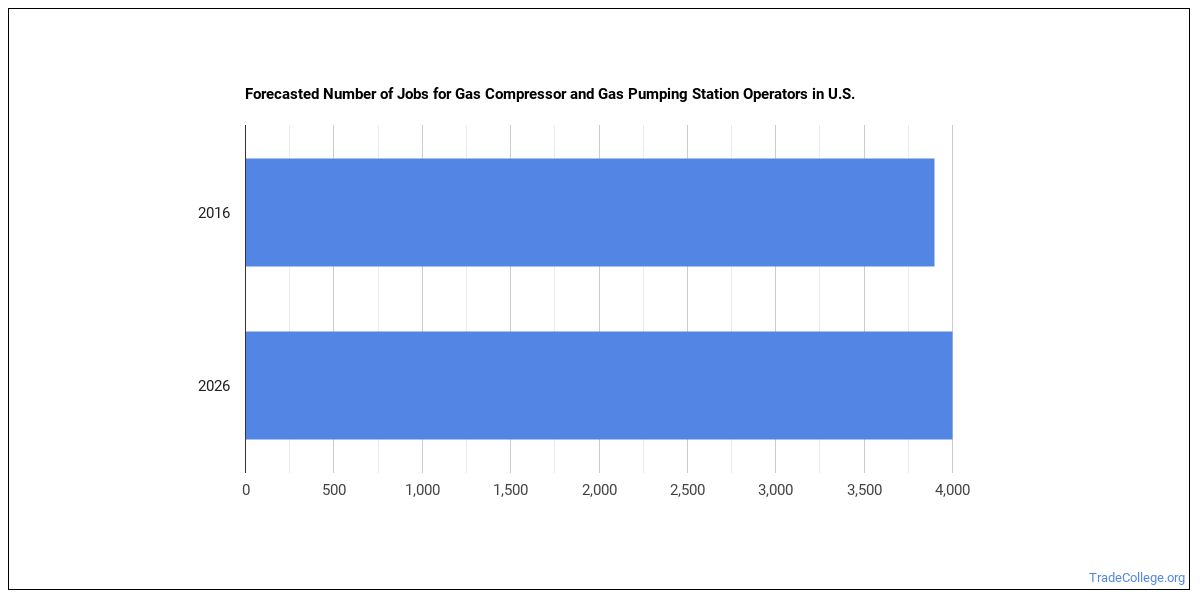
The U.S. employs around 1,089,993 gas compressor and gas pumping station operators working in the United States today. Employment is projected to grow by +4.1% over the projection horizon.
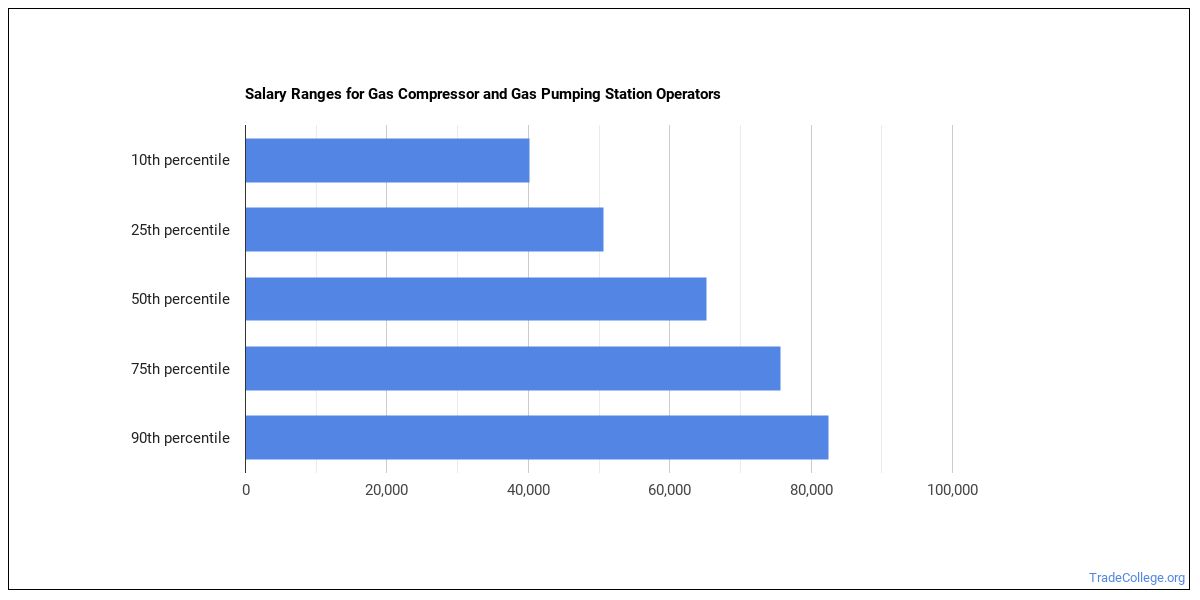
Salary for Gas Compressor and Gas Pumping Station Operators
| Statistic | Value |
|---|---|
| Annual median | $51,900 |
| Hourly median | $24.95 |
| 10th percentile | $31,317 |
| 25th percentile | $41,608 |
| 75th percentile | $62,191 |
| 90th percentile | $72,483 |
Pay can vary substantially based on experience, location, and industry.
How Much Do Gas Compressor and Gas Pumping Station Operators Make in Different U.S. States?
| State | Annual median salary |
|---|---|
| Michigan | $107,550 |
| Kansas | $105,790 |
| Alaska | $104,550 |
| Indiana | $98,360 |
| Ohio | $91,740 |
| New Mexico | $84,960 |
| West Virginia | $78,780 |
| Texas | $77,370 |
| Montana | $73,540 |
| Nebraska | $64,230 |
| Arkansas | $64,110 |
| Pennsylvania | $64,080 |
| Virginia | $63,410 |
| Tennessee | $62,650 |
| California | $60,270 |
| New York | $59,590 |
| Oregon | $58,720 |
| North Carolina | $56,670 |
| Oklahoma | $52,000 |
| Kentucky | $48,980 |
| Missouri | $47,510 |
| Washington | $47,360 |
| Alabama | $39,410 |
| Florida | $37,260 |
| Puerto Rico | $21,540 |
Top-Paying U.S. Regions
Compensation for gas compressor and gas pumping station operators vary by region. Top regions by median wage:
| Region | Median annual wage | Share of U.S. jobs | Location quotient |
|---|---|---|---|
| Far Western US | $104,550 | 2.1% | 7.65 |
| Great Lakes | $96,952 | 10.6% | 0.99 |
| Plains States | $81,294 | 4.8% | 1.44 |
| Southwest | $76,155 | 54.8% | 3.93 |
| Middle Atlantic | $63,530 | 13.0% | 1.93 |
| Southeast | $58,199 | 13.5% | 2.75 |
| Other U.S. Territories | $21,540 | 1.3% | 1.61 |
Highest-Paying Metro Areas for Gas Compressor and Gas Pumping Station Operators
| Metro area | State | Median annual wage | Employment |
|---|---|---|---|
| Chicago-Naperville-Elgin, IL-IN | IL | $98,810 | 30 |
| Cleveland, OH | OH | $90,490 | 30 |
| Houston-Pasadena-The Woodlands, TX | TX | $88,080 | |
| Dallas-Fort Worth-Arlington, TX | TX | $72,030 | 110 |
| Pittsburgh, PA | PA | $68,590 | 70 |
| Boston-Cambridge-Newton, MA-NH | MA | $63,900 | 40 |
| New York-Newark-Jersey City, NY-NJ | NY | $60,320 | |
| Greeley, CO | CO | $57,530 |
Industry Breakdown
The largest employers of gas compressor and gas pumping station operators are concentrated in the following sectors:
| Industry | Employment | Median annual wage |
|---|---|---|
| Transportation and Warehousing | 1,970 | $80,830 |
| Wholesale Trade | 780 | $49,480 |
| Mining, Quarrying, and Oil and Gas Extraction | 750 | $64,810 |
| Utilities | 500 | $92,020 |
| Retail Trade | 350 | $56,670 |
| Manufacturing | 190 | $63,410 |
| Construction | 80 | $79,940 |
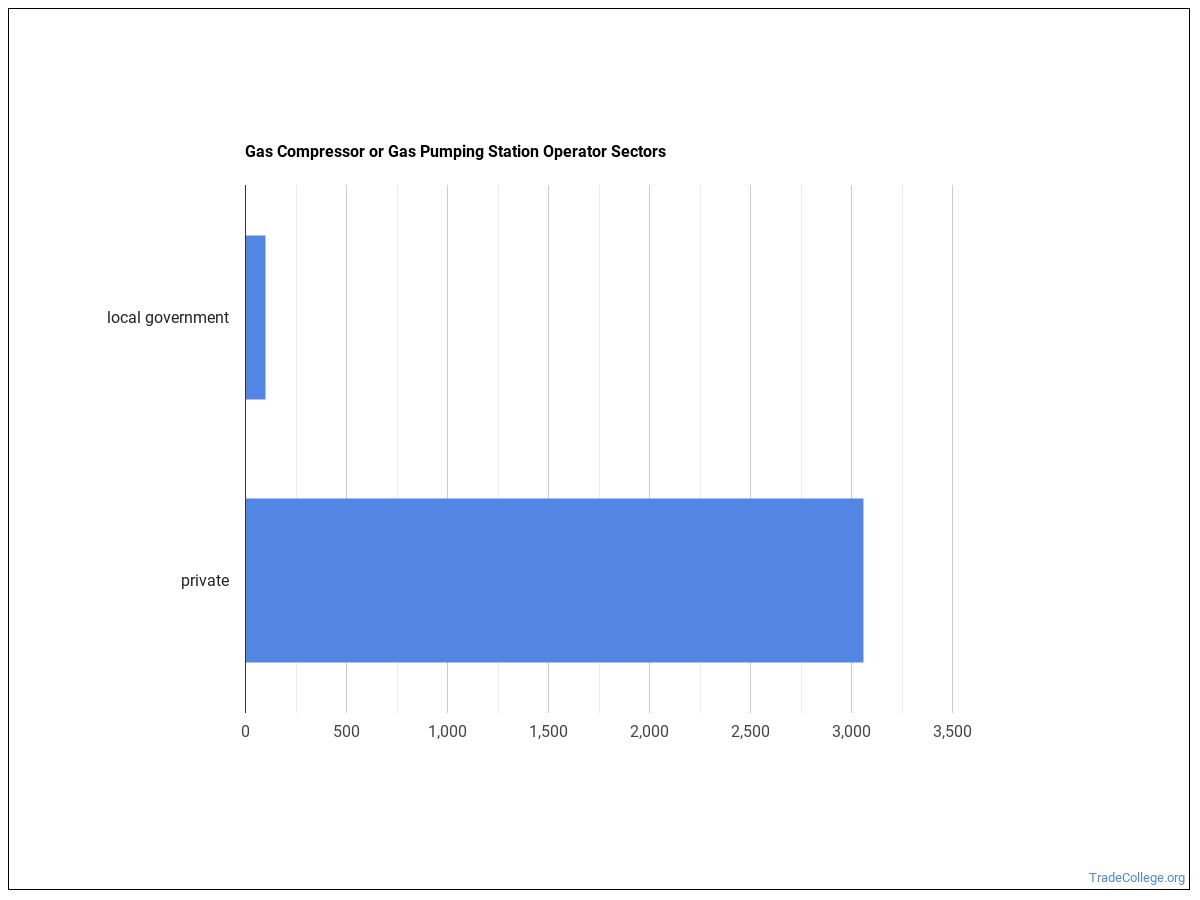
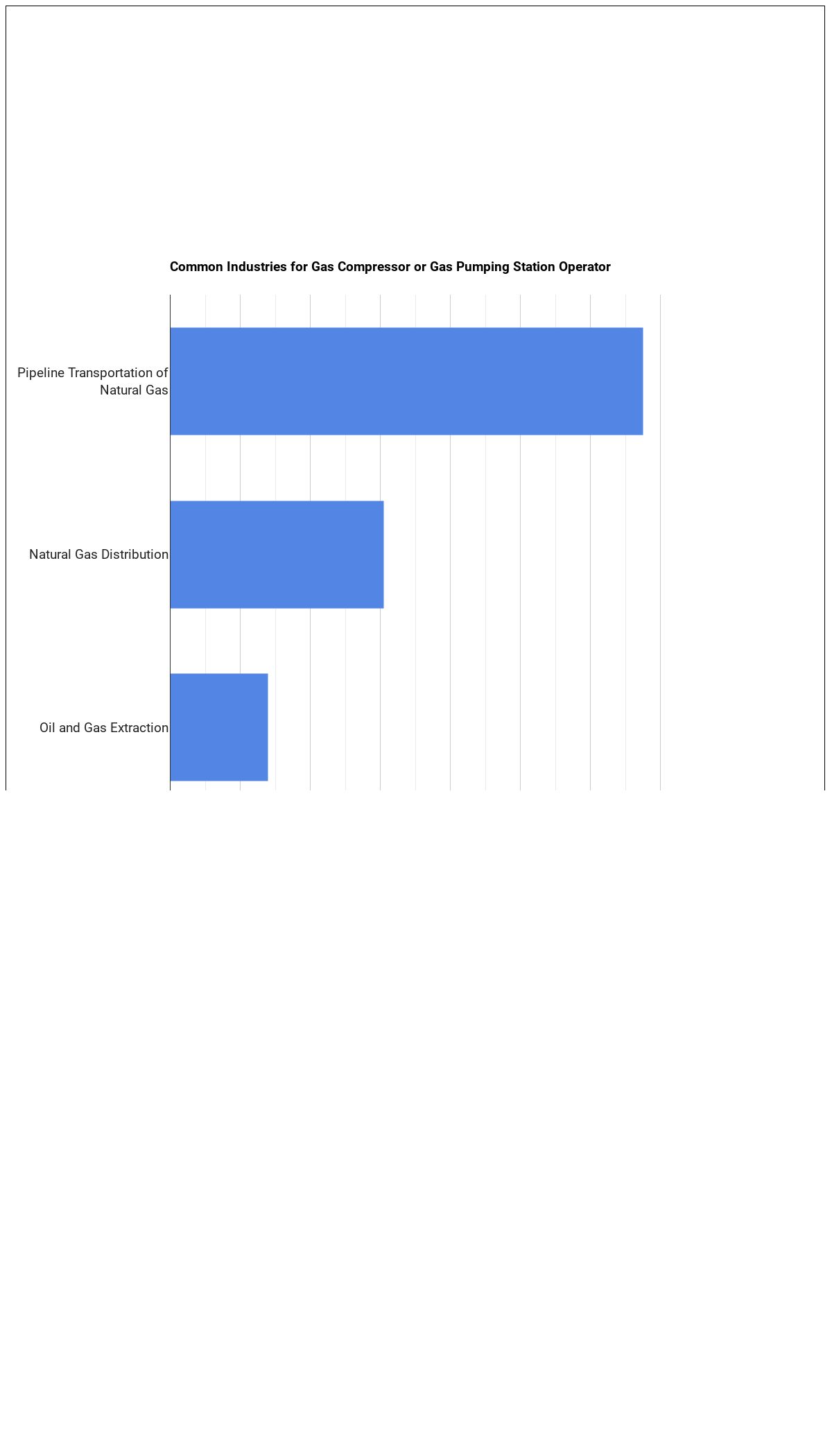
Gas Compressor and Gas Pumping Station Operators work in the following industries:
Software Gas Compressor and Gas Pumping Station Operators Use
- Spreadsheet software: Microsoft Excel (hot technology)
- Office suite software: Microsoft Office software (hot technology)
- Electronic mail software: Microsoft Outlook (hot technology)
- Word processing software: Microsoft Word (hot technology)
Work Environment
The work environment for gas compressor and gas pumping station operators reflects the following characteristics:
- Wear Common Protective or Safety Equipment such as Safety Shoes, Glasses, Gloves, Hearing Protection, Hard Hats, or Life Jackets
- Outdoors, Exposed to All Weather Conditions
- Telephone Conversations
- Health and Safety of Other Workers
Education and Training
Most gas compressor and gas pumping station operators positions require a high school diploma or equivalent as the typical entry-level education. This occupation sits in Some Preparation Needed (Job Zone 2), signaling the level of preparation typically expected.
Similar Occupations
Similar Occupations
- Control and Valve Installers and Repairers, Except Mechanical Door (Primary-Long)
- Industrial Machinery Mechanics (Supplemental)
- Maintenance Workers, Machinery (Supplemental)
- Geothermal Technicians (Supplemental)
- Engine and Other Machine Assemblers (Supplemental)
- Metal-Refining Furnace Operators and Tenders (Supplemental)
- Heat Treating Equipment Setters, Operators, and Tenders, Metal and Plastic (Supplemental)
- Power Plant Operators (Primary-Short)
Sources
This profile draws on the following authoritative sources:
- U.S. Bureau of Labor Statistics — Occupational Employment and Wage Statistics (OEWS) for employment and wage data by state and industry.
- BLS Employment Projections for total employment and growth forecasts.
- O*NET (Occupational Information Network) for skills, knowledge, tasks, work activities, work context, technology, and education-zone data.
SOC code: 53-7071.00 (Gas Compressor and Gas Pumping Station Operators).

TradeCollege.org provides higher-education, college and university, degree, program, career, salary, and other helpful information to students, faculty, institutions, and other internet audiences. Presented information and data are subject to change. Inclusion on this website does not imply or represent a direct relationship with the company, school, or brand. Information, though believed correct at time of publication, may not be correct, and no warranty is provided. Contact the schools to verify any information before relying on it. Financial aid may be available for those who qualify. TradeCollege.org is a for-profit site, and the displayed options may include sponsored or recommended results, not necessarily based on your preferences.
© TradeCollege.org – All Rights Reserved.