Find Trade Colleges
Cytotechnologists: Career Overview
Stain, mount, and study cells to detect evidence of cancer, hormonal abnormalities, and other pathological conditions following established standards and practices.
What Do Cytotechnologists Do?
The day-to-day responsibilities of cytotechnologists span:
- Examine cell samples to detect abnormalities in the color, shape, or size of cellular components and patterns.
- Document specimens by verifying patients' and specimens' information.
- Submit slides with abnormal cell structures to pathologists for further examination.
- Prepare and analyze samples, such as Papanicolaou (PAP) smear body fluids and fine needle aspirations (FNAs), to detect abnormal conditions.
- Examine specimens, using microscopes, to evaluate specimen quality.
- Maintain effective laboratory operations by adhering to standards of specimen collection, preparation, or laboratory safety.
- Provide patient clinical data or microscopic findings to assist pathologists in the preparation of pathology reports.
- Assist pathologists or other physicians to collect cell samples by fine needle aspiration (FNA) biopsy or other method.
Key Skills and Knowledge
Effective cytotechnologists rely on a mix of skills and domain knowledge.
Top Skills
The competencies most important for this role, rated on an importance scale of 0 to 5:
Core Knowledge
Related Job Titles
This career also goes by job titles like:
- Certified Cytotechnologist
- Cytologist
- Cytology Applications Specialist
- Cytology Coordinator
- Cytology Technical Specialist
- Cytopathology Technologist
- Cytotechnologist
Job Outlook
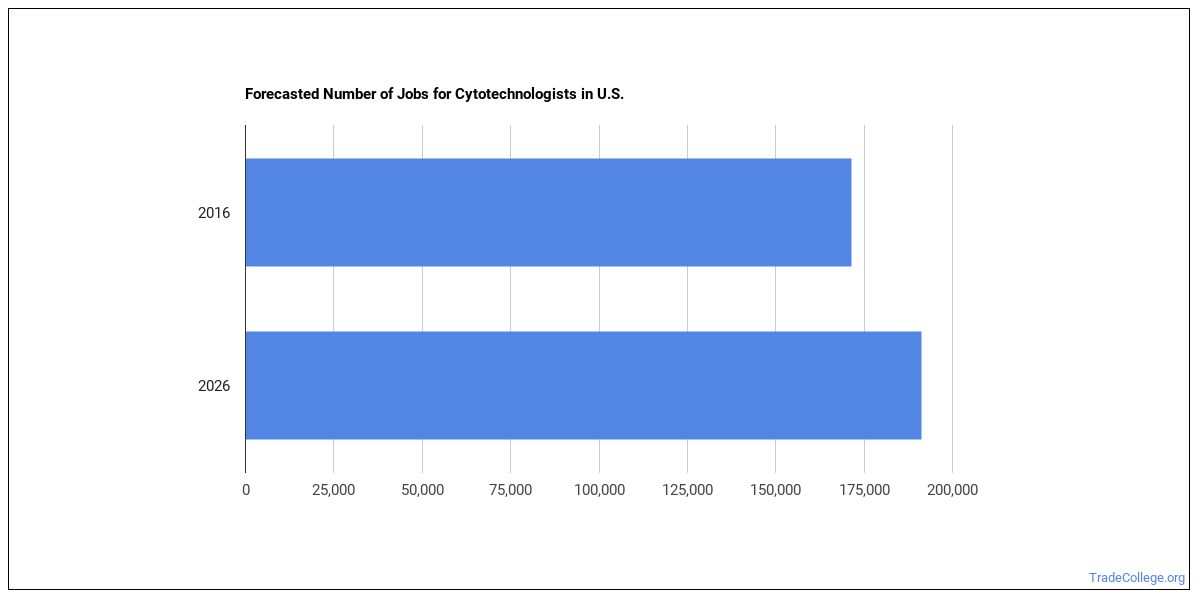
There are about 2,344,909 cytotechnologists working in the United States today. Demand is forecast to grow by +10.3% over the projection horizon.
How Much Do Cytotechnologists Make?
| Statistic | Value |
|---|---|
| Annual median | $155,812 |
| Hourly median | $74.91 |
| 10th percentile | $89,619 |
| 25th percentile | $122,715 |
| 75th percentile | $188,909 |
| 90th percentile | $222,005 |
Pay can vary substantially based on experience, location, and industry.

Tech Stack
- Expert system software: Ansible software (hot technology)
- Medical software: MEDITECH software (hot technology)
- Spreadsheet software: Microsoft Excel (hot technology)
- Office suite software: Microsoft Office software (hot technology)
- Word processing software: Microsoft Word (hot technology)
What the Workplace Is Like
The work environment for cytotechnologists is shaped by the following characteristics:
- Indoors, Environmentally Controlled
- Spend Time Making Repetitive Motions
- Importance of Being Exact or Accurate
- Face-to-Face Discussions with Individuals and Within Teams
How to Become Cytotechnologists
Typical cytotechnologists positions require a bachelor’s degree as the typical entry-level education. This career aligns with Extensive Preparation Needed (Job Zone 5), indicating the level of preparation typically expected.
Other Careers to Consider
Similar Occupations
- Microbiologists (Primary-Long)
- Medical Scientists, Except Epidemiologists (Primary-Long)
- Physicians, Pathologists (Primary-Short)
- Radiologists (Primary-Long)
- Medical and Clinical Laboratory Technologists (Primary-Short)
- Cytogenetic Technologists (Primary-Short)
- Histotechnologists (Primary-Short)
- Medical and Clinical Laboratory Technicians (Supplemental)
Top Programs to Study For This Career
Future cytotechnologists commonly pursue programs in:
Health Professions and Related Programs
5 programs across 1 majors
References
Data on this page comes from the following authoritative sources:
- U.S. Bureau of Labor Statistics — Occupational Employment and Wage Statistics (OEWS) for employment and wage data by state and industry.
- BLS Employment Projections for total employment and growth forecasts.
- O*NET (Occupational Information Network) for skills, knowledge, tasks, work activities, work context, technology, and education-zone data.
SOC code: 29-2011.02 (Medical and Clinical Laboratory Technologists).

TradeCollege.org provides higher-education, college and university, degree, program, career, salary, and other helpful information to students, faculty, institutions, and other internet audiences. Presented information and data are subject to change. Inclusion on this website does not imply or represent a direct relationship with the company, school, or brand. Information, though believed correct at time of publication, may not be correct, and no warranty is provided. Contact the schools to verify any information before relying on it. Financial aid may be available for those who qualify. TradeCollege.org is a for-profit site, and the displayed options may include sponsored or recommended results, not necessarily based on your preferences.
© TradeCollege.org – All Rights Reserved.