Find Trade Colleges
Air Traffic Controllers: Career Overview
Control air traffic on and within vicinity of airport, and movement of air traffic between altitude sectors and control centers, according to established procedures and policies. Authorize, regulate, and control commercial airline flights according to government or company regulations to expedite and ensure flight safety.
What Tasks Do Air Traffic Controllers Take On?
The core tasks performed by air traffic controllers cover:
- Inform pilots about nearby planes or potentially hazardous conditions, such as weather, speed and direction of wind, or visibility problems.
- Issue landing and take-off authorizations or instructions.
- Transfer control of departing flights to traffic control centers and accept control of arriving flights.
- Provide flight path changes or directions to emergency landing fields for pilots traveling in bad weather or in emergency situations.
- Alert airport emergency services in cases of emergency or when aircraft are experiencing difficulties.
- Monitor or direct the movement of aircraft within an assigned air space or on the ground at airports to minimize delays and maximize safety.
- Direct pilots to runways when space is available or direct them to maintain a traffic pattern until there is space for them to land.
- Monitor aircraft within a specific airspace, using radar, computer equipment, or visual references.
What Air Traffic Controllers Need to Know
Top air traffic controllers rely on a mix of skills and domain knowledge.
Key Skills
The abilities most important for this role, rated on an importance scale of 0 to 5:
Top Knowledge Areas
Other Air Traffic Controllers Job Titles
Common job titles for this role include:
- Access Control Specialist
- Air Route Controller
- Air Route Traffic Controller
- Air Traffic Control Operator
- Air Traffic Control Specialist (ATCS)
- Air Traffic Control Support Specialist (ATC Support Specialist)
- Air Traffic Controller (ATC)
- Air Traffic Coordinator
How Many Air Traffic Controllers Are There?
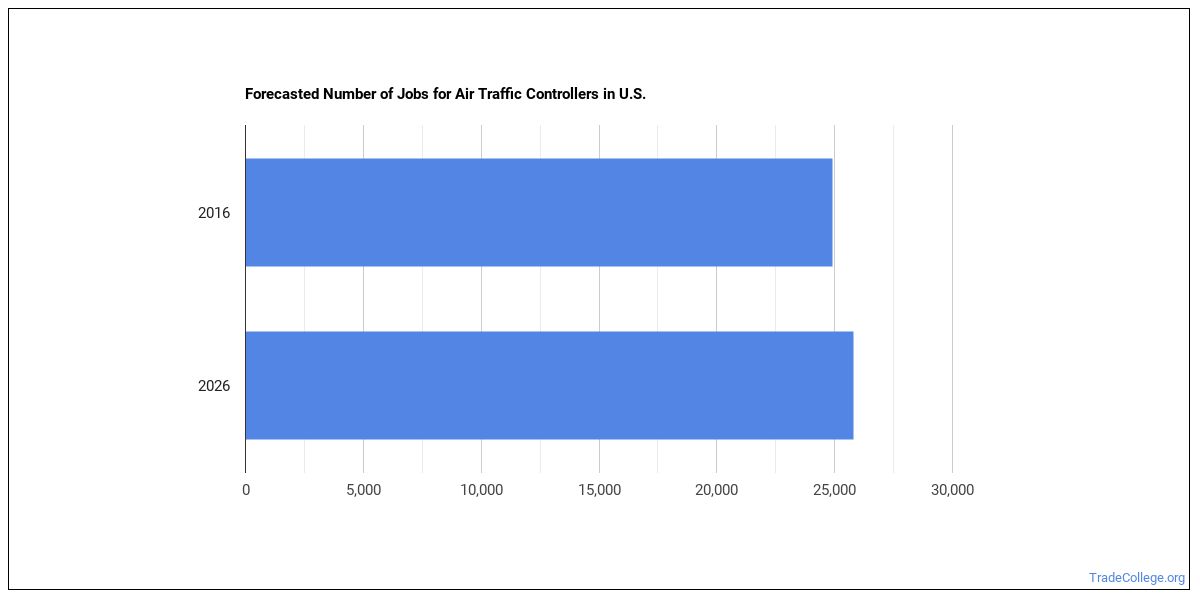
The U.S. employs around 502,845 air traffic controllers working in the United States today. Demand is forecast to grow by +1.9% over the projection horizon.
How Much Do Air Traffic Controllers Make?
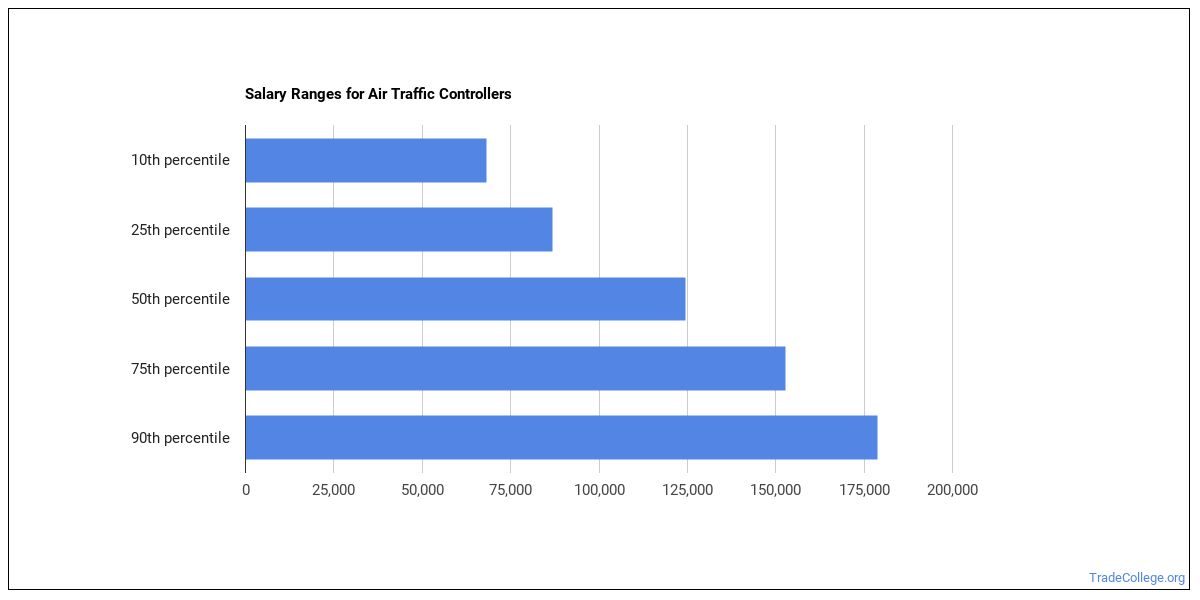
| Statistic | Value |
|---|---|
| Annual median | $46,187 |
| Hourly median | $22.21 |
| 10th percentile | $29,247 |
| 25th percentile | $37,717 |
| 75th percentile | $54,656 |
| 90th percentile | $63,126 |
Wages vary widely based on experience, location, and industry.
How Much Do Air Traffic Controllers Make in Different U.S. States?
| State | Annual median salary |
|---|---|
| Virginia | $185,890 |
| Minnesota | $176,030 |
| Illinois | $175,090 |
| Georgia | $174,600 |
| Colorado | $172,310 |
| Texas | $167,710 |
| Washington | $164,070 |
| Kansas | $156,620 |
| Utah | $156,120 |
| Indiana | $155,790 |
| Tennessee | $153,670 |
| California | $152,010 |
| Nevada | $147,700 |
| New Mexico | $145,290 |
| Florida | $144,710 |
| New York | $142,190 |
| Hawaii | $142,040 |
| New Jersey | $135,470 |
| Arizona | $130,960 |
| Pennsylvania | $129,310 |
| Kentucky | $126,550 |
| Rhode Island | $123,610 |
| Connecticut | $121,910 |
| Oklahoma | $121,580 |
| North Dakota | $121,470 |
| North Carolina | $120,580 |
| Alaska | $120,370 |
| Puerto Rico | $119,560 |
| Idaho | $117,150 |
| Missouri | $115,440 |
| Maryland | $114,620 |
| Michigan | $113,650 |
| Oregon | $113,030 |
| Alabama | $112,740 |
| Nebraska | $108,990 |
| Guam | $108,200 |
| South Carolina | $107,330 |
| Wisconsin | $106,750 |
| Massachusetts | $103,230 |
| Louisiana | $99,670 |
| Arkansas | $99,490 |
| South Dakota | $98,530 |
| Iowa | $95,200 |
| Mississippi | $91,480 |
| Wyoming | $89,650 |
| West Virginia | $86,390 |
| District of Columbia | $35,940 |
Pay by U.S. Region
Earnings for air traffic controllers differ across the country. The following regions pay the most:
| Region | Median annual wage | Share of U.S. jobs | Location quotient |
|---|---|---|---|
| Rocky Mountains | $162,324 | 5.8% | 1.64 |
| Southwest | $156,557 | 14.1% | 1.20 |
| Great Lakes | $154,117 | 10.1% | 1.05 |
| Plains States | $148,828 | 7.4% | 1.33 |
| Southeast | $148,525 | 29.7% | 1.29 |
| Far Western US | $147,299 | 18.7% | 2.23 |
| Other U.S. Territories | $116,720 | 0.8% | 1.79 |
| New England | $112,536 | 1.2% | 0.33 |
Highest-Paying Metro Areas for Air Traffic Controllers
| Metro area | State | Median annual wage | Employment |
|---|---|---|---|
| Sacramento-Roseville-Folsom, CA | CA | $192,500 | 240 |
| San Francisco-Oakland-Fremont, CA | CA | $188,930 | 420 |
| Chicago-Naperville-Elgin, IL-IN | IL | $184,930 | 840 |
| Dallas-Fort Worth-Arlington, TX | TX | $182,890 | 780 |
| Atlanta-Sandy Springs-Roswell, GA | GA | $182,310 | 820 |
| Philadelphia-Camden-Wilmington, PA-NJ-DE-MD | PA | $181,200 | 190 |
| New York-Newark-Jersey City, NY-NJ | NY | $180,090 | 1,090 |
| Minneapolis-St. Paul-Bloomington, MN-WI | MN | $178,920 | 580 |
Industry Breakdown
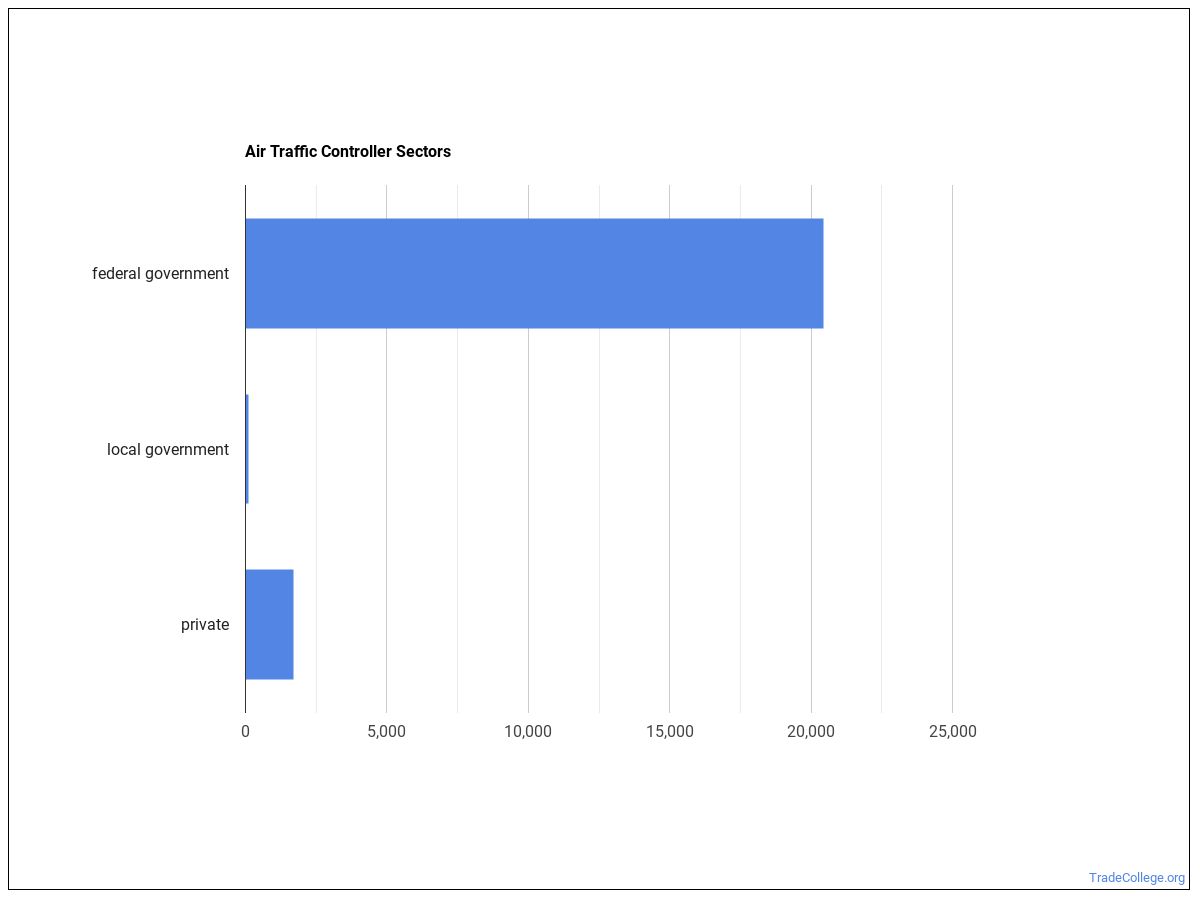
The bulk of air traffic controllers are found across these industries:
| Industry | Employment | Median annual wage |
|---|---|---|
| Transportation and Warehousing | 1,730 | $82,400 |
| Educational Services | 120 | $61,100 |
| Professional, Scientific, and Technical Services | 70 | $164,370 |
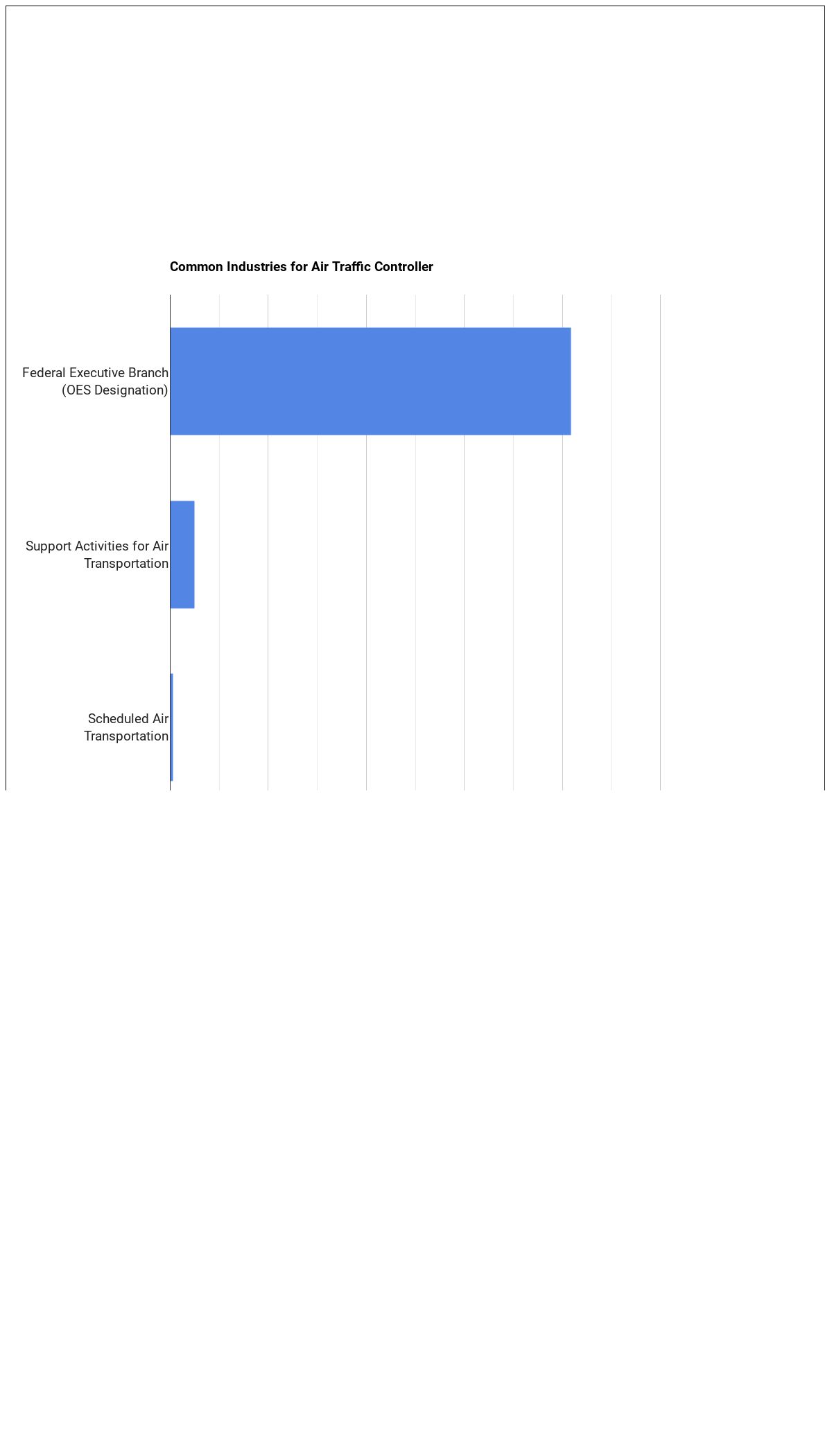
Below are examples of industries where air traffic controllers work:
Software Air Traffic Controllers Use
- Document management software: Adobe Acrobat (hot technology)
- Data base user interface and query software: Microsoft Access (hot technology)
- Spreadsheet software: Microsoft Excel (hot technology)
- Office suite software: Microsoft Office software (hot technology)
- Electronic mail software: Microsoft Outlook (hot technology)
- Presentation software: Microsoft PowerPoint (hot technology)
- Word processing software: Microsoft Word (hot technology)
- Enterprise resource planning ERP software: SAP software (hot technology)
The Day-to-Day Environment
The on-the-job environment of air traffic controllers reflects the following characteristics:
- Frequency of Decision Making
- Indoors, Environmentally Controlled
- Importance of Being Exact or Accurate
- Impact of Decisions on Co-workers or Company Results
- Work With or Contribute to a Work Group or Team
How to Become Air Traffic Controllers
Typical air traffic controllers positions require a high school diploma or equivalent as the typical entry-level education. This career aligns with Medium Preparation Needed (Job Zone 3), signaling the level of preparation typically expected.
Related Careers
Similar Occupations
- Transportation, Storage, and Distribution Managers (Supplemental)
- Public Safety Telecommunicators (Primary-Long)
- Dispatchers, Except Police, Fire, and Ambulance (Primary-Long)
- Avionics Technicians (Supplemental)
- Power Distributors and Dispatchers (Supplemental)
- Aircraft Cargo Handling Supervisors (Primary-Short)
- First-Line Supervisors of Material-Moving Machine and Vehicle Operators (Supplemental)
- First-Line Supervisors of Passenger Attendants (Supplemental)
Top Programs to Study For This Career
Aspiring air traffic controllers often complete programs in:
Transportation and Materials Moving
1 programs across 1 majors
About the Data
Statistics shown above are sourced from the following authoritative sources:
- U.S. Bureau of Labor Statistics — Occupational Employment and Wage Statistics (OEWS) for employment and wage data by state and industry.
- BLS Employment Projections for total employment and growth forecasts.
- O*NET (Occupational Information Network) for skills, knowledge, tasks, work activities, work context, technology, and education-zone data.
SOC code: 53-2021.00 (Air Traffic Controllers).

TradeCollege.org provides higher-education, college and university, degree, program, career, salary, and other helpful information to students, faculty, institutions, and other internet audiences. Presented information and data are subject to change. Inclusion on this website does not imply or represent a direct relationship with the company, school, or brand. Information, though believed correct at time of publication, may not be correct, and no warranty is provided. Contact the schools to verify any information before relying on it. Financial aid may be available for those who qualify. TradeCollege.org is a for-profit site, and the displayed options may include sponsored or recommended results, not necessarily based on your preferences.
© TradeCollege.org – All Rights Reserved.