Find Trade Colleges
Agricultural Equipment Operators: Career Overview
Drive and control equipment to support agricultural activities such as tilling soil; planting, cultivating, and harvesting crops; feeding and herding livestock; or removing animal waste. May perform tasks such as crop baling or hay bucking. May operate stationary equipment to perform post-harvest tasks such as husking, shelling, threshing, and ginning.
The Daily Work of Agricultural Equipment Operators Take On?
The day-to-day responsibilities of agricultural equipment operators cover:
- Load and unload crops or containers of materials, manually or using conveyors, handtrucks, forklifts, or transfer augers.
- Mix specified materials or chemicals, and dump solutions, powders, or seeds into planter or sprayer machinery.
- Spray fertilizer or pesticide solutions to control insects, fungus and weed growth, and diseases, using hand sprayers.
- Observe and listen to machinery operation to detect equipment malfunctions.
- Manipulate controls to set, activate, and adjust mechanisms on machinery.
- Operate or tend equipment used in agricultural production, such as tractors, combines, and irrigation equipment.
- Adjust, repair, and service farm machinery and notify supervisors when machinery malfunctions.
- Attach farm implements such as plows, discs, sprayers, or harvesters to tractors, using bolts and hand tools.
What Agricultural Equipment Operators Need to Know
Top agricultural equipment operators draw on a mix of skills and domain knowledge.
Key Skills
These are the skills that matter most in this role, rated on an importance scale of 0 to 5:
Core Knowledge
Other Agricultural Equipment Operators Job Titles
This career also goes by job titles like:
- Agricultural Equipment Operator (Ag Equipment Operator)
- Agricultural Equipment Operators
- Agricultural Farm Equipment Operator
- Agricultural Plow Operator
- Agriculture Equipment Operator
- Baler
- Baler Operator
- Bean Picker Machine Operator
How Many Agricultural Equipment Operators Are There?
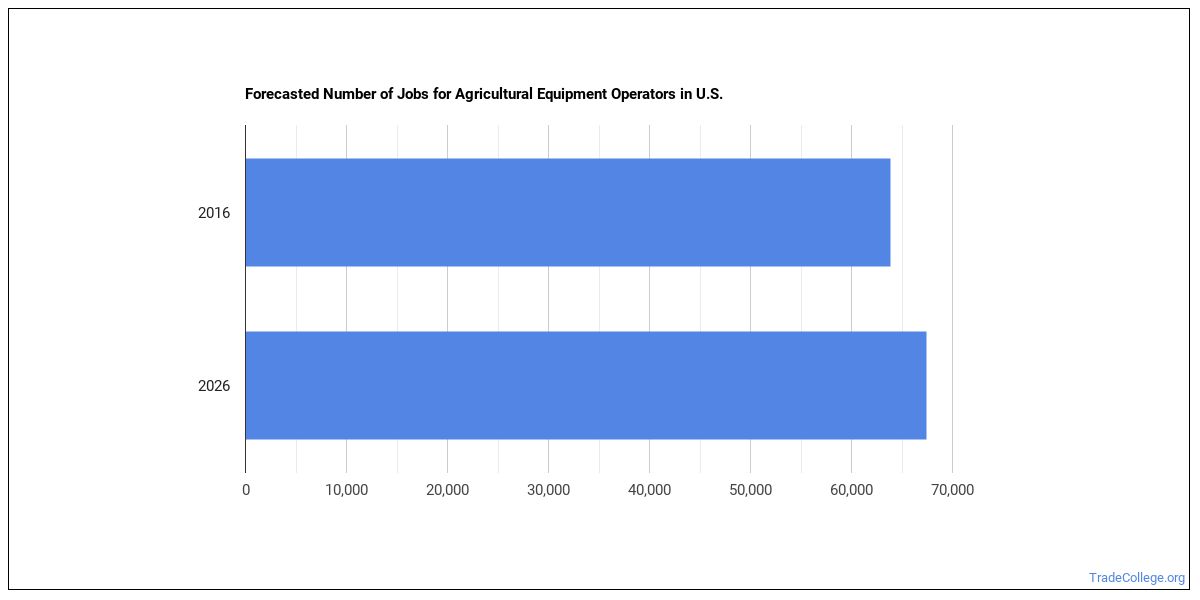
The U.S. employs around 143,965 agricultural equipment operators working in the United States today. Demand is forecast to grow by +0.8% over the projection horizon.
Agricultural Equipment Operators Pay
| Statistic | Value |
|---|---|
| Annual median | $25,669 |
| Hourly median | $12.34 |
| 10th percentile | $20,000 |
| 25th percentile | $22,000 |
| 75th percentile | $29,800 |
| 90th percentile | $33,931 |
Wages vary widely based on experience, location, and industry.

Pay by State
| State | Annual median salary |
|---|---|
| Montana | $53,900 |
| New York | $51,100 |
| Delaware | $50,450 |
| Ohio | $49,070 |
| Indiana | $48,930 |
| Iowa | $48,690 |
| Minnesota | $48,390 |
| North Dakota | $47,640 |
| Wisconsin | $47,520 |
| Maine | $47,500 |
| Illinois | $46,810 |
| New Jersey | $46,650 |
| Missouri | $46,610 |
| South Dakota | $45,890 |
| Virginia | $45,740 |
| Nebraska | $45,690 |
| Idaho | $44,700 |
| Kentucky | $44,700 |
| Kansas | $44,510 |
| Colorado | $42,940 |
| Michigan | $42,600 |
| South Carolina | $42,580 |
| Utah | $42,060 |
| Pennsylvania | $41,660 |
| Maryland | $41,440 |
| North Carolina | $40,300 |
| California | $40,130 |
| Washington | $39,980 |
| Tennessee | $39,980 |
| Oregon | $39,730 |
| Hawaii | $39,440 |
| Massachusetts | $39,310 |
| Vermont | $36,610 |
| Florida | $35,510 |
| New Mexico | $35,460 |
| Georgia | $34,770 |
| Oklahoma | $34,340 |
| Arizona | $34,270 |
| Mississippi | $30,570 |
| Arkansas | $30,380 |
| Texas | $29,930 |
| Alabama | $29,410 |
| Puerto Rico | $20,560 |
Where Agricultural Equipment Operators Earn the Most
Compensation for agricultural equipment operators shift depending on where you work. Top regions by median wage:
| Region | Median annual wage | Share of U.S. jobs | Location quotient |
|---|---|---|---|
| Great Lakes | $47,104 | 17.7% | 1.39 |
| Plains States | $46,978 | 19.6% | 3.69 |
| Rocky Mountains | $45,340 | 1.9% | 1.35 |
| Middle Atlantic | $43,394 | 3.1% | 0.43 |
| New England | $40,594 | 0.5% | 0.40 |
| Far Western US | $40,098 | 31.6% | 2.18 |
| Southeast | $36,104 | 15.9% | 1.00 |
| Southwest | $32,138 | 9.4% | 0.95 |
Top Metro Areas
| Metro area | State | Median annual wage | Employment |
|---|---|---|---|
| Indianapolis-Carmel-Greenwood, IN | IN | $54,020 | 140 |
| Minneapolis-St. Paul-Bloomington, MN-WI | MN | $53,510 | 100 |
| Columbus, OH | OH | $52,370 | 100 |
| Lafayette-West Lafayette, IN | IN | $51,200 | 40 |
| Rochester, NY | NY | $50,960 | 30 |
| Washington-Arlington-Alexandria, DC-VA-MD-WV | DC | $50,460 | 40 |
| Des Moines-West Des Moines, IA | IA | $50,170 | 140 |
| Dubuque, IA | IA | $50,010 | 40 |
Which Industries Hire Agricultural Equipment Operators
Most agricultural equipment operators are found across these industries:
| Industry | Employment | Median annual wage |
|---|---|---|
| Agriculture, Forestry, Fishing and Hunting | 16,020 | $37,940 |
| Wholesale Trade | 9,560 | $46,200 |
| Manufacturing | 1,820 | $46,460 |
| Transportation and Warehousing | 930 | $46,680 |
| Administrative and Support and Waste Management and Remediation Services | 700 | $43,150 |
| Retail Trade | 670 | $47,110 |
| Management of Companies and Enterprises | 160 | $41,790 |
| Professional, Scientific, and Technical Services | 120 | $38,220 |
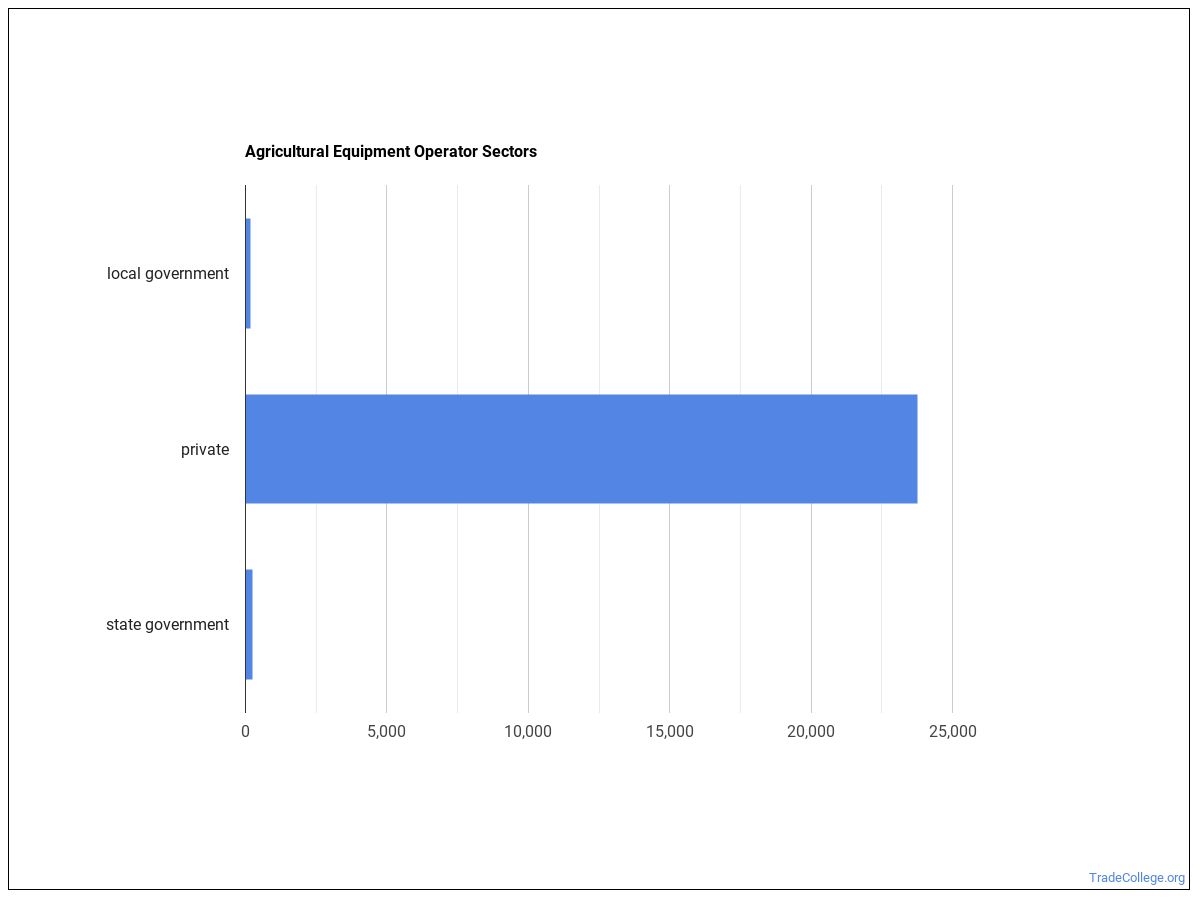
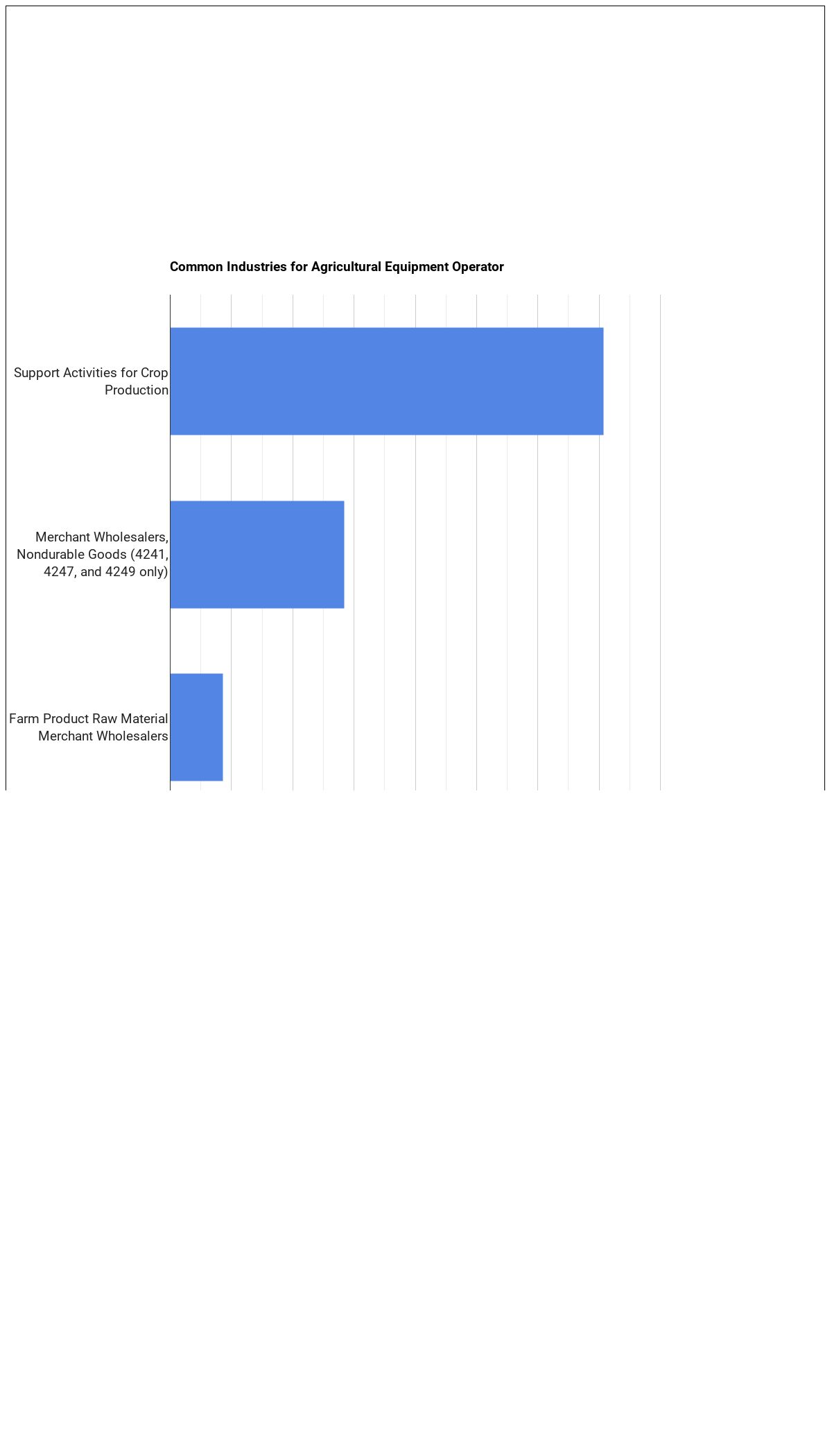
The table below shows some of the most common industries where those employed in this career field work.
Tools and Technology
- Data base user interface and query software: Microsoft Access (hot technology)
- Spreadsheet software: Microsoft Excel (hot technology)
- Presentation software: Microsoft PowerPoint (hot technology)
The Day-to-Day Environment
The on-the-job environment of agricultural equipment operators tends to involve the following characteristics:
- Outdoors, Exposed to All Weather Conditions
- Face-to-Face Discussions with Individuals and Within Teams
- In an Enclosed Vehicle or Operate Enclosed Equipment
- Exposed to Very Hot or Cold Temperatures
- Determine Tasks, Priorities and Goals
Getting Started in This Career
Typical agricultural equipment operators positions require less than a high school diploma as the typical entry-level education. The role falls in Some Preparation Needed (Job Zone 2), reflecting the level of preparation typically expected.
Related Careers
Similar Occupations
- Pesticide Handlers, Sprayers, and Applicators, Vegetation (Primary-Long)
- Farmworkers and Laborers, Crop, Nursery, and Greenhouse (Primary-Short)
- Paving, Surfacing, and Tamping Equipment Operators (Supplemental)
- Operating Engineers and Other Construction Equipment Operators (Supplemental)
- Excavating and Loading Machine and Dragline Operators, Surface Mining (Supplemental)
- Industrial Machinery Mechanics (Supplemental)
- Maintenance Workers, Machinery (Supplemental)
- Milling and Planing Machine Setters, Operators, and Tenders, Metal and Plastic (Primary-Short)
Sources
This profile draws on the following authoritative sources:
- U.S. Bureau of Labor Statistics — Occupational Employment and Wage Statistics (OEWS) for employment and wage data by state and industry.
- BLS Employment Projections for total employment and growth forecasts.
- O*NET (Occupational Information Network) for skills, knowledge, tasks, work activities, work context, technology, and education-zone data.
SOC code: 45-2091.00 (Agricultural Equipment Operators).

TradeCollege.org provides higher-education, college and university, degree, program, career, salary, and other helpful information to students, faculty, institutions, and other internet audiences. Presented information and data are subject to change. Inclusion on this website does not imply or represent a direct relationship with the company, school, or brand. Information, though believed correct at time of publication, may not be correct, and no warranty is provided. Contact the schools to verify any information before relying on it. Financial aid may be available for those who qualify. TradeCollege.org is a for-profit site, and the displayed options may include sponsored or recommended results, not necessarily based on your preferences.
© TradeCollege.org – All Rights Reserved.